Introduction
The Gulf's grocery market is moving at extraordinary speed. Consumers increasingly expect groceries, snacks, beverages, household essentials, and personal-care products to arrive within minutes, while retailers compete on assortment, discounts, delivery speed, and availability. This rapid evolution makes Quick Commerce in the Gulf scraping increasingly valuable for businesses seeking a clear view of this highly competitive digital marketplace.
For retailers, brands, marketplaces, investors, and researchers, online quick-commerce platforms provide a continuously changing stream of market signals. Product prices fluctuate throughout the day, promotional campaigns appear and disappear, products go out of stock, and assortment differs between neighborhoods. Systematically collecting these signals creates a structured foundation for Gulf quick commerce market analysis and helps businesses understand what consumers can actually purchase in different locations.
At the same time, GCC quick commerce grocery data scrape initiatives can bring together product names, categories, prices, discounts, brands, pack sizes, availability, ratings, delivery information, and store-level details. Instead of relying on occasional manual checks, organizations can establish a repeatable data pipeline capable of monitoring thousands of grocery listings across multiple Gulf markets.
Why Quick Commerce Data Matters in the Gulf?
Quick commerce has developed into an important part of the Gulf's digital retail ecosystem. High smartphone penetration, sophisticated payment infrastructure, dense urban populations, and strong demand for convenience have encouraged consumers to purchase everyday products through digital platforms.
Markets such as the UAE, Saudi Arabia, Qatar, Kuwait, Bahrain, and Oman offer particularly interesting opportunities for comparative analysis. However, the market is not uniform. A product that is competitively priced in Dubai may have a different price in Abu Dhabi, Riyadh, Doha, or Kuwait City.
This creates a major challenge for businesses trying to understand regional performance.
Traditional market research often provides snapshots. Quick-commerce data can provide continuous observations.
A structured data collection strategy can capture:
- Product names and descriptions
- Brand and manufacturer information
- Categories and subcategories
- Regular and promotional prices
- Discount percentages
- Pack sizes and quantities
- Product availability
- Store or fulfillment location
- Ratings and review counts
- Delivery estimates
- Promotional labels
- Product images
- SKU or product identifiers where available
When collected consistently, these fields become a powerful source of competitive and consumer intelligence.
Monitoring Grocery Prices Across Gulf Markets
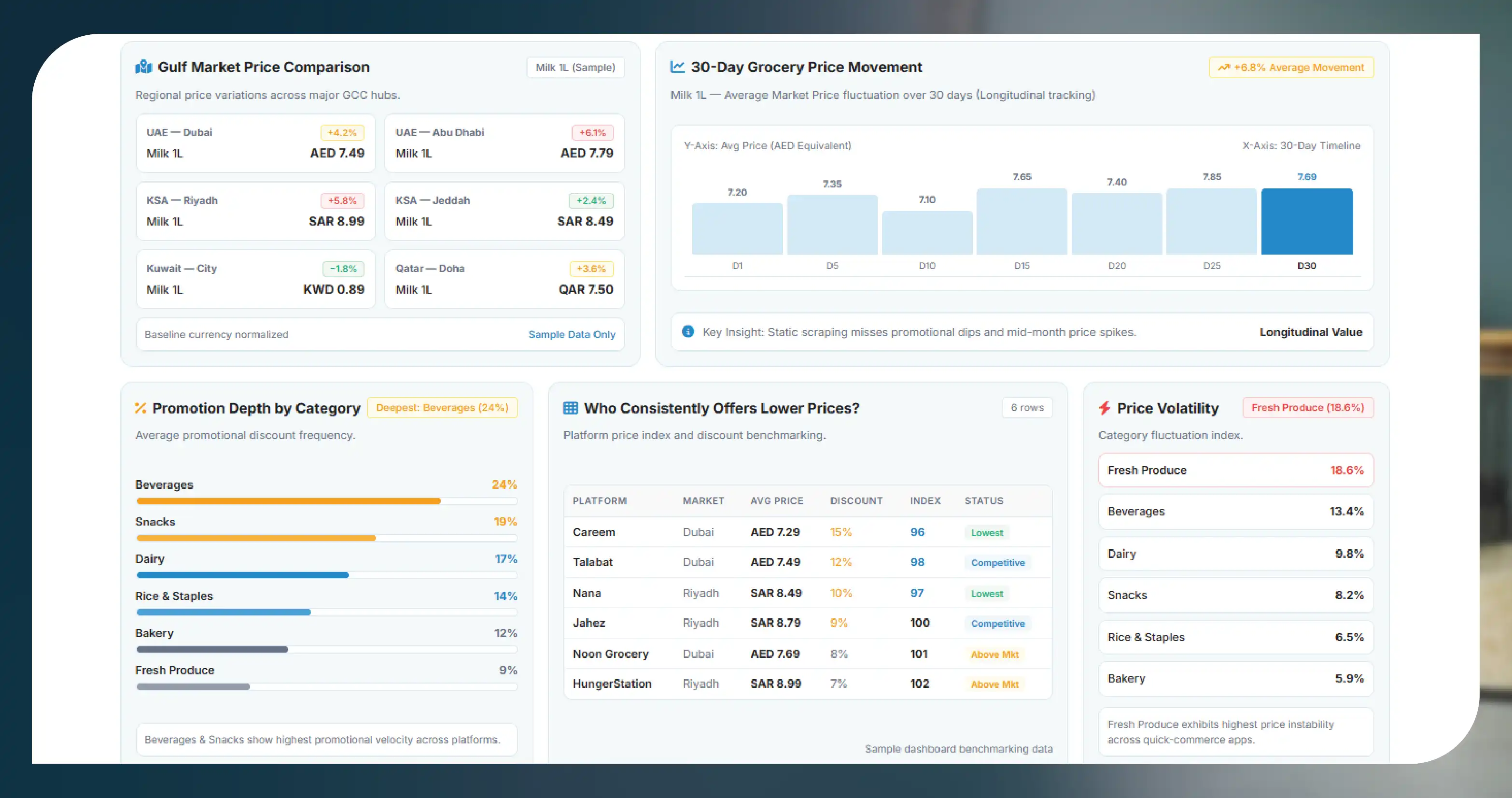
Pricing is one of the most dynamic elements of quick commerce. Platforms can adjust prices according to demand, promotions, inventory conditions, location, time, and commercial strategy.
This makes Gulf grocery price data monitoring useful for companies that need to understand price movements rather than simply observe today's prices.
For example, a consumer brand can compare the price of its products across several platforms and identify where promotional discounts are strongest. A retailer can monitor competing private-label products and determine whether its pricing remains competitive. An analyst can study how staple categories such as milk, bread, eggs, rice, beverages, snacks, and fresh produce change over time.
Historical datasets make these comparisons even more valuable.
Instead of asking, "What is the price today?", businesses can investigate questions such as:
- How frequently does a retailer discount a product?
- Which brands receive the deepest promotions?
- How quickly do prices return to normal?
- Which cities experience the highest price volatility?
- Are premium products discounted differently from value products?
- Which platforms consistently offer lower prices?
The answers become much clearer when supported by longitudinal data.
Competitive Intelligence for GCC Quick Commerce
Competition in Gulf quick commerce extends beyond price. Businesses also compete through assortment depth, product availability, delivery promises, promotions, private-label offerings, and customer experience.
This is why quick commerce competitive intelligence GCC programs should evaluate multiple dimensions simultaneously.
A competitor may have a higher listed price but compensate with frequent promotions. Another may offer fewer brands but maintain stronger stock availability. A third may dominate a particular neighborhood because of a larger assortment.
Scraped datasets allow businesses to compare these differences systematically.
For consumer packaged goods companies, the data can reveal whether products are consistently listed across platforms. For retailers, it can identify assortment gaps. For investors, it can help reveal market expansion patterns. For marketplace operators, it can expose competitive weaknesses and opportunities.
Scraping Assortment Data Across the Gulf
Assortment is one of the strongest indicators of a quick-commerce platform's positioning. A marketplace offering 10,000 grocery products has a different value proposition from one specializing in a smaller curated selection.
Businesses can scrape quick commerce assortment data in the Gulf to identify which products, brands, pack sizes, and categories are available on different platforms.
Assortment analysis can answer practical questions:
- Which grocery categories have the largest selection?
- Which brands appear across competing platforms?
- Where are assortment gaps?
- Which products are exclusive to specific retailers?
- How frequently are new products introduced?
- Which categories have expanded or contracted over time?
For FMCG manufacturers, this information can support distribution planning. For retailers, it can guide assortment optimization. For market researchers, it can reveal changing consumer preferences.
Building a GCC Quick-Commerce Data Pipeline
A reliable GCC quick commerce data scraping workflow generally starts by identifying relevant digital platforms, product categories, geographic markets, and data fields.
The collection layer can then gather structured information from applicable public-facing listings while preserving relationships between products, stores, locations, prices, and timestamps.
The next stage is normalization.
Different platforms may describe the same product differently. One listing might display "Coca-Cola Original 1.5L," while another uses a slightly different naming convention. Product matching and normalization help transform inconsistent listings into comparable records.
A standardized dataset might include:
| Data Field | Purpose |
|---|---|
| Product Name | Identifies the listed item |
| Brand | Enables brand-level comparisons |
| Category | Supports assortment analysis |
| Regular Price | Establishes baseline pricing |
| Sale Price | Captures promotional pricing |
| Discount | Measures promotional intensity |
| Pack Size | Enables unit-price comparisons |
| Availability | Measures stock conditions |
| Location | Enables geographic analysis |
| Timestamp | Supports historical tracking |
| Platform | Enables competitor benchmarking |
Once standardized, the data can be stored in databases, spreadsheets, cloud platforms, or analytics environments depending on the organization's requirements.
Food Data Scraping in UAE & Gulf Markets
The UAE is particularly valuable for digital grocery intelligence because consumers can encounter multiple retailers and quick-commerce providers within the same metropolitan area.
Food Data Scraping in UAE & Gulf projects can help businesses monitor grocery listings across cities and compare pricing, availability, assortment, and promotional activity.
The same framework can be extended across Saudi Arabia, Qatar, Kuwait, Bahrain, and Oman. A multi-market dataset allows businesses to distinguish local behavior from broader regional trends.
For example, an FMCG company might discover that a particular beverage category receives aggressive promotions in the UAE but maintains relatively stable pricing in Saudi Arabia. Another analysis might reveal that premium imported products have broader availability in one market than another.
These insights can influence pricing, distribution, promotional planning, and market-entry decisions.
Detecting Promotions and Discounts
Promotions can significantly influence grocery purchasing behavior. Quick-commerce platforms may display percentage discounts, multi-buy offers, bundle deals, limited-time promotions, loyalty pricing, or reduced prices.
Tracking these promotional signals over time creates a clearer understanding of promotional intensity.
Businesses can measure how frequently competitors discount products and whether promotions are concentrated around weekends, holidays, seasonal periods, or specific events.
Historical promotional data can also help determine whether a discount represents a genuine price reduction or simply reflects temporary changes in the listed baseline price.
Understanding Availability and Stockouts
Price alone does not determine competitive performance. A product that is attractively priced but unavailable cannot generate a completed purchase.
Availability monitoring therefore becomes a critical component of quick-commerce intelligence.
Repeated data collection can identify products that frequently disappear from listings, categories with persistent stock shortages, or retailers that maintain stronger availability.
Brands can use these insights to investigate distribution problems. Retailers can identify replenishment issues. Analysts can study whether stockouts occur more frequently during high-demand periods.
When availability is combined with pricing and assortment information, businesses gain a much richer understanding of marketplace performance.
From Raw Listings to Actionable Intelligence
The real value of quick-commerce scraping does not come from collecting millions of records alone. It comes from transforming those records into decisions.
Dashboards can visualize price changes, assortment movements, availability rates, promotional frequency, and competitor positioning. Automated alerts can identify significant price changes, new product launches, stockouts, or unusual promotional activity.
Businesses can also combine quick-commerce data with internal sales information, historical datasets, demographic information, or geographic intelligence.
This creates a more complete market picture.
For example, if sales decline while competitor prices fall sharply, pricing pressure may be responsible. If sales remain strong while availability decreases, demand may be exceeding supply. If a competitor suddenly expands assortment, it may signal a strategic category investment.
Data makes these signals easier to detect.
How Food Data Scrape Can Help You?
1. Competitive Pricing Intelligence
Food Data Scrape tracks grocery prices, discounts, and promotions across Gulf platforms, helping businesses benchmark competitors, identify pricing gaps, and make faster, evidence-based commercial decisions.
2. Assortment Optimization
It reveals product categories, brands, pack sizes, and availability patterns across platforms, helping retailers identify assortment gaps and optimize product selection for local consumer demand.
3. Market Expansion Insights
Consistent grocery data across Gulf countries helps brands compare market conditions, discover underserved categories, evaluate competitors, and identify expansion opportunities using current digital retail intelligence.
4. Availability Monitoring
Automated monitoring highlights stockouts, disappearing listings, and changing availability patterns, enabling retailers and brands to investigate supply challenges and protect revenue across competitive marketplaces.
5. Promotional Performance Analysis
Historical promotional data helps businesses understand discount frequency, promotional depth, seasonal campaigns, and competitor strategies, supporting smarter trade planning and stronger promotional effectiveness across markets.
Conclusion
The Gulf's quick-commerce ecosystem is becoming increasingly dynamic, making timely data essential for organizations that want to understand digital grocery competition. Continuous monitoring can transform fragmented product listings into structured intelligence covering prices, promotions, assortment, availability, brands, and geographic differences.
With Real-Time GCC Market Intelligence, businesses can move beyond occasional market snapshots and observe how the digital grocery landscape changes over time.
Organizations seeking to Scrape Quick Commerce Data can build datasets that support pricing intelligence, assortment optimization, competitive benchmarking, stock monitoring, and market research.
The opportunity also extends beyond the Gulf. Comparing GCC marketplaces with Quick Commerce Platforms Globally can reveal broader pricing patterns, assortment strategies, promotional models, and consumer trends.
As quick commerce continues to evolve, businesses that consistently transform marketplace data into actionable intelligence will be better positioned to respond to competition, understand consumers, and capture emerging opportunities.
Ready to turn Gulf quick-commerce listings into actionable market intelligence? Partner with Food Data Scrape to build structured, scalable, and decision-ready grocery datasets tailored to your business needs.
Are you in need of high-class scraping services? Food Data Scrape should be your first point of call. We are undoubtedly the best in Food Data Aggregator and Mobile Grocery App Scraping service and we render impeccable data insights and analytics for strategic decision-making. With a legacy of excellence as our backbone, we help companies become data-driven, fueling their development. Please take advantage of our tailored solutions that will add value to your business. Contact us today to unlock the value of your data.
Get a Free Food Data Sample in 48 Hours.
Tell us your platforms, target markets and required fields — we'll map exactly what's possible with food data scraping, recommend the right approach, and send a working sample so you can verify quality before any commitment.
Request a strategy call
Thanks — our data team will reach out within 48 hours with your sample.