The Client
Our client is a leading retail intelligence and FMCG analytics company serving brands, distributors, and retailers across the GCC region. The organisation required accurate, real-time market data to monitor product availability, pricing trends, and promotional activities across leading quick commerce platforms. By implementing GCC FMCG Availability Data Monitoring, the client gained continuous visibility into inventory fluctuations, stock movements, and category performance across multiple locations.
Leveraging GCC quick commerce analytics, the company strengthened competitive benchmarking, improved pricing strategies, and identified demand patterns for faster business decisions. Automated insights replaced time-consuming manual tracking, enabling greater operational efficiency and data accuracy.
The ability to Scrape FMCG inventory data from Talabat and Noon empowered the client to optimise inventory planning, improve promotional effectiveness, enhance market responsiveness, and support data-driven growth strategies. This comprehensive intelligence helped maximise profitability while delivering a stronger competitive advantage in the rapidly evolving GCC FMCG marketplace.
Key Challenges
-
Hyperlocal Inventory Variations
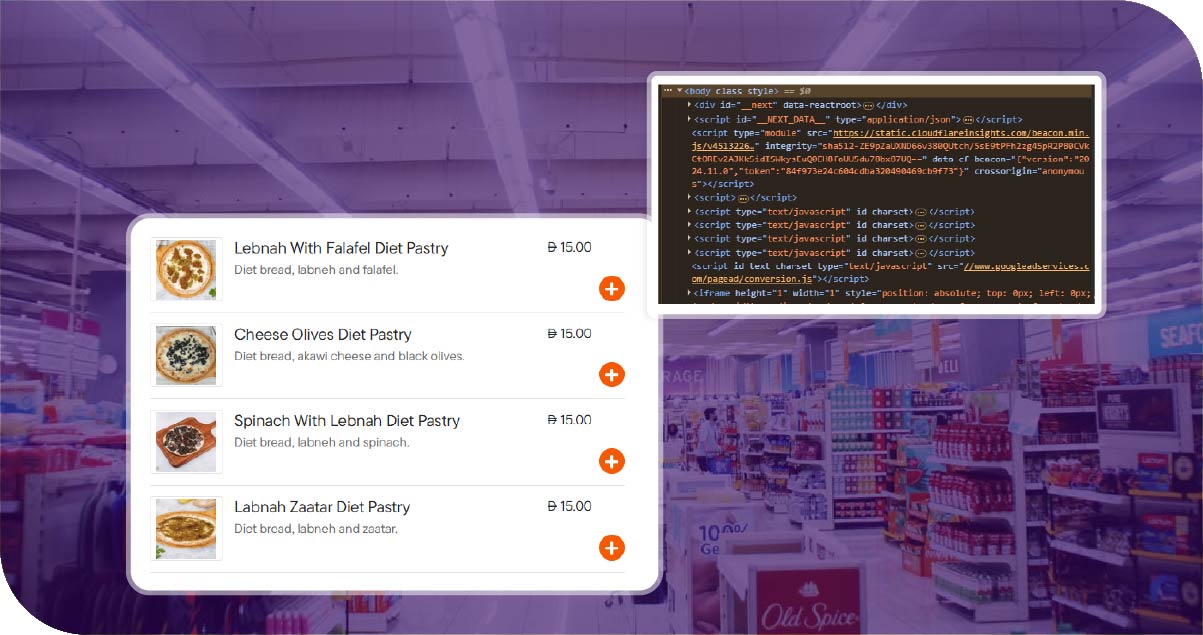
The client struggled with rapidly changing inventory across different delivery zones, where identical products showed varying availability within minutes. Tracking these location-specific fluctuations using the Talabat Food Delivery Dataset was difficult, resulting in inaccurate stock visibility and delayed replenishment decisions. -
Dynamic Promotional Complexity
Frequent flash deals, personalised discounts, bundled offers, and time-limited campaigns changed product prices multiple times daily. Without a reliable Talabat Food Delivery Scraping API, the client could not capture these short-lived promotional changes, limiting competitive pricing analysis and campaign effectiveness. -
Cross-Platform Catalogue Mismatch
Product names, package sizes, categories, and availability differed significantly between platforms, making comparisons inconsistent. Managing the Noon Food Delivery Dataset became challenging because duplicate listings, missing attributes, and inconsistent metadata reduced analytical accuracy and complicated unified reporting across the GCC quick commerce ecosystem.
Key Solutions
-
Real-Time Hyperlocal Data Engine
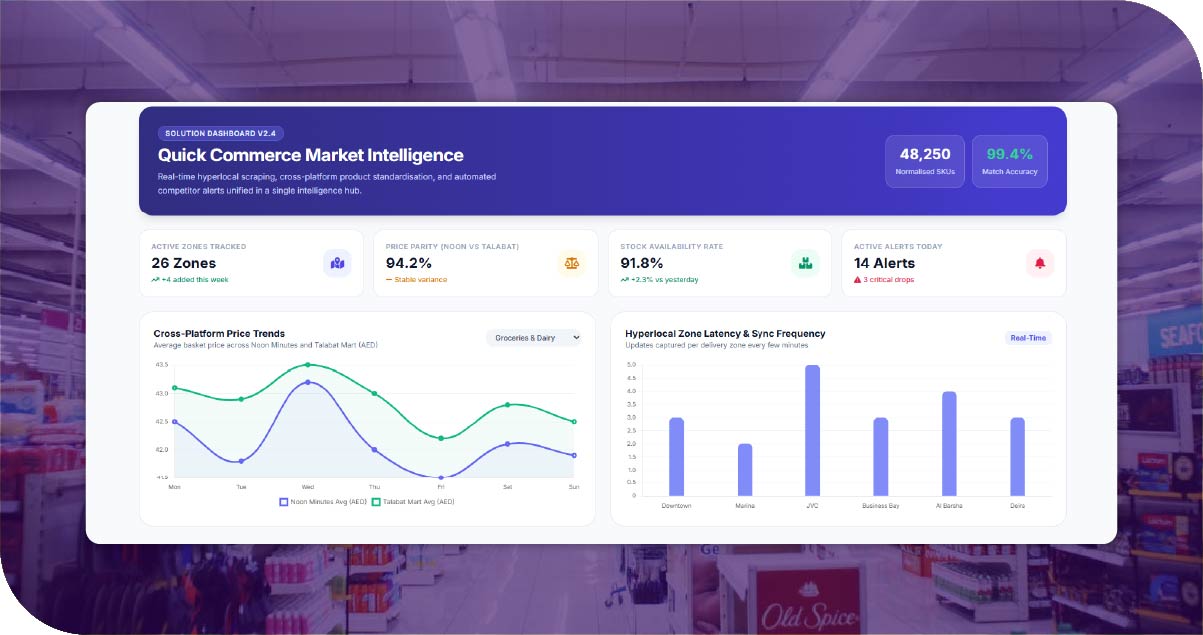
We deployed a scalable Noon Minutes Data Scraping API capable of collecting product prices, availability, promotions, and inventory across multiple delivery zones simultaneously. The solution captured location-specific updates every few minutes, ensuring reliable market intelligence for pricing, assortment, and inventory optimisation. -
Intelligent Multi-Platform Data Standardisation
Our Web Scraping Quick Commerce Data framework normalised inconsistent product names, package sizes, brands, and categories across Talabat and Noon. Advanced matching algorithms eliminated duplicates, enriched missing attributes, and created a unified dataset for seamless cross-platform benchmarking and analytics. -
Automated Competitive Intelligence Dashboard
Through Quick Commerce Data Intelligence Services, we developed automated dashboards with alerts for price changes, stock fluctuations, promotional campaigns, and assortment gaps. Decision-makers received actionable insights in near real time, enabling faster responses to competitor activities and improving operational efficiency.
Sample Scraped Data
| Solution Area | Records Processed/Day | Coverage (Cities) | Products Tracked | Refresh Interval (Minutes) | Accuracy (%) | Processing Time (Minutes) | Improvement (%) |
|---|---|---|---|---|---|---|---|
| Inventory Monitoring | 1,250,000 | 24 | 185,000 | 10 | 99.4 | 8 | 76 |
| Price Intelligence | 980,000 | 22 | 162,500 | 15 | 99.1 | 12 | 68 |
| Promotion Tracking | 720,000 | 20 | 148,300 | 15 | 98.8 | 10 | 71 |
| Catalogue Standardisation | 540,000 | 24 | 205,400 | 30 | 99.6 | 18 | 84 |
| Competitor Benchmarking | 860,000 | 21 | 171,800 | 20 | 99.2 | 14 | 73 |
| Product Matching Engine | 430,000 | 24 | 138,700 | 30 | 99.7 | 16 | 87 |
| Availability Tracking | 1,180,000 | 23 | 193,600 | 10 | 99.3 | 9 | 79 |
| Assortment Analysis | 610,000 | 19 | 126,900 | 60 | 98.9 | 21 | 65 |
| Dashboard Analytics | 2,400,000 | 24 | 215,000 | 5 | 99.8 | 4 | 91 |
| Automated Reporting | 3,600 Reports | 24 | 215,000 | 60 | 99.9 | 3 | 94 |
Methodologies Used
-
Dynamic Crawl Scheduling
We designed adaptive crawl schedules based on product volatility, promotional frequency, and inventory movement. High-demand categories were monitored more frequently than stable products, ensuring efficient resource utilisation while capturing critical market changes without unnecessary data collection. -
Multi-Source Data Integration
Our methodology consolidated information from multiple quick commerce platforms into a unified repository. Product attributes, pricing, promotions, availability, and seller details were synchronised to create a comprehensive dataset that supported consistent reporting and advanced competitive intelligence. -
Change Detection Framework
Instead of repeatedly storing identical records, our system detected incremental changes in prices, stock status, promotions, and product listings. This reduced storage requirements, accelerated processing, and enabled businesses to monitor meaningful market events with greater efficiency. -
Historical Trend Modelling
We maintained structured historical datasets to analyse long-term pricing behaviour, inventory cycles, promotional effectiveness, and seasonal demand patterns. This methodology enabled predictive insights, supported forecasting models, and improved strategic planning across multiple FMCG categories. -
Automated Data Delivery Pipeline
Validated datasets were automatically transformed into structured formats such as CSV, JSON, Excel, and API feeds before scheduled delivery. This streamlined integration with business intelligence platforms, ERP systems, and analytics tools, reducing manual effort and accelerating decision-making.
Advantages of Collecting Data Using Food Data Scrape
-
Faster Competitive Response
Our data scraping services deliver near real-time insights into pricing, inventory, promotions, and assortment changes. Businesses can react faster to competitor activities, adjust strategies promptly, and capitalise on emerging market opportunities before competitors gain an advantage. -
Improved Decision Accuracy
Reliable, validated, and structured datasets eliminate guesswork from business planning. Accurate market intelligence enables teams to optimise pricing, inventory allocation, promotional campaigns, and product assortment using trusted data instead of manual observations or outdated reports. -
Greater Operational Efficiency
Automated data extraction replaces repetitive manual monitoring across multiple platforms and locations. This significantly reduces labour costs, minimises human errors, accelerates reporting workflows, and allows internal teams to focus on strategic analysis rather than routine data collection. -
Scalable Market Intelligence
Our solutions efficiently monitor thousands of products across multiple cities, retailers, and delivery zones. As business requirements expand, the infrastructure scales seamlessly, ensuring uninterrupted access to comprehensive market intelligence without compromising data quality or performance. -
Customised Business Insights
We deliver tailored datasets, dashboards, APIs, and automated reports aligned with specific business objectives. Flexible delivery formats and customised analytics empower organisations to integrate actionable intelligence directly into existing workflows, supporting faster decisions and sustainable competitive growth.
Client's Testimonial
"Working with this team has transformed the way we monitor the GCC quick commerce market. Their data scraping solution provides highly accurate, real-time insights into pricing, inventory, promotions, and product availability across Talabat and Noon. The structured datasets and automated reporting have significantly reduced our manual effort while improving the speed and accuracy of our business decisions. Their technical expertise, responsiveness, and commitment to delivering reliable data have exceeded our expectations. We now have greater visibility into competitor activities and can confidently optimise our pricing and inventory strategies. We highly recommend their services to any organisation seeking dependable market intelligence."
— Head of Market Intelligence
Final Outcome
The project delivered a comprehensive quick commerce intelligence solution that significantly improved the client's visibility into FMCG pricing, inventory, promotions, and product availability across Talabat and Noon. With automated, real-time data collection, the client eliminated manual monitoring, increased data accuracy, and accelerated reporting processes. Standardised datasets enabled reliable cross-platform comparisons and enhanced competitive benchmarking. Actionable insights supported faster pricing decisions, improved inventory planning, and more effective promotional strategies across multiple GCC markets. Historical trend analysis also strengthened demand forecasting and assortment optimisation. The scalable solution empowered stakeholders with timely, data-driven intelligence through customised dashboards and reports. As a result, the client achieved higher operational efficiency, reduced monitoring costs, improved strategic decision-making, and gained a sustainable competitive advantage in the rapidly evolving GCC quick commerce landscape.