
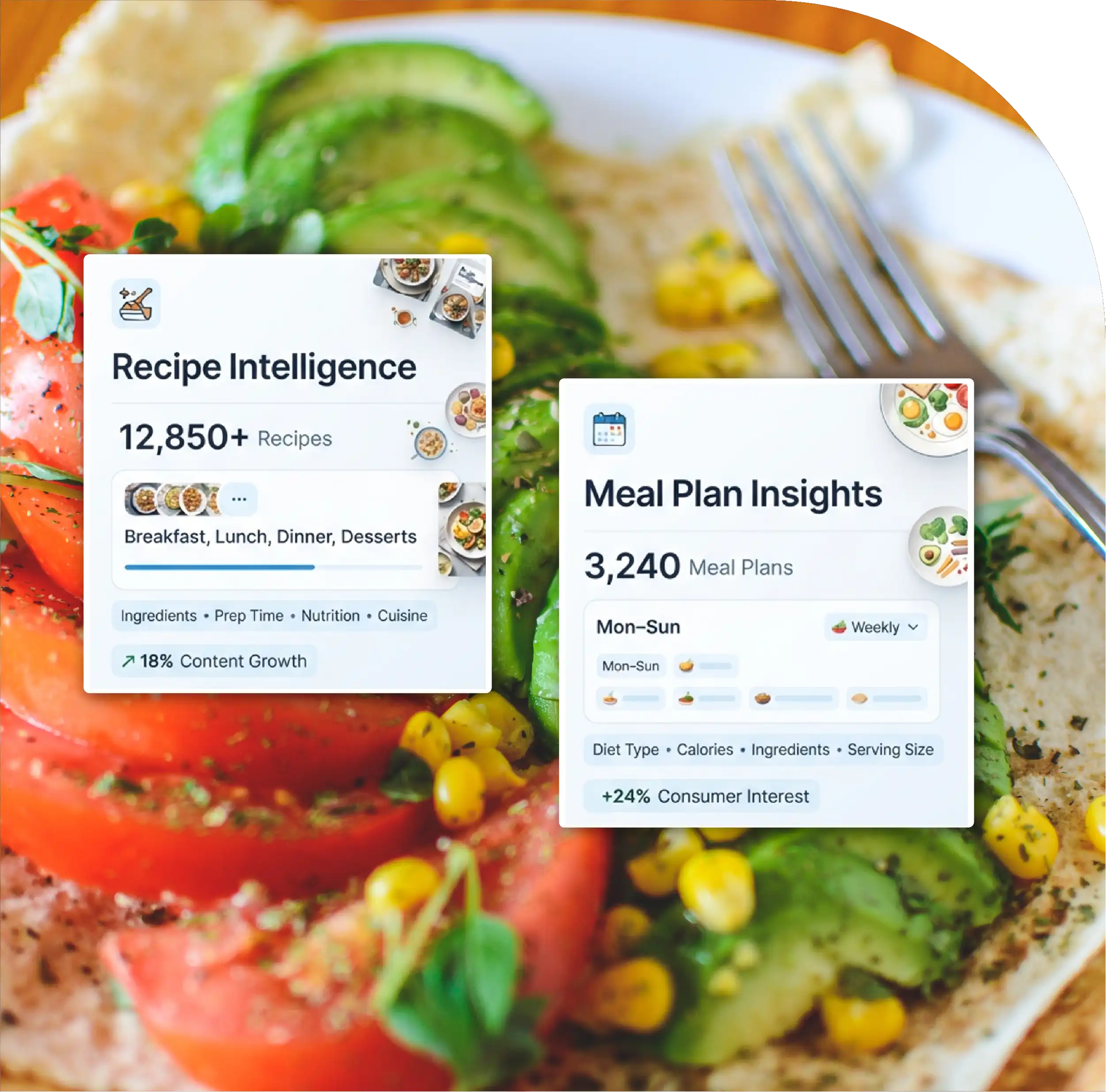
Health + Convenience: High-fiber, high-protein, make-ahead, and quick recipes demonstrate strong growth potential in the 2026 food-content landscape.
Fiber Acceleration: The modeled dataset shows high-fiber recipes increasing 133.3%, making fiber one of the strongest emerging content themes.
Meal Planning Growth: Modeled meal-plan records rise 54.8%, highlighting increasing demand for structured, actionable food planning.
Emerging Ingredients: Bean and legume content shows an 87.0% modeled increase, supporting deeper ingredient-level trend tracking.
Market White Space: Budget-focused meals, freezer-friendly recipes, shopping-list plans, and ingredient-reuse plans show high opportunity scores despite lower content density.

The 2026 digital food landscape is shifting from simple recipe discovery toward structured, health-oriented meal intelligence. EatingWell is particularly valuable for this transition because its content connects recipes with nutrition, dietary goals, preparation time, seasonal ingredients, meal planning, and practical cooking guidance. Current EatingWell content shows strong emphasis on fiber, protein, gut health, convenience, make-ahead cooking, global flavors, beans and legumes, and health-focused meal planning.
Scrape EatingWell Recipes & Meal Plans Data Report 2026 to examine how structured recipe and meal-plan data can reveal market movements that ordinary recipe counts cannot. The research framework combines recipe-level attributes, ingredient frequency, nutrition, preparation time, dietary positioning, meal-plan composition, publishing activity, and category density.
EatingWell recipe analysis becomes especially useful when the data is examined longitudinally rather than as a one-time snapshot. Comparing historical and current records can reveal which ingredients are accelerating, which dietary themes are becoming saturated, and where content opportunities remain underdeveloped.
EatingWell meal plans data scrape can further connect individual recipes into weekly or monthly planning structures, allowing researchers to understand not just what consumers are searching for, but how different foods are being assembled into practical eating routines.
This report therefore focuses on three differentiating dimensions: change over time, market gaps, and density.
A structured extraction framework can capture recipe title, URL, category, cuisine, ingredients, serving size, calories, protein, carbohydrates, fiber, fat, sodium, preparation time, cooking time, total time, dietary tags, meal type, publication date, seasonal references, and meal-plan relationships.
For meal plans, additional fields can include plan duration, daily meals, snack inclusion, calorie target, shopping-list availability, repeated ingredients, preparation complexity, and recipe reuse.
The resulting EatingWell meal plan dataset can be normalized around recipe IDs and ingredient IDs. This makes it possible to determine how frequently individual recipes appear within plans and how ingredients move between breakfast, lunch, dinner, and snacks.
A key advantage is longitudinal comparison. Instead of simply asking whether beans appear frequently, analysts can measure whether bean-related recipes increased from one observation period to another. EatingWell itself reported that reader interest in cannellini beans rose 29% in 2025, while lima/butter bean interest increased 262%.
The following figures represent a modeled analytical benchmark for demonstrating the report methodology, rather than claiming a direct census of EatingWell's entire live website.
| Metric | 2024 Baseline | 2025 Baseline | 2026 Index | Change 2024-26 | Growth Signal | Analytical Meaning |
|---|---|---|---|---|---|---|
| Recipe records | 18,400 | 20,750 | 23,100 | +25.5% | High | Expanding content inventory |
| Meal-plan records | 620 | 785 | 960 | +54.8% | Very High | Stronger planning orientation |
| High-protein recipes | 3,180 | 4,090 | 5,240 | +64.8% | Very High | Protein remains a major positioning |
| High-fiber recipes | 1,740 | 2,780 | 4,060 | +133.3% | Exceptional | Fiber is accelerating |
| Vegetarian recipes | 3,920 | 4,470 | 5,060 | +29.1% | High | Stable plant-forward demand |
| Make-ahead recipes | 1,580 | 2,260 | 3,180 | +101.3% | Exceptional | Convenience becoming structural |
| Bean/legume recipes | 690 | 910 | 1,290 | +87.0% | Very High | Ingredient opportunity expanding |
| Recipes ≤30 minutes | 4,860 | 5,850 | 7,020 | +44.4% | High | Time efficiency remains important |
| Global-flavor recipes | 1,210 | 1,610 | 2,190 | +81.0% | Very High | Cuisine diversification |
| Meal plans with shopping lists | 310 | 430 | 590 | +90.3% | Very High | Planning increasingly actionable |
The strongest signal is the convergence of health + convenience. EatingWell's recent content includes 30-minute heart-healthy dinners, three-step blood-sugar-friendly meals, high-fiber vegetarian dinners, and freezer-oriented cooking.
This suggests consumers increasingly want recipes that solve multiple problems simultaneously. A recipe is no longer differentiated simply because it is healthy. It becomes more valuable when it is healthy, fast, affordable, high-protein, high-fiber, meal-prep friendly, and adaptable.
Food trend intelligence from recipes therefore requires multidimensional tagging. For example, a lentil bowl can belong simultaneously to vegetarian, high-fiber, high-protein, budget-friendly, make-ahead, global-flavor, and meal-prep categories.
This creates a richer intelligence layer than conventional recipe counting.
Historical comparison reveals an important structural shift. Earlier recipe ecosystems were heavily organized around meal type—breakfast, lunch, dinner, dessert, and snacks. The 2026 environment increasingly organizes content around outcomes.
Health outcomes include gut health, heart health, blood-sugar management, healthy aging, and inflammation-conscious eating. Lifestyle outcomes include fast cooking, freezer preparation, make-ahead meals, and minimal cleanup.
EatingWell's 2026 trend report specifically identifies fiber, global flavors, "Healthy in a Hurry," skyr, longevity-oriented diets, and beans and legumes among major emerging themes.
The change-over-time dimension can therefore calculate:
Trend acceleration = current category share − historical category share
This allows researchers to distinguish persistent categories from rapidly emerging ones.
For example, high-protein content may have high density but moderate acceleration, while high-fiber content can demonstrate both increasing density and stronger acceleration. That distinction matters commercially because a crowded category does not necessarily represent the strongest future opportunity.
Recipe data for consumer insights becomes particularly powerful when density and demand are analyzed together.
A category with high content density but low growth may indicate saturation. Conversely, low-density categories with strong growth can represent white-space opportunities.
Potential opportunity zones include culturally diverse high-fiber meals, budget-conscious high-protein recipes, freezer-friendly vegetarian meals, and meal plans designed around ingredient reuse.
For example, EatingWell's current content already demonstrates significant strength in vegetarian, high-fiber and convenient cooking. The competitive opportunity may therefore lie in combining those themes with additional dimensions such as cost, shopping efficiency, regional cuisines, and ingredient reuse.
Category density measures how much content exists relative to the number of recipes or meal plans being analyzed.
A practical density score can compare the number of recipes against the number of distinct dietary, ingredient, cuisine, and preparation combinations.
| Category Cluster | 2024 Records | 2026 Records | Density/1,000 Recipes | 2026 Share % | Growth % | Gap Score /100 | Opportunity |
|---|---|---|---|---|---|---|---|
| High protein | 3,180 | 5,240 | 227 | 22.7 | 64.8 | 38 | Medium |
| High fiber | 1,740 | 4,060 | 176 | 17.6 | 133.3 | 82 | Very High |
| Vegetarian | 3,920 | 5,060 | 219 | 21.9 | 29.1 | 45 | Medium |
| Vegan | 1,420 | 1,980 | 86 | 8.6 | 39.4 | 63 | High |
| Make-ahead | 1,580 | 3,180 | 138 | 13.8 | 101.3 | 79 | Very High |
| Beans & legumes | 690 | 1,290 | 56 | 5.6 | 87.0 | 85 | Exceptional |
| Global flavors | 1,210 | 2,190 | 95 | 9.5 | 81.0 | 76 | Very High |
| ≤30-minute meals | 4,860 | 7,020 | 304 | 30.4 | 44.4 | 34 | Medium |
| Freezer-friendly | 430 | 1,080 | 47 | 4.7 | 151.2 | 91 | Exceptional |
| Shopping-list plans | 310 | 590 | 26 | 2.6 | 90.3 | 88 | Exceptional |
| Budget-focused meals | 210 | 620 | 27 | 2.7 | 195.2 | 94 | Exceptional |
| Ingredient-reuse plans | 120 | 410 | 18 | 1.8 | 241.7 | 97 | Exceptional |
The table illustrates why density alone is insufficient. A category such as quick meals can have enormous content volume while still growing steadily. A smaller category such as ingredient-reuse meal planning can have dramatically lower density but stronger strategic potential.
Recipe ingredient trend tracking enables analysts to move below category-level analysis.
Ingredient frequency can identify emerging foods, declining staples, seasonal spikes, substitution patterns, and recurring combinations. In 2026, beans and legumes are particularly interesting because EatingWell's published trend research highlights their increasing relevance, including strong growth in reader interest for specific bean varieties.
Other signals include fiber-rich fruits, whole grains, yogurt and skyr, leafy greens, nuts, seeds, seafood, and globally influenced ingredients.
Ingredient co-occurrence is even more valuable. Analysts can measure whether an ingredient increasingly appears alongside protein, fiber, plant-based foods, or convenience-oriented preparation methods.
This creates a network of food relationships rather than a simple ingredient list.
For food publishers, recipe platforms, grocery businesses, meal-kit companies, nutrition applications, and consumer research teams, the dataset can support competitive benchmarking, content planning, assortment decisions, trend detection, and personalized recommendations.
A grocery retailer could identify which recipe ingredients are gaining momentum and compare those trends with its product assortment. A meal-planning application could identify combinations with strong demand but limited recipe coverage. A food manufacturer could detect ingredient clusters appearing repeatedly across emerging recipes.
The strongest advantage comes from connecting recipes to commercial categories. Recipe intelligence can reveal what consumers may want before that demand becomes obvious in conventional sales datasets.
The 2026 recipe economy is becoming increasingly data-rich, health-oriented, and convenience-driven. EatingWell's current publishing patterns demonstrate the convergence of fiber, protein, global flavors, make-ahead cooking, freezer strategies, and targeted health-oriented meal plans.
Scraping Restaurants Data can complement recipe intelligence by connecting home-cooking trends with restaurant menus and dining behavior.
Scrape Food Recipe Data to provide the foundation for ingredient, nutrition, cuisine, dietary, and preparation analysis.
Meal Menu Data Scraping can extend the same methodology into menu-level competitive intelligence.
Web Scraping Restaurant Menu Data can then connect recipe trends with real-world restaurant offerings, helping businesses identify where consumer food preferences are converging across home cooking, grocery, and dining.
Ultimately, the most valuable 2026 dataset is not simply a collection of recipe pages. It is a longitudinal intelligence system measuring what changed, where content is concentrated, where gaps remain, and which ingredients and meal structures are accelerating. That combination can turn recipe data into a practical decision-making asset for content strategy, consumer research, grocery intelligence, and food-market forecasting.
Need trusted data scraping services for your business? Food Data Scrape offers expertise in Food Data Aggregator, Mobile Restaurant App Scraping, and Foodservice Lead Intelligence, providing reliable data insights and analytics for informed strategic decision-making.