Introduction
The modern foodservice industry is no longer driven by assumptions or historical sales reports. Customer expectations evolve rapidly across dine-in, takeaway, drive-through, mobile ordering, and delivery platforms. Restaurants, cloud kitchens, food manufacturers, distributors, and hospitality brands need access to continuous market intelligence to understand these changing behaviours before competitors do. This is where the need to Scrape Foodservice Customer Insights Data becomes an essential business strategy rather than an optional research exercise.
Consumer preferences are shifting faster than traditional market research can capture. Digital interactions, menu updates, pricing changes, ordering patterns, reviews, promotions, and seasonal demand all create valuable signals that reveal what customers actually purchase instead of what they claim to prefer. Businesses that collect, process, and analyse these signals gain a measurable competitive advantage.
Foodservice Customer Insights Data Scraping enables organisations to gather structured information from multiple public digital sources, transforming scattered customer interactions into meaningful business intelligence.
Foodservice Consumer Data Scraping provides restaurants, suppliers, and food brands with continuously updated insights that support menu innovation, pricing strategies, demand prediction, inventory planning, and customer engagement across multiple dining channels.
Why Customer Behaviour Has Changed?
The restaurant industry today operates in an entirely different environment than it did just a few years ago. Customers no longer follow a single dining pattern. A family may dine inside a restaurant during weekends, order takeaway during busy weekdays, and rely on food delivery apps when convenience becomes the priority.
This multi-channel behaviour means every customer generates different purchasing signals depending on time, location, occasion, weather, pricing, and personal preferences.
Restaurants that continue making operational decisions based only on POS reports or quarterly surveys often fail to recognise emerging opportunities until competitors have already captured them.
Web data collection changes this approach by providing real-time visibility into evolving customer behaviour. Instead of relying on delayed reports, businesses can monitor live menu changes, customer reviews, ordering trends, promotional campaigns, pricing movements, cuisine popularity, and regional demand patterns across thousands of restaurants simultaneously.
Why Real-Time Customer Insights Matter?
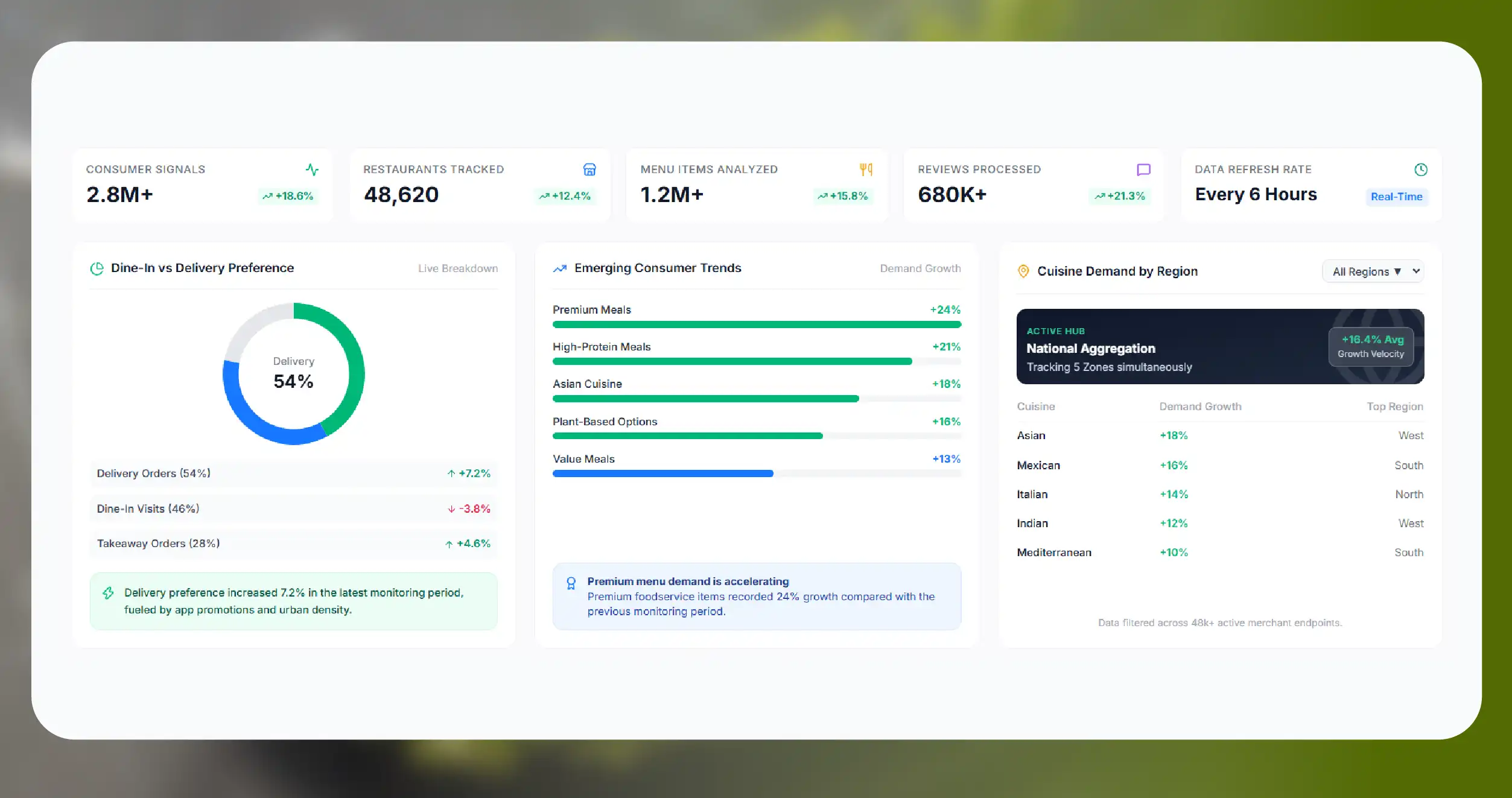
Foodservice decisions become significantly more accurate when supported by continuously updated market intelligence.
Restaurant operators need to know whether consumers are choosing dine-in experiences more frequently than delivery, whether premium menu items are gaining popularity, or whether certain cuisines are expanding faster in specific regions.
Similarly, food manufacturers supplying restaurants require visibility into ingredient demand before production planning begins.
Rather than depending solely on historical sales data, organisations can analyse public digital information collected from restaurant websites, delivery platforms, reservation portals, review sites, and online menus.
This approach reduces uncertainty while improving operational planning across marketing, procurement, menu engineering, and customer acquisition.
Understanding Customer Demand Across Every Channel
Today's customer journey extends across multiple digital touchpoints.
A customer may discover a restaurant through search engines, compare menus using delivery platforms, read customer reviews, browse social media photographs, check pricing, reserve a table online, and later place a repeat takeaway order.
- Each interaction contributes valuable behavioural data.
- Collecting information from only one source provides an incomplete picture.
Businesses achieve stronger insights by combining menu availability, pricing updates, promotional campaigns, cuisine trends, customer ratings, review sentiment, location intelligence, delivery coverage, seasonal offerings, and restaurant expansion activities into a unified analytical framework.
This creates richer Foodservice Market Data Intelligence capable of identifying demand shifts before they become obvious within internal sales reports.
Turning Restaurant Data into Actionable Intelligence
Raw data alone creates little value.
Businesses must transform collected information into structured datasets that answer practical commercial questions.
- Which menu categories are growing?
- Which cuisines are expanding across urban markets?
- How often are restaurants changing prices?
- Which promotional campaigns generate higher customer engagement?
- Which ingredients appear most frequently across successful menu launches?
These insights allow organisations to Extract restaurant customer behavior data from multiple public sources and convert it into measurable competitive intelligence.
The ability to observe industry-wide movements instead of isolated business performance helps organisations make proactive decisions with greater confidence.
Building Better Menu Strategies
Successful menus reflect customer demand rather than internal assumptions.
Restaurants introducing new dishes benefit from analysing how similar menu items perform across competing brands.
Businesses can identify flavour combinations, ingredient preferences, portion sizes, pricing ranges, seasonal promotions, limited-time offers, dietary preferences, and regional variations before launching new products.
Instead of investing months into traditional research, operators gain continuous visibility into evolving consumer preferences.
This allows marketing teams, chefs, procurement managers, and executive leadership to collaborate using shared market intelligence supported by current data.
Improving Operational Decisions Through Analytics
Modern restaurant operations increasingly depend on predictive decision-making.
Inventory planning, supplier negotiations, staffing schedules, pricing adjustments, promotional timing, and menu optimisation all benefit from reliable analytical inputs.
High-quality Foodservice customer Data analytics helps organisations identify demand fluctuations before they affect daily operations.
- Restaurant groups can forecast ingredient consumption more accurately.
- Suppliers can prioritise production according to emerging category demand.
- Food manufacturers can evaluate market expansion opportunities with reduced commercial risk.
The result is improved operational efficiency alongside stronger customer satisfaction.
Predicting Future Demand More Accurately
Demand forecasting has become one of the most valuable applications of restaurant data collection.
Traditional forecasting models rely heavily on historical sales.
However, customer preferences frequently shift due to economic conditions, weather changes, holidays, social media influence, local events, and competitive activity.
By integrating continuously updated public restaurant information into forecasting models, businesses improve planning accuracy.
Advanced Foodservice demand forecasting supports inventory optimisation, staffing decisions, procurement scheduling, promotional planning, and supply chain management while reducing food waste and operational costs.
Applications Across the Foodservice Industry
Restaurant customer insight data benefits far more than restaurants alone.
- Food manufacturers analyse menu trends to identify emerging ingredients gaining popularity.
- Food distributors monitor restaurant expansion to identify new supply opportunities.
- Hospitality groups evaluate regional cuisine preferences before entering new markets.
- Investors assess restaurant performance indicators during acquisition research.
- Technology providers improve recommendation engines using menu intelligence.
- Marketing agencies identify customer engagement opportunities through review analysis and promotional monitoring.
The same structured datasets support strategic decision-making across multiple industries connected to foodservice.
Turn Foodservice Customer Insights into Business Growth with Our Data Scraping Solutions—Contact Us Today for a Custom Data Extraction Demo!
Leveraging Automated Food Data Collection
Manual monitoring of thousands of restaurants quickly becomes impossible.
- Restaurant menus change frequently.
- Prices fluctuate.
- New promotions launch daily.
- Delivery coverage expands regularly.
- Customer reviews continuously influence purchasing decisions.
Automated Food Data Scraping enables organisations to monitor these changes efficiently while maintaining structured historical records.
Businesses receive consistent updates without dedicating extensive internal resources to repetitive manual research.
Automation also improves scalability as restaurant networks expand across cities, regions, or countries.
Competitive Benchmarking Using Restaurant Intelligence
Competitive analysis requires continuous monitoring rather than occasional observation.
Businesses benefit from comparing menu diversity, pricing strategies, promotional frequency, customer ratings, cuisine categories, delivery availability, operating hours, geographic expansion, and seasonal campaigns across competing brands.
Comprehensive Restaurant Data Intelligence enables decision-makers to identify market gaps, benchmark performance, discover innovation opportunities, and respond faster to changing competitive conditions.
Instead of reacting after losing customers, businesses recognise evolving market dynamics while opportunities remain available.
Ensuring Data Quality and Scalability
Successful restaurant intelligence projects depend on consistent data quality.
Information collected from multiple public sources requires validation, normalisation, deduplication, categorisation, and standardisation before analysis begins.
Reliable scraping infrastructure ensures regular updates while maintaining structured formats suitable for business intelligence platforms, machine learning models, dashboards, CRM systems, ERP integrations, and forecasting software.
Scalable collection methods also allow organisations to expand monitoring from hundreds to hundreds of thousands of restaurants without compromising accuracy.
How Food Data Scrape Can Help You?
Monitor Restaurant Trends Continuously
Our specialists continuously collect restaurant menus, pricing, promotions, customer reviews, delivery availability, and cuisine trends, helping your organisation monitor changing customer preferences through reliable, structured, and regularly refreshed market intelligence.
Build Smarter Competitive Intelligence
We aggregate competitor data across multiple public platforms, enabling businesses to compare pricing strategies, menu innovation, promotional campaigns, customer engagement, and regional performance for stronger commercial decision-making and sustainable growth.
Support Better Forecasting
Our structured datasets improve forecasting models by combining restaurant activity, seasonal demand, pricing behaviour, customer sentiment, menu expansion, and market movements to strengthen planning accuracy across operations and supply chains.
Deliver Customised Business Data
Every organisation requires different intelligence. We customise restaurant datasets according to your preferred locations, cuisines, competitors, delivery platforms, customer segments, update frequency, and analytical objectives for maximum business relevance.
Enable AI-Ready Data Integration
We prepare clean, structured restaurant intelligence suitable for analytics dashboards, business intelligence platforms, machine learning models, forecasting systems, CRM solutions, ERP software, and enterprise reporting environments without extensive manual processing.
Conclusion
Customer behaviour continues evolving across every restaurant channel, making continuous market visibility essential for competitive success. Businesses that rely solely on historical reports often struggle to respond quickly to changing consumer expectations, pricing dynamics, and menu innovation. Data-driven organisations, however, gain the ability to anticipate market movements rather than simply reacting after opportunities have passed.
Our specialised data scraping solutions help restaurants, suppliers, manufacturers, technology providers, and hospitality brands collect reliable public market information at scale. Whether you need to Extract Restaurant Menu Data, monitor competitor pricing, analyse customer behaviour, or build comprehensive Food Datasets, our customised solutions deliver accurate, structured intelligence that supports smarter business decisions. With our scalable Food Data Scraping API, organisations can seamlessly integrate real-time restaurant intelligence into existing analytics platforms, enabling continuous innovation, stronger forecasting, and sustainable competitive advantage across the evolving foodservice industry.
If you are seeking for a reliable data scraping services, Food Data Scrape is at your service. We hold prominence in Food Data Aggregator and Mobile Restaurant App Scraping with impeccable data analysis for strategic decision-making.