
The report provides comprehensive insights into the rapidly expanding functional food industry, where consumers increasingly seek products that support immunity, digestion, energy, cognitive health, and overall wellness. The report analyzes market trends across retail stores, grocery platforms, restaurant menus, food delivery apps, and digital marketplaces to uncover evolving ingredient preferences, pricing strategies, and purchasing behaviors. It highlights the growing popularity of probiotics, adaptogens, fermented foods, protein-rich products, and antioxidant ingredients while examining regional demand and competitive positioning. Businesses can leverage these insights to optimize product development, monitor competitor assortments, improve pricing decisions, and identify emerging consumer preferences before they become mainstream. By combining real-time data collection with AI-driven analytics, the report enables manufacturers, retailers, foodservice operators, and market researchers to make informed decisions based on accurate and continuously updated intelligence. It serves as a valuable resource for organizations seeking sustainable growth in the dynamic functional food market.
Market Growth
Functional foods experience accelerating demand across global retail and foodservice markets.
Consumer Demand
Health-conscious consumers increasingly prioritize nutrition, immunity, energy, and digestive wellness.
Ingredient Trends
Probiotics, adaptogens, turmeric, matcha, kefir dominate product innovation across categories.
Pricing Intelligence
Real-time monitoring improves competitive pricing strategies and profitability across retailers.
Business Insights
Actionable datasets enable smarter forecasting, innovation, and strategic market expansion.

The functional food industry is entering a transformative phase as consumers increasingly demand products that deliver measurable health benefits alongside great taste. From immunity-supporting beverages and gut-friendly fermented foods to protein-rich snacks and adaptogenic ingredients, the category continues to expand across retail shelves, foodservice menus, and online marketplaces. Businesses are relying on advanced data intelligence to identify emerging preferences, optimize pricing strategies, and launch products aligned with changing consumer expectations.
Scrape Functional Food Trends Data 2026 to capture real-time information from digital food ecosystems, helping brands understand ingredient popularity, pricing movements, menu innovation, customer sentiment, and regional demand patterns. At the same time, Functional Food Market Data Extraction 2026 supports competitive benchmarking across retailers, restaurants, grocery platforms, and health-focused marketplaces, while Consumer Food Trends Data Collection 2026 provides actionable insights into evolving wellness priorities.
Combined with AI-powered analytics and continuous market monitoring, these datasets empower manufacturers, retailers, foodservice operators, and researchers to make faster, evidence-based decisions that strengthen product development, marketing effectiveness, and long-term business growth.
Functional foods have evolved from a niche health segment into one of the fastest-growing categories within the global food industry. Consumers increasingly seek products that improve immunity, digestive health, cognitive performance, energy, sleep quality, and overall wellness without compromising taste or convenience. This behavioral shift has encouraged manufacturers, retailers, restaurants, and food delivery platforms to continuously innovate with functional ingredients such as probiotics, adaptogens, botanicals, fermented foods, superfoods, protein blends, vitamins, and natural antioxidants.
The growing complexity of consumer preferences makes web scraping and automated market intelligence essential for monitoring product launches, ingredient trends, pricing movements, promotional campaigns, nutritional claims, and customer reviews. Businesses that collect structured market intelligence can rapidly identify emerging ingredients before they become mainstream while adapting pricing and merchandising strategies according to regional demand.
Modern data collection combines retailer websites, grocery marketplaces, restaurant menus, delivery platforms, health food stores, nutrition brands, social conversations, and consumer review platforms into unified analytics dashboards. These datasets enable organizations to understand not only what consumers purchase but also why they purchase it.
Consumer expectations have shifted significantly over the past few years. Functional foods are no longer viewed only as nutritional supplements but as everyday meal components supporting healthier lifestyles.
Popular categories include probiotic yogurt, fermented beverages, kombucha, kefir, protein snacks, collagen drinks, herbal teas, adaptogenic coffee, fortified cereals, vitamin-enhanced beverages, high-fiber meals, omega-rich snacks, plant proteins, antioxidant-rich fruits, and immune-supporting ingredients.
Restaurants increasingly integrate functional ingredients into breakfast bowls, smoothies, soups, salads, desserts, beverages, and grab-and-go meals.
Digital ordering platforms further accelerate visibility by highlighting nutritional benefits directly within menu descriptions.
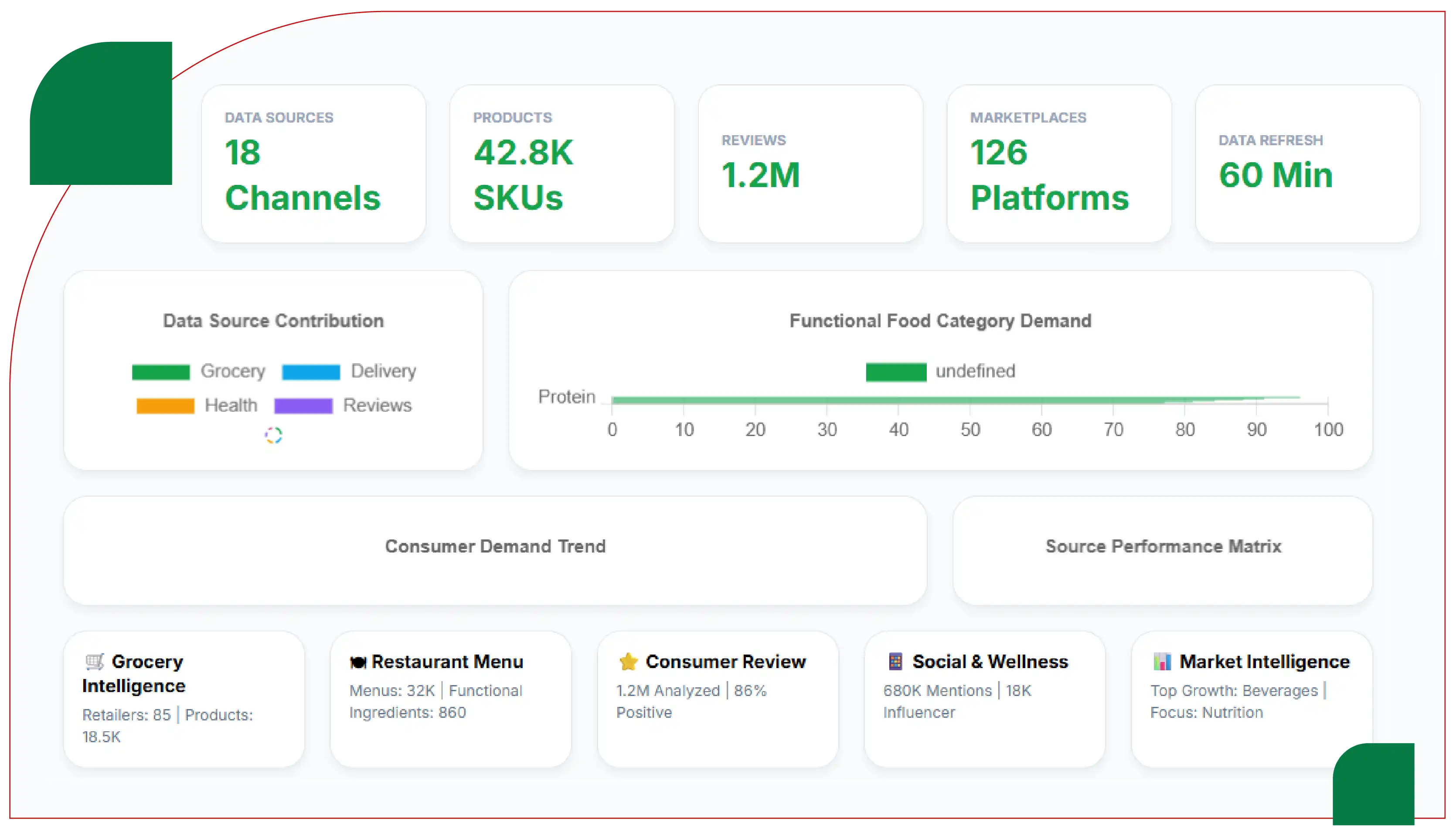
Businesses collect structured datasets from multiple digital sources including grocery retailers, health food marketplaces, restaurant menus, online supermarkets, food delivery applications, nutrition stores, pharmacy chains, manufacturer websites, recipe platforms, social media discussions, food blogs, wellness communities, consumer review platforms, promotional advertisements, influencer content, and subscription meal services.
Integrating multiple sources produces a comprehensive understanding of consumer demand across online and offline purchasing journeys.
| Product Category | Primary Ingredient | Average Retail Price (USD) | Monthly Search Growth | Consumer Rating | Online Availability (%) | Menu Adoption (%) | Weekly Mentions | Health Claim |
|---|---|---|---|---|---|---|---|---|
| Probiotic Yogurt | Greek Yogurt | 5.99 | 18% | 4.8 | 96 | 44 | 62,540 | Gut Health |
| Matcha Latte | Matcha | 6.49 | 23% | 4.7 | 91 | 38 | 54,820 | Energy |
| Turmeric Shot | Turmeric | 3.99 | 31% | 4.6 | 87 | 29 | 48,130 | Anti-inflammatory |
| Kombucha | Fermented Tea | 4.89 | 27% | 4.7 | 94 | 36 | 59,900 | Digestion |
| Chia Bowl | Chia Seeds | 8.49 | 22% | 4.8 | 82 | 41 | 46,270 | Fiber |
| Blueberry Smoothie | Blueberries | 7.99 | 20% | 4.7 | 88 | 39 | 44,510 | Antioxidants |
| Protein Bar | Whey Protein | 2.99 | 19% | 4.5 | 99 | 18 | 73,640 | Muscle Recovery |
| Kefir Drink | Kefir | 5.29 | 25% | 4.6 | 79 | 22 | 35,980 | Probiotics |
| Spinach Salad | Spinach | 10.99 | 16% | 4.7 | 85 | 52 | 39,220 | Vitamins |
| Honey Oats Bowl | Honey | 6.99 | 17% | 4.8 | 90 | 43 | 41,880 | Natural Energy |
Health-conscious consumers increasingly prioritize multifunctional products delivering several wellness benefits simultaneously. Rather than purchasing products with only one nutritional advantage, shoppers seek combinations such as protein plus probiotics, fiber plus antioxidants, collagen plus vitamins, or energy plus adaptogens.
Morning consumption remains the strongest purchasing occasion due to breakfast habits, gym routines, workplace nutrition, and meal replacement trends.
Cold seasons generally experience increased demand for immune-supporting beverages, herbal teas, ginger products, turmeric drinks, and vitamin-rich foods.
Summer months generate higher consumption of hydration beverages, electrolyte drinks, antioxidant smoothies, and fruit-based wellness products.
Retail pricing varies considerably depending upon retailer positioning, private label competition, package size, promotional frequency, geographical region, and ingredient sourcing.
Functional Food Price Monitoring enables organizations to compare identical products across supermarkets, health food stores, pharmacy retailers, online grocery marketplaces, and direct-to-consumer websites. Continuous monitoring identifies discount cycles, seasonal promotions, bundle pricing, subscription pricing, and competitive pricing gaps.
Historical pricing trends further help brands forecast future promotional calendars and optimize product positioning.
Businesses increasingly Extract Health Food Product Data from thousands of retailer listings to understand ingredient adoption rates across multiple product categories.
Popular functional ingredients include turmeric, ginger, matcha, spirulina, probiotics, collagen, chia seeds, flaxseed, berries, mushrooms, green tea, oats, almonds, avocado, spinach, fermented vegetables, kefir, cacao, honey, and botanical extracts.
Ingredient intelligence supports product innovation by identifying emerging combinations before competitors recognize market opportunities.
| Region | Leading Benefit | Top Ingredient | Average Basket Value (USD) | Repeat Purchase Rate | Monthly Product Launches | Restaurant Adoption | Consumer Sentiment |
|---|---|---|---|---|---|---|---|
| USA Northeast | Immunity | Ginger | 41.20 | 64% | 218 | High | Very Positive |
| USA Midwest | Protein | Greek Yogurt | 37.85 | 61% | 191 | Medium | Positive |
| USA South | Energy | Matcha | 39.40 | 58% | 204 | High | Positive |
| USA West | Gut Health | Kefir | 46.10 | 68% | 237 | Very High | Very Positive |
| Canada | Antioxidants | Blueberries | 42.90 | 63% | 166 | Medium | Positive |
| United Kingdom | Fiber | Chia Seeds | 35.75 | 57% | 154 | Medium | Positive |
| Germany | Fermented Foods | Miso | 38.80 | 60% | 148 | Growing | Positive |
| Australia | Protein | Greek Yogurt | 40.25 | 62% | 173 | High | Positive |
| Japan | Digestive Health | Miso | 43.10 | 71% | 198 | Very High | Excellent |
| Brazil | Natural Energy | Honey | 33.95 | 56% | 129 | Growing | Positive |
Manufacturers increasingly Extract Functional Food Product Insights from retailer catalogs, food delivery applications, online recipes, and social conversations to identify emerging product concepts.
Popular innovations include botanical beverages, mushroom coffee, fermented snacks, protein desserts, collagen smoothies, vitamin waters, functional bakery products, adaptogenic chocolate, brain-health beverages, electrolyte hydration drinks, and gut-friendly frozen meals.
Continuous market monitoring enables brands to validate ideas before large-scale production begins.
Customer reviews provide valuable information beyond numerical ratings. Natural language processing identifies common themes such as flavor satisfaction, packaging quality, ingredient transparency, perceived health benefits, digestive improvement, texture preferences, sweetness levels, and value for money.
Brands combine review analytics with Consumer Trend Data Scraping to discover unmet customer expectations and emerging nutritional demands.
Social listening further captures discussions surrounding new ingredients, celebrity endorsements, wellness influencers, and seasonal health concerns.
Leading manufacturers continuously monitor competitor product launches, nutritional claims, promotional campaigns, ingredient additions, certification labels, and pricing changes.
Retail assortment analysis identifies product expansion across grocery chains while restaurant menu tracking highlights ingredient adoption throughout foodservice channels.
Historical datasets help estimate product lifecycle performance and category saturation.
Artificial intelligence increasingly predicts demand by analyzing pricing history, seasonal trends, weather patterns, consumer reviews, online search behavior, restaurant menus, grocery inventory, and promotional campaigns.
Predictive models estimate future popularity for functional ingredients months before widespread market adoption.
These forecasts improve procurement planning, production scheduling, inventory management, and promotional investment.
Organizations consolidate structured datasets into centralized analytics platforms that visualize pricing movements, ingredient popularity, retailer assortment, promotional frequency, customer ratings, nutritional claims, competitor launches, regional demand, and seasonal purchasing patterns.
Integrated Food Demand Trends analytics enable executives to monitor category performance through interactive reporting while centralized Food Price Dashboard solutions simplify daily pricing comparisons across hundreds of retailers and marketplaces.
Functional foods will continue expanding as consumers increasingly integrate wellness into everyday eating habits. Personalized nutrition, AI-driven recommendations, microbiome research, precision health, sustainable sourcing, and transparent ingredient labeling will further accelerate innovation throughout the category.
Businesses investing in automated data collection will possess stronger competitive advantages by identifying market opportunities before they become mainstream.
The functional food market represents one of the most data-driven opportunities within the modern food industry. Organizations that continuously monitor ingredients, pricing, consumer sentiment, nutritional claims, and product innovation can rapidly adapt to changing consumer expectations while minimizing business risks. Comprehensive market intelligence transforms raw online information into actionable business decisions supporting product development, pricing optimization, demand forecasting, and competitive benchmarking.
Integrated Food Datasets provide structured information from retailers, restaurants, grocery platforms, and digital marketplaces, while advanced Food Intelligence platforms convert these datasets into predictive insights that guide strategic planning. Modern Food Scraping API solutions automate continuous collection, validation, and delivery of high-quality functional food data, enabling brands, retailers, manufacturers, researchers, and foodservice operators to confidently navigate the rapidly evolving wellness economy throughout 2026 and beyond.
If you are seeking for a reliable data scraping services, Food Data Scrape is at your service. We hold prominence in Food Data Aggregator and Mobile Restaurant App Scraping with impeccable data analysis for strategic decision-making.