Introduction
Grocery prices can vary significantly between stores, even when they belong to the same retail chain. Product availability, regional demand, promotional campaigns, fulfillment costs, and local competition influence the prices shoppers see when browsing online grocery platforms. For retailers, market researchers, grocery delivery businesses, and pricing analysts, understanding these variations is essential for developing effective pricing strategies and competitive intelligence systems.
Businesses increasingly scrape grocery prices by ZIP code to collect localized product prices, discounts, package sizes, and availability information across different retail locations. This approach helps identify how the same product is priced across neighborhoods and markets, supporting more accurate price comparisons and regional analysis.
Store-Specific Grocery Price Data Scraping By ZIP Code enables organizations to gather structured information from grocery platforms operated by Kroger, Safeway, H-E-B, and Meijer. Meanwhile, ZIP-Level Grocery Price Monitoring helps track pricing changes across selected postal codes over time. By combining location-specific data collection with historical analysis, companies can understand regional pricing differences, identify promotional opportunities, monitor competitors, and make data-driven decisions in an increasingly competitive grocery marketplace.
Understanding Store-Specific Grocery Price Scraping
Store-specific grocery price scraping involves collecting product information associated with a particular store, fulfillment location, or delivery ZIP code. Unlike general grocery scraping, which may capture a product's name and advertised price, localized scraping connects the information to a defined geographic area and retail context.
For example, a shopper selecting one ZIP code on Kroger's website may see different product availability or promotional offers than a shopper selecting another ZIP code. Similar differences can occur across Safeway, H-E-B, and Meijer, depending on their local operations and online shopping systems.
A comprehensive collection process typically captures product names, brand names, product identifiers, listed prices, unit prices, package sizes, promotional discounts, availability indicators, and collection timestamps. It can also record store identifiers, ZIP codes, product categories, and fulfillment options when available.
The objective is not simply to gather prices. It is to create a consistent dataset that makes meaningful comparisons possible across stores, locations, products, and collection periods.
Why Grocery Prices Must Be Tracked by ZIP Code?
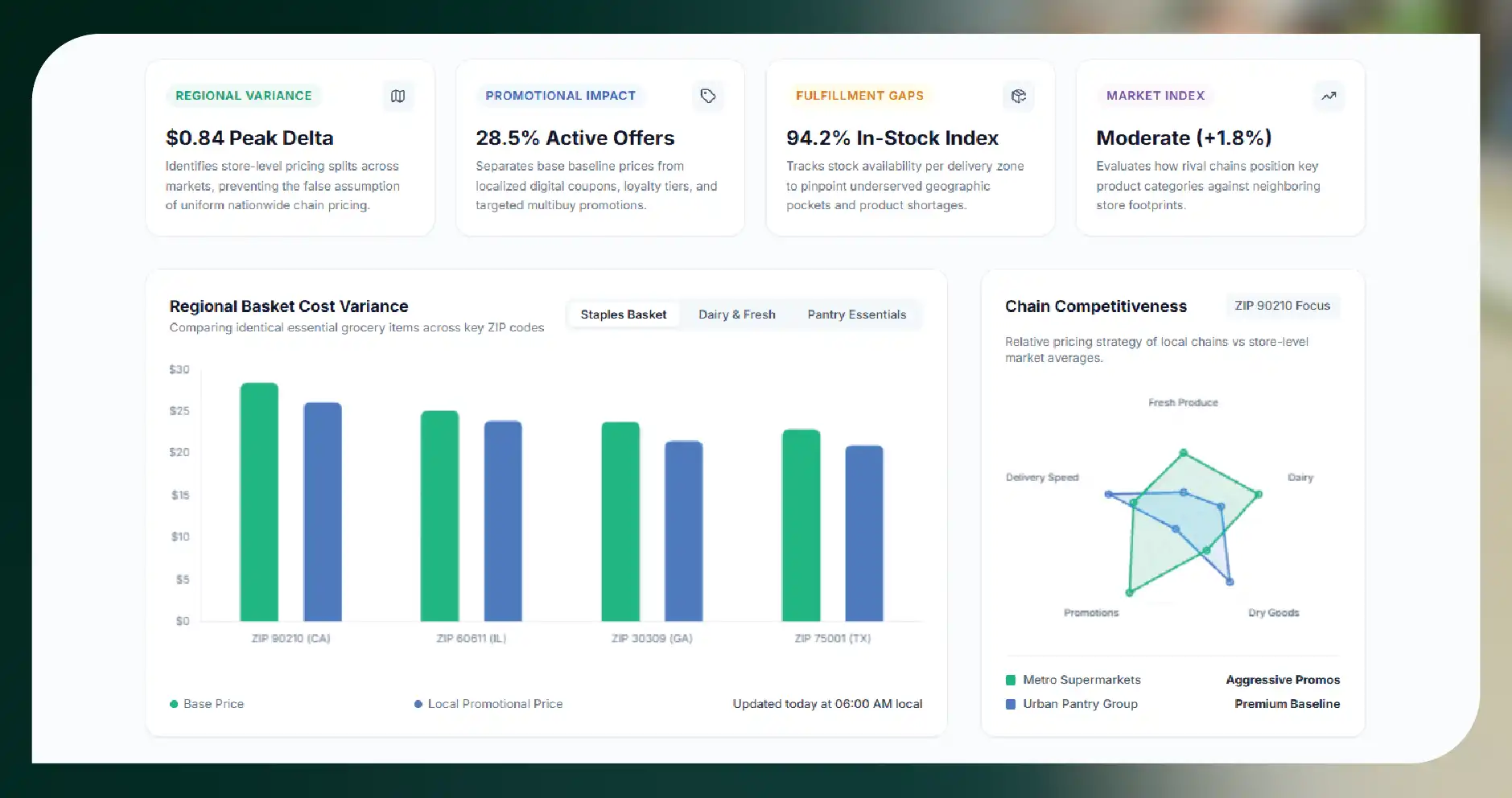
Grocery retailers operate across different regional markets, each with its own competitive environment. A product's advertised price may reflect local promotions, store-level pricing decisions, supply conditions, or the retailer's online fulfillment arrangements.
ZIP-level tracking helps businesses understand these differences.
Regional price variations: The same branded cereal, milk, or cooking oil may have different listed prices across retail locations. Comparing prices by ZIP code helps identify these variations without assuming that a chain has uniform pricing nationwide.
Promotional differences: Discounts, digital coupons, loyalty offers, and multibuy promotions may differ by location or customer eligibility. Recording the applicable promotional details helps analysts distinguish standard prices from temporary offers.
Local availability: Some products may be available for delivery in one area but unavailable in another. Connecting product records to a location helps businesses evaluate assortment differences and understand where demand may be underserved.
Competitive positioning: Comparing grocery prices across neighboring retail markets can reveal where particular chains appear more or less competitive for selected product categories.
How to Collect Grocery Prices from Kroger, Safeway, H-E-B, and Meijer?
The following workflow describes a general data collection approach. Actual fields, access methods, and location behavior depend on each retailer's website, permitted access methods, and online shopping configuration.
1. Select Target ZIP Codes and Stores
Begin by defining the geographic markets you want to analyze. Choose representative ZIP codes across urban, suburban, and smaller markets, then identify the corresponding stores or fulfillment locations available through each retailer's shopping interface.
For example, a project might compare grocery listings in 10 ZIP codes across multiple metropolitan areas. The selected sample should account for differences in retailer coverage, store availability, and product assortment.
Create a location mapping table containing the ZIP code, city, state, retailer, store identifier, and any available fulfillment information. Keep store identifiers separate from ZIP codes because a postal area may be served by multiple stores, while one store may serve customers across several ZIP codes.
2. Identify Product Categories and Matching Products
Next, determine which grocery categories should be collected. Common categories include dairy, fresh produce, meat, beverages, frozen foods, packaged snacks, breakfast products, household essentials, and personal care items.
Build a standardized product list for comparing equivalent items across retailers. Useful matching attributes include:
- Product name and brand
- UPC or GTIN, when available
- Package size and measurement unit
- Product variant, flavor, or formulation
- Category and subcategory
- Organic, conventional, or dietary attributes
Product matching is particularly important when comparing different package sizes. A 32-ounce product should not be directly compared with a 24-ounce version using only the displayed price. Calculating a consistent unit price makes the comparison more meaningful.
3. Collect Kroger Grocery Pricing Information
Kroger's online shopping experience can provide information about products, prices, promotions, and availability associated with a selected shopping location. A collection workflow should first establish the relevant location through the retailer's permitted interface or an authorized data access method.
Once the location is selected, collect accessible product listings and preserve the associated store or location context. Depending on the available fields, records may include regular prices, promotional prices, package sizes, product identifiers, and availability status.
Repeat the collection for the selected ZIP codes, ensuring that location selection is confirmed before each collection run. This helps prevent prices associated with one store from being incorrectly assigned to another.
4. Collect Safeway Grocery Pricing Information
Safeway's online grocery listings can be analyzed using a similar location-aware process. Start by selecting the relevant delivery area or store, then capture the product information made available for that shopping context.
Pay attention to loyalty pricing, digital promotions, and other offer conditions. An advertised price may require membership or a qualifying purchase, so promotional conditions should be recorded separately whenever the source exposes them.
When comparing Safeway with other retailers, normalize product sizes and distinguish regular prices from conditional discounts. This prevents misleading comparisons in which one retailer's standard price is compared with another retailer's loyalty-only offer.
5. Collect H-E-B Grocery Pricing Information
H-E-B operates primarily in Texas, making it particularly relevant for analyzing grocery competition across local Texas markets. Begin by mapping target ZIP codes to stores and online shopping locations available through H-E-B's permitted interfaces.
H-E-B Grocery Delivery Scraping API helps capture accessible product attributes, listed prices, package sizes, promotions, and availability indicators. Fresh foods and private-label products deserve special attention because product specifications and package formats may differ from those offered by competing retailers.
For H-E-B, product matching should account for variable-weight items, such as meat and produce, where the final purchase price can depend on the selected weight. Where possible, store both the listed price and the unit-price basis to support consistent analysis.
6. Collect Meijer Grocery Pricing Information
Meijer provides another useful comparison point for regional grocery research, particularly in the Midwest. Its online shopping listings can be analyzed by selecting relevant store locations and capturing the product information available for those locations.
Track standard prices, discounts, package sizes, product categories, and stock indicators where accessible. Special offers should be recorded with collection dates and applicable conditions because promotions can change over time.
For cross-retailer comparisons, ensure that each Meijer product is matched to an equivalent item from the comparison set. When an exact equivalent is unavailable, classify the record as a similar product rather than treating it as an identical match.
Building a Reliable ZIP Code-Level Grocery Dataset
Once data has been collected from the four retailers, the next step is to consolidate the records into a consistent structure.
A useful dataset can contain the following fields:
| Field | Purpose |
|---|---|
| ZIP Code | Identifies the selected geographic market |
| Retailer | Names Kroger, Safeway, H-E-B, or Meijer |
| Store ID | Identifies the associated store when available |
| Product ID | Supports product identification and matching |
| Product Name | Stores the listed product description |
| Brand | Supports brand-level comparisons |
| Package Size | Records the quantity or weight |
| Regular Price | Captures the standard listed price when available |
| Promotional Price | Records an advertised discounted price |
| Unit Price | Enables normalized price comparisons |
| Availability | Indicates the observed stock or listing status |
| Collection Timestamp | Records when the information was retrieved |
A standardized structure allows analysts to compare prices across retailers without losing the geographic context that makes the dataset valuable.
Data Cleaning, Validation, and Product Matching
Raw grocery listings frequently contain inconsistent descriptions, duplicate records, missing identifiers, and changing package formats. Data cleaning is therefore essential before calculating price differences or market averages.
First, standardize units of measurement. Convert compatible quantities into consistent units, such as ounces, pounds, liters, or grams, while preserving the original package description. Second, normalize product names and brand labels to improve matching accuracy.
Third, validate prices and promotional details. Flag missing values, unusual price changes, duplicate product records, and potentially inconsistent currency or unit information. A sudden price change may reflect a genuine promotion, a product-size change, or a collection error, so automated checks should flag anomalies for review rather than automatically deleting them.
Finally, distinguish unavailable products from products that were not successfully collected. These conditions have different meanings and should not be combined into a single blank value.
Analyzing Store-Level Grocery Price Differences
Once the dataset has been cleaned, analysts can use it to understand regional pricing patterns.
Store-Specific Grocery Pricing Intelligence enables businesses to evaluate how grocery prices differ by retailer, location, category, and product. Analysts can calculate average prices for matched products, compare promotional frequency, and identify locations with relatively higher or lower prices.
Store-Level Grocery Price Comparison also supports market-basket analysis. A market basket is a predefined group of grocery products used to compare the overall cost of a representative shopping list across stores. Instead of relying on one product, businesses can evaluate the combined cost of milk, eggs, bread, produce, meat, and household essentials.
The comparison should use equivalent products, consistent package sizes, and clearly defined pricing rules. Analysts should also report the number of matched products in each basket so readers can distinguish robust comparisons from results based on limited data.
Tracking Changes Through Automated Price Monitoring
Grocery pricing data becomes more valuable when collected consistently over time. A one-time snapshot reveals prices at a particular moment, while repeated collection helps identify trends, promotional cycles, and changes in competitive positioning.
An automated workflow can schedule collection runs, validate retrieved records, update a central database, and generate alerts when selected products change price.
Extract Store-Specific Product Data from permitted sources at a frequency appropriate to the research objective. Some projects may require daily observations, while others can use weekly or promotion-focused collection schedules.
Real-Time Price Monitoring should be understood as a capability dependent on source access, collection frequency, and system latency. Unless the retailer provides a genuine real-time feed, scheduled scraping produces periodic observations rather than guaranteed live prices.
A monitoring dashboard can display price histories, product availability, promotional changes, and ZIP-code comparisons. Alerts can notify analysts when a price crosses a defined threshold or when a product becomes unavailable in a target market.
Using AI to Improve Grocery Price Intelligence
Artificial intelligence can help transform large volumes of grocery records into more useful business insights.
AI Grocery Intelligence can support product matching, category classification, anomaly detection, and the identification of unusual price movements. Machine-learning models can suggest equivalent products when names differ across retailers, although confidence scores and human review remain important for ambiguous matches.
Predictive analytics can also help identify recurring promotional patterns or estimate how local prices change across collection periods. However, historical observations do not automatically establish the causes of price changes or prove future pricing behavior.
For businesses managing extensive product catalogs, AI-assisted analysis can reduce manual review and help prioritize important changes. The underlying data must still be accurate, consistently collected, and representative of the markets being analyzed.
Challenges and Compliance Considerations
Store-specific grocery scraping involves practical and technical challenges. Retailers may change their website layouts, product identifiers, pricing displays, or location-selection processes. Automated workflows therefore require monitoring, maintenance, and validation.
Other challenges include:
- Incomplete product coverage across ZIP codes.
- Loyalty prices that depend on membership or account eligibility.
- Dynamic promotions and variable-weight products.
- Differences between online and in-store prices.
- Inconsistent availability information.
- Duplicate or incorrectly matched product listings.
Businesses should use authorized APIs, licensed datasets, or publicly accessible pages where collection is permitted. Review applicable terms of service, privacy requirements, and access restrictions before implementing a collection process. Respect technical controls, avoid collecting unnecessary personal information, and use appropriate request rates.
A responsible data pipeline should also preserve timestamps and source context, making it easier to audit observations and understand the limitations of the resulting analysis.
How Food Data Scrape Can Help You?
1. Customized Grocery Data Collection: Food Data Scrape can help businesses collect permitted grocery product listings, prices, discounts, package sizes, and availability indicators across selected ZIP codes, creating structured datasets for regional analysis and competitor benchmarking.
2. Multi-Retailer Price Comparison: Compare matched grocery products across Kroger, Safeway, H-E-B, and Meijer to understand price differences, promotional positioning, and regional market variations using standardized product attributes and consistent unit-price calculations.
3. Automated Price Tracking: Develop scheduled monitoring workflows that capture recurring price observations, maintain historical records, and flag notable changes. Collection frequency can be tailored to business objectives, source limitations, and permitted access methods.
4. Data Cleaning and Enrichment: Organize raw grocery listings into consistent formats, standardize product attributes, identify duplicate records, and support product matching so analysts can conduct more reliable store-level comparisons and market-basket evaluations.
5. Actionable Grocery Intelligence: Transform structured grocery data into dashboards, competitive reports, and analytical datasets that help retailers, delivery platforms, and market researchers evaluate regional pricing patterns and make better-informed business decisions.
Conclusion
Scraping store-specific grocery prices by ZIP code helps businesses move beyond broad national price comparisons and understand how grocery pricing varies across individual retail markets. By collecting location-associated product listings from Kroger, Safeway, H-E-B, and Meijer, organizations can analyze promotional differences, product availability, unit prices, and market-basket costs.
A reliable workflow combines location mapping, standardized product matching, structured extraction, data validation, and recurring monitoring. Historical observations can then support regional benchmarking, pricing analysis, and competitive research, while AI-assisted methods can improve classification and anomaly detection.
A well-maintained Kroger Groceries Dataset can provide valuable insights into product pricing, promotions, and regional grocery trends.
A structured Safeway Grocery Dataset helps businesses compare product availability, discounts, and store-level pricing patterns.
Combining these resources with comparable H-E-B and Meijer information supports comprehensive grocery market analysis.
Consistent ZIP Code-Level Grocery Price Data enables businesses to identify local price differences, monitor changing offers, and develop informed retail strategies.
Accurate product matching, transparent methodology, responsible data collection, and consideration of store locations, customer eligibility, and fulfillment conditions are essential for reliable results.
Are you in need of high-class scraping services? Food Data Scrape should be your first point of call. We are undoubtedly the best in Food Data Aggregator and Mobile Grocery App Scraping service and we render impeccable data insights and analytics for strategic decision-making. With a legacy of excellence as our backbone, we help companies become data-driven, fueling their development. Please take advantage of our tailored solutions that will add value to your business. Contact us today to unlock the value of your data.