Introduction
Japan's foodservice industry is entering a new phase where consumer expectations are evolving faster than ever before. The biggest opportunities are no longer limited to premium dinner experiences or seasonal menu launches. Instead, restaurants, cafés, convenience chains, delivery brands, and food manufacturers are competing to win everyday eating occasions that happen during breakfast, commuting hours, afternoon breaks, and quick evening meals. Businesses that understand these changing habits early will be better positioned to develop successful products, optimise pricing, and respond to shifting customer preferences.
The need to Scrape Japan Food Trends Data 2026 has become an essential strategy for organisations seeking real-time visibility into these rapidly changing market behaviours.
As consumer conversations continue to evolve across digital platforms, Japan Food Data Scraping enables businesses to capture valuable information from menus, delivery platforms, retailer catalogues, consumer reviews, and pricing updates.
Rather than depending solely on historical reports, Japan Food Trend Data Monitoring allows decision-makers to identify emerging food preferences while they are still gaining momentum.
The New Direction of Japan's Food Industry
Japanese consumers have always valued quality, consistency, and convenience. However, several demographic and lifestyle changes are reshaping purchasing behaviour across the country.
Urban lifestyles, smaller households, hybrid work schedules, increasing numbers of single-person homes, and long commuting times are encouraging consumers to seek meals that are portable, affordable, and satisfying without sacrificing quality.
Instead of waiting for special occasions to dine out, many consumers now purchase food several times throughout the day.
This behavioural shift has created significant opportunities across:
- Quick-service restaurants
- Coffee chains
- Convenience stores
- Ready-to-eat food retailers
- Food delivery platforms
- Grab-and-go concepts
Businesses that continuously analyse digital food signals can adapt their menus far faster than competitors relying on quarterly market reports.
Why Data Has Become the New Competitive Advantage?
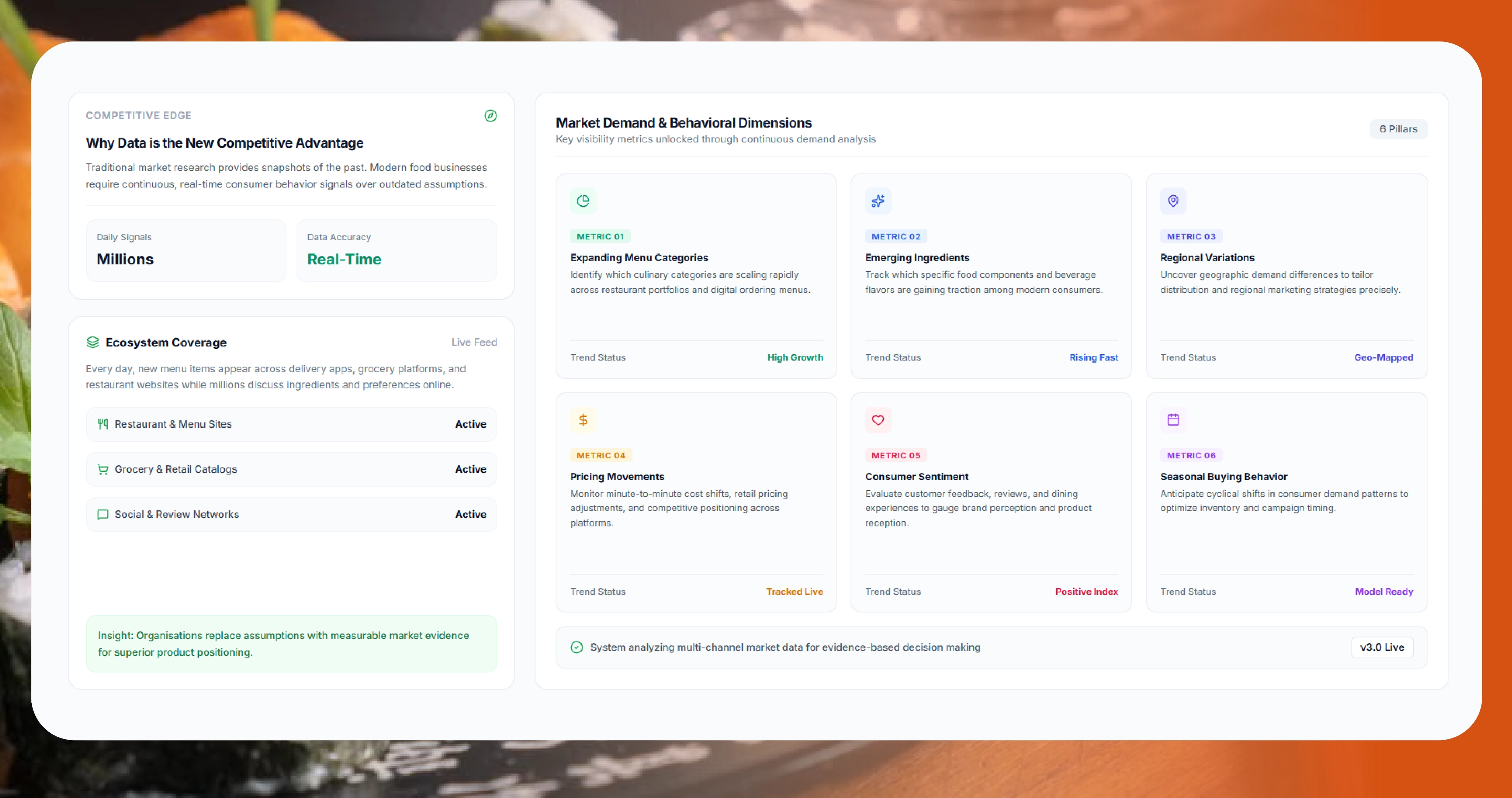
Traditional market research often provides a snapshot of what happened several months ago. Modern food businesses require information that reflects today's consumer behaviour rather than yesterday's trends.
Every day, thousands of new menu items appear across restaurant websites, delivery applications, grocery platforms, and retail catalogues. Millions of consumers also discuss meals, ingredients, beverages, dining experiences, and product recommendations online.
Collecting and analysing these signals provides valuable visibility into shifting demand.
This continuous flow of information helps organisations understand:
- Which menu categories are expanding
- Which ingredients are becoming popular
- Regional variations in demand
- Pricing movements
- Consumer sentiment
- Seasonal buying behaviour
Instead of relying on assumptions, companies can build products based on measurable market evidence.
Coffee Is Becoming the Centre of Daytime Consumption

One of the strongest developments across Japan's food market is the growing importance of coffee-led occasions.
Rather than acting simply as a beverage purchase, coffee increasingly drives additional food purchases throughout the day.
Consumers often pair coffee with sandwiches, pastries, rice balls, desserts, bakery items, hot snacks, and breakfast meals.
This shift has encouraged restaurants to rethink menu architecture.
Instead of designing food first and beverages second, many operators are building integrated daytime experiences centred around premium coffee offerings.
Understanding these relationships allows businesses to create stronger product bundles while improving average transaction values.
Comfort Food Is Winning Everyday Consumers
Another noticeable development is the growing preference for comforting, familiar meals.
Consumers increasingly seek foods that feel warm, satisfying, reliable, and convenient.
This demand extends across numerous categories including:
- Rice bowls
- Soups
- Noodle dishes
- Bakery products
- Hot sandwiches
- Curry meals
- Bento boxes
- Fresh bakery snacks
The appeal lies not only in taste but also in emotional familiarity.
Many consumers prefer dependable comfort foods during busy weekdays rather than highly experimental menu items.
This behavioural trend creates opportunities for restaurants to refresh classic recipes with premium ingredients instead of introducing completely unfamiliar concepts.
The Growing Role of Japan Food Pricing Data Extraction
Price remains an important purchasing factor even in premium-focused markets.
Consumers are willing to spend more when they clearly perceive higher quality, freshness, or convenience.
For businesses, monitoring pricing movements across restaurants, grocery retailers, convenience stores, and delivery platforms provides valuable competitive intelligence.
Japan food pricing data extraction enables organisations to analyse:
| Data Category | Business Value |
|---|---|
| Menu prices | Monitor competitor pricing strategies |
| Promotional offers | Track discount frequency |
| Combo meals | Compare bundled pricing |
| Beverage pricing | Identify premium positioning |
| Delivery charges | Understand customer acquisition strategies |
| Seasonal pricing | Measure price fluctuations |
| Limited-time offers | Detect promotional campaigns |
| Regional differences | Compare city-specific pricing |
These insights help businesses optimise pricing while maintaining competitiveness.
Understanding Consumer Behaviour Through Digital Signals
Modern food businesses increasingly rely on digital conversations to understand evolving eating habits.
Consumer discussions reveal changing preferences before they become visible in official sales reports.
These conversations highlight growing interest in:
- Breakfast routines
- Portable meals
- Afternoon snacks
- Health-conscious eating
- Premium convenience
- Seasonal flavours
- Limited-edition products
Analysing these signals supports stronger product planning and faster innovation cycles.
Building Stronger Japan Food Market Intelligence

Raw information alone offers limited value unless transformed into meaningful business intelligence.
Japan Food Market Intelligence combines multiple datasets to create a comprehensive understanding of market behaviour.
Typical sources include:
- Restaurant menus
- Food delivery applications
- Convenience store catalogues
- Grocery retailers
- Consumer reviews
- Recipe websites
- Social conversations
- Promotional campaigns
When these datasets are integrated, businesses gain a clearer picture of changing demand across different customer segments and geographic regions.
This enables more confident strategic planning.
Why Everyday Eating Occasions Matter?
For many years, restaurants concentrated heavily on lunch and dinner service.
Today's consumer journey is significantly more fragmented.
Many people now purchase food multiple times throughout the day.
- Morning coffee.
- Mid-morning snacks.
- Lunch.
- Afternoon refreshments.
- Evening takeaway.
- Late-night convenience purchases.
Each occasion creates new revenue opportunities.
Businesses that understand these eating windows can develop highly targeted menu offerings rather than relying solely on traditional meal periods.
The Importance of Japan Food Consumer Insights
Consumer behaviour changes continuously.
Successful food businesses monitor not only what customers buy but also why they make those purchasing decisions.
Japan Food Consumer Insights help organisations identify:
- Emerging dietary preferences
- Lifestyle-driven purchasing behaviour
- Convenience expectations
- Premium purchasing motivations
- Regional taste differences
- Age-based consumption patterns
- Changing meal occasions
These insights improve forecasting accuracy while reducing product development risks.
Stay Ahead of Japan's Rapidly Evolving Food Industry
Get accurate market intelligence, real-time pricing, consumer trends, and customised datasets that help you innovate faster and make smarter business decisions with our advanced data scraping solutions.
How Food Businesses Can Respond?
The most successful operators are treating daytime consumption as an independent business opportunity rather than an extension of traditional restaurant service.
This often includes:
- Developing stronger beverage programmes.
- Introducing portable meal formats.
- Expanding breakfast availability.
- Refreshing comfort-food offerings.
- Creating premium versions of everyday favourites.
- Improving delivery-friendly packaging.
- Testing limited-time seasonal products.
Rather than making major menu changes all at once, many businesses launch small pilot programmes before scaling successful concepts nationwide.
The Expanding Importance of Food Trends
Consumer preferences rarely remain static.
Food Trends increasingly emerge through continuous online conversations rather than traditional advertising campaigns.
Popular movements currently include:
- Higher-quality convenience meals.
- Fresh bakery products.
- Premium beverages.
- Seasonal flavours.
- Comfort-focused menus.
- Portable breakfast options.
- Restaurant-quality ready-to-eat meals.
Companies monitoring these developments in real time can respond months earlier than businesses relying solely on annual market research.
Why Flavor & Ingredient Insights Matter?
Ingredients often become popular long before they appear on mainstream restaurant menus.
Tracking Flavor & Ingredient Insights allows food manufacturers and restaurant operators to identify rising demand across herbs, spices, sauces, proteins, beverages, desserts, bakery fillings, and regional specialities.
Businesses frequently monitor:
- Ingredient popularity.
- Seasonal flavour combinations.
- Premium additions.
- Limited-edition ingredients.
- Regional preferences.
- Cross-category adoption.
This information supports faster innovation while reducing uncertainty during product development.
Transforming Market Data into Business Decisions
Modern analytics platforms enable organisations to transform large volumes of structured and unstructured information into practical business intelligence.
Instead of reviewing individual menus manually, businesses can monitor thousands of locations simultaneously.
Automated data collection supports:
- Competitive benchmarking.
- Menu comparison.
- Pricing analysis.
- Regional expansion planning.
- Consumer demand forecasting.
- Product portfolio optimisation.
- Operational planning.
- Investment decisions.
These capabilities allow companies to respond more quickly to changing market conditions while improving long-term strategic planning.
How Food Data Scrape Can Help You?
Comprehensive Food Market Data Collection
Our data scraping services collect large-scale food data from restaurant menus, grocery platforms, delivery apps, and retail websites, helping businesses access structured, accurate, and continuously updated market intelligence for better decision-making.
Real-Time Trend Monitoring
Monitor emerging food trends, seasonal demand, consumer preferences, and menu innovations through automated data collection, enabling your business to identify market shifts early and respond with faster product and marketing strategies.
Competitive Pricing Intelligence
Track competitor menu prices, promotional offers, discounts, bundled meals, and product availability across Japan, allowing your team to optimise pricing strategies, improve competitiveness, and maximise revenue opportunities effectively.
Consumer Behaviour & Market Insights
Extract valuable consumer signals from reviews, ratings, menus, and digital platforms to understand purchasing behaviour, ingredient preferences, dining occasions, and evolving food consumption patterns across diverse customer segments.
Customised Data for Business Growth
Receive tailored datasets, API integrations, and automated data delivery designed around your business objectives, empowering restaurants, food manufacturers, retailers, and researchers with reliable insights for confident strategic planning.
Conclusion
Japan's food industry is evolving around convenience, quality, portability, and everyday eating occasions. Businesses that continue focusing only on traditional dining experiences risk overlooking some of the fastest-growing opportunities within the market.
Continuous monitoring of menus, pricing, consumer discussions, delivery platforms, and retail channels enables organisations to make faster, more informed decisions supported by current market evidence rather than outdated assumptions.
Whether launching new products, expanding restaurant concepts, developing packaged foods, or refining pricing strategies, access to reliable market intelligence has become an essential competitive advantage.
Modern Food Data Scraping in the Japan solutions enable businesses to capture large-scale market information with speed and accuracy.
Integrated Food Delivery Scraping API services further strengthen visibility across restaurant platforms, delivery marketplaces, and evolving consumer purchasing behaviour.
Combined with comprehensive Food Datasets, organisations can uncover emerging opportunities, anticipate demand shifts, and build food strategies that align with the future of Japan's dynamic food ecosystem.
If you are seeking for a reliable data scraping services, Food Data Scrape is at your service. We hold prominence in Food Data Aggregator and Mobile Restaurant App Scraping with impeccable data analysis for strategic decision-making.