The Client
The client was a UAE-based grocery and consumer-products business operating in a highly competitive retail environment. Its management team needed a dependable source of online supermarket pricing information to evaluate competitor movements and improve its own pricing strategy.
The project required UAE Supermarket Pricing Data Extraction from major grocery platforms, with particular emphasis on product prices, discounts, pack sizes, availability, and category information. The client also wanted stronger UAE Grocery Market Intelligence to understand how competitors positioned everyday essentials, packaged foods, beverages, household products, and personal-care items.
Another priority was UAE Grocery Competitor Price Monitoring, because manual comparisons were time-consuming and could not provide sufficient coverage. The client therefore engaged our food data scraping team to develop a structured, scalable, and recurring data collection process capable of supporting pricing analysis and business decisions.
Key Challenges
-
Inconsistent Real-Time Price Monitoring
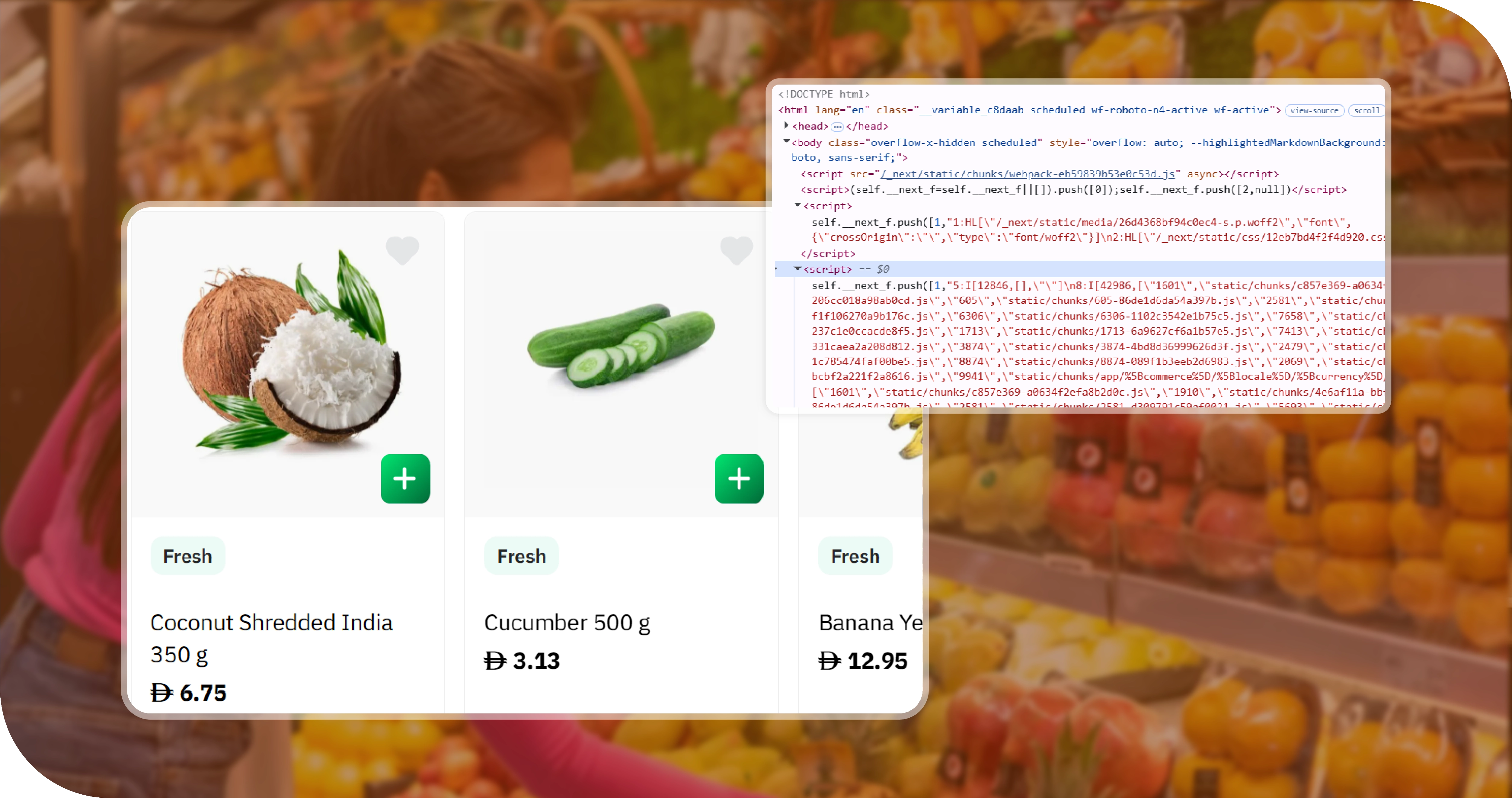
Real-Time Price Monitoring was difficult because supermarket prices, promotional offers, stock status, pack sizes, and product availability could change frequently. Manual collection created delays, while inconsistent product naming made reliable comparisons across competing supermarket platforms challenging. -
Extensive Product Coverage
The client needed to Scrape Lulu Hypermarket Grocery Data across numerous categories and thousands of individual SKUs. Collecting product names, prices, discounts, brands, pack sizes, availability, and category attributes manually would require significant employee time and repetitive verification. -
Complex Carrefour Data Requirements
The client required a reliable Carrefour Grocery Delivery Scraping API workflow capable of handling large volumes of product information. Different product structures, promotional pricing, availability indicators, and changing website elements made automated extraction and normalization essential for dependable competitive analysis.
Key Solutions
-
Automated Multi-Source Data Collection
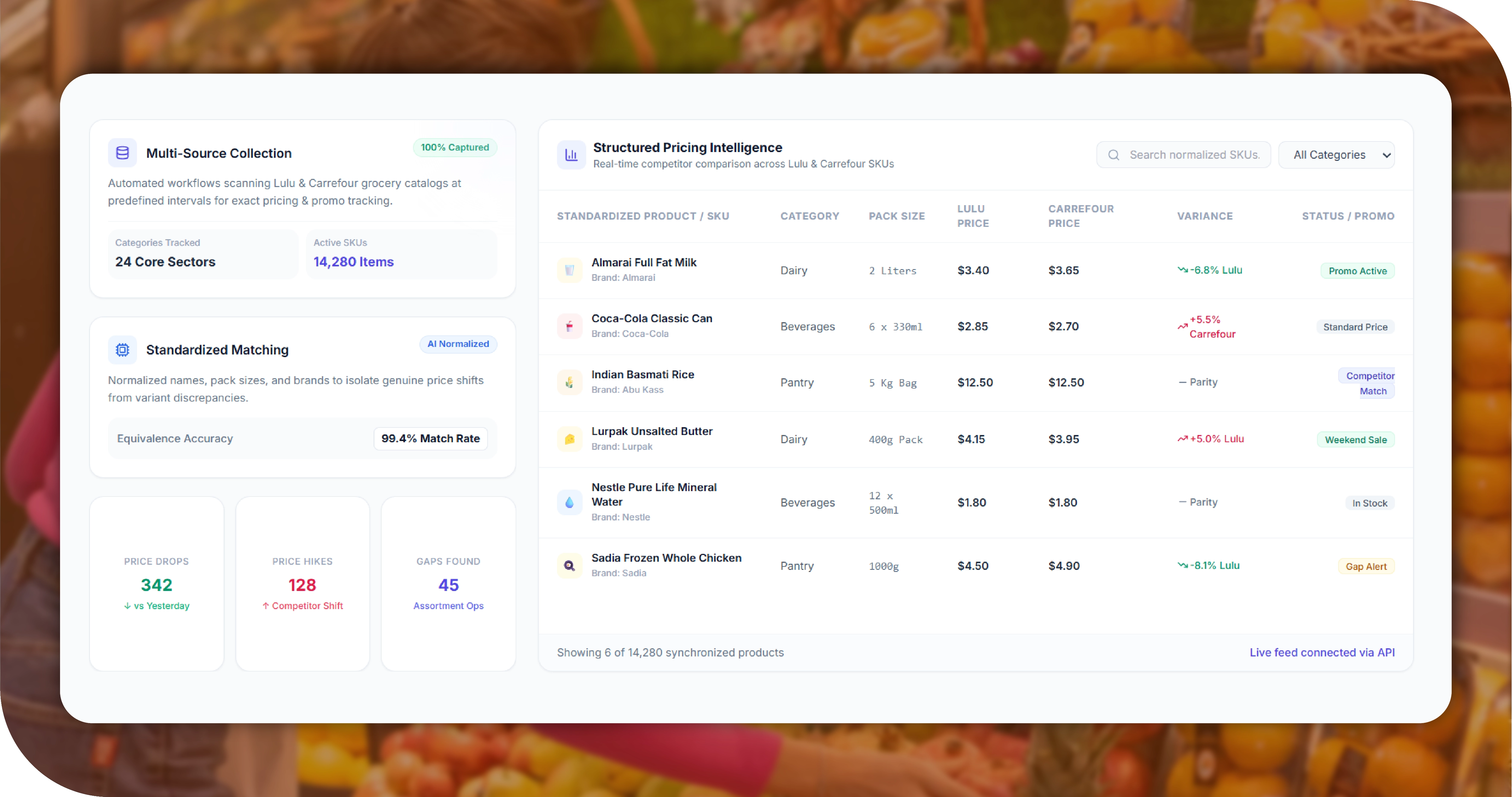
We developed an automated collection workflow covering selected Lulu and Carrefour grocery categories. The system captured product titles, brands, categories, pack sizes, listed prices, discounted prices, availability, and promotional information at predefined intervals for consistent monitoring. -
Product Matching and Data Standardization
We standardized product attributes and created matching logic to compare equivalent or closely related SKUs. Product names, quantities, brands, and pack sizes were normalized, helping the client distinguish genuine price movements from differences caused by product variants. -
Structured Pricing Intelligence Dashboard
The collected information was transformed into structured datasets suitable for dashboards and analytical workflows. The client could identify price increases, reductions, promotions, unavailable products, and competitor gaps without manually visiting multiple supermarket websites.
Illustrative Data Coverage and Results
| Data Metric | Before Solution | After Implementation | Improvement |
|---|---|---|---|
| Grocery SKUs monitored | 0 | 18,750+ | 18,750 |
| Product categories covered | 0 | 42+ | 42 |
| Daily price records collected | 0 | 37,500+ | 37,500 |
| Weekly price observations | 2,100 | 262,500 | 124.9× |
| Competitor platforms monitored | 1 manually | 2 automated | 2× |
| Manual research hours/week | 32 | 5 | 84.4% reduction |
| Average data processing time | 18 hours | 2.5 hours | 86.1% reduction |
| Promotional products identified/month | 180 | 1,420 | 688.9% increase |
| Price-change events detected/month | 320 | 3,850 | 1,103.1% increase |
| Product matching accuracy | 71% | 96% | +25 percentage points |
| Data fields captured/SKU | 6 | 14 | 133.3% increase |
| Availability observations/week | 2,100 | 262,500 | 124.9× |
| Reporting frequency | Weekly | Daily | 7× |
| Competitor price comparisons | 450/week | 8,750/week | 19.4× |
| Estimated research workload | High | Low | 84% reduction |
Figures are illustrative and can be replaced with verified client-specific metrics.
Methodologies Used
-
Source Identification and Scope Definition
We first identified relevant supermarket pages, product categories, grocery segments, and required data attributes. The collection scope was designed around the client's pricing objectives, ensuring that resources focused on commercially important products instead of unnecessary information. -
Automated Web Data Extraction
Automated extraction processes were configured to collect product-level information at scheduled intervals. Product titles, brands, prices, discounts, pack sizes, categories, availability, and related attributes were captured systematically to reduce repetitive manual research and improve collection consistency. -
Product Matching Methodology
A product matching methodology was applied to identify comparable products between supermarket platforms. Brand names, product descriptions, package quantities, units, and variants were standardized so analysts could distinguish meaningful competitive price differences from simple SKU variations. -
Data Cleaning and Validation
Raw records were processed through validation rules designed to identify missing fields, duplicate records, abnormal prices, inconsistent units, and incomplete product information. Cleaning procedures improved dataset reliability before the information was delivered for pricing and competitive analysis. -
Recurring Monitoring and Reporting
The solution was designed around recurring data collection rather than one-time extraction. Scheduled monitoring captured new prices and changes over time, enabling the client to develop historical datasets and identify recurring promotional patterns, competitor movements, and category-level pricing trends.
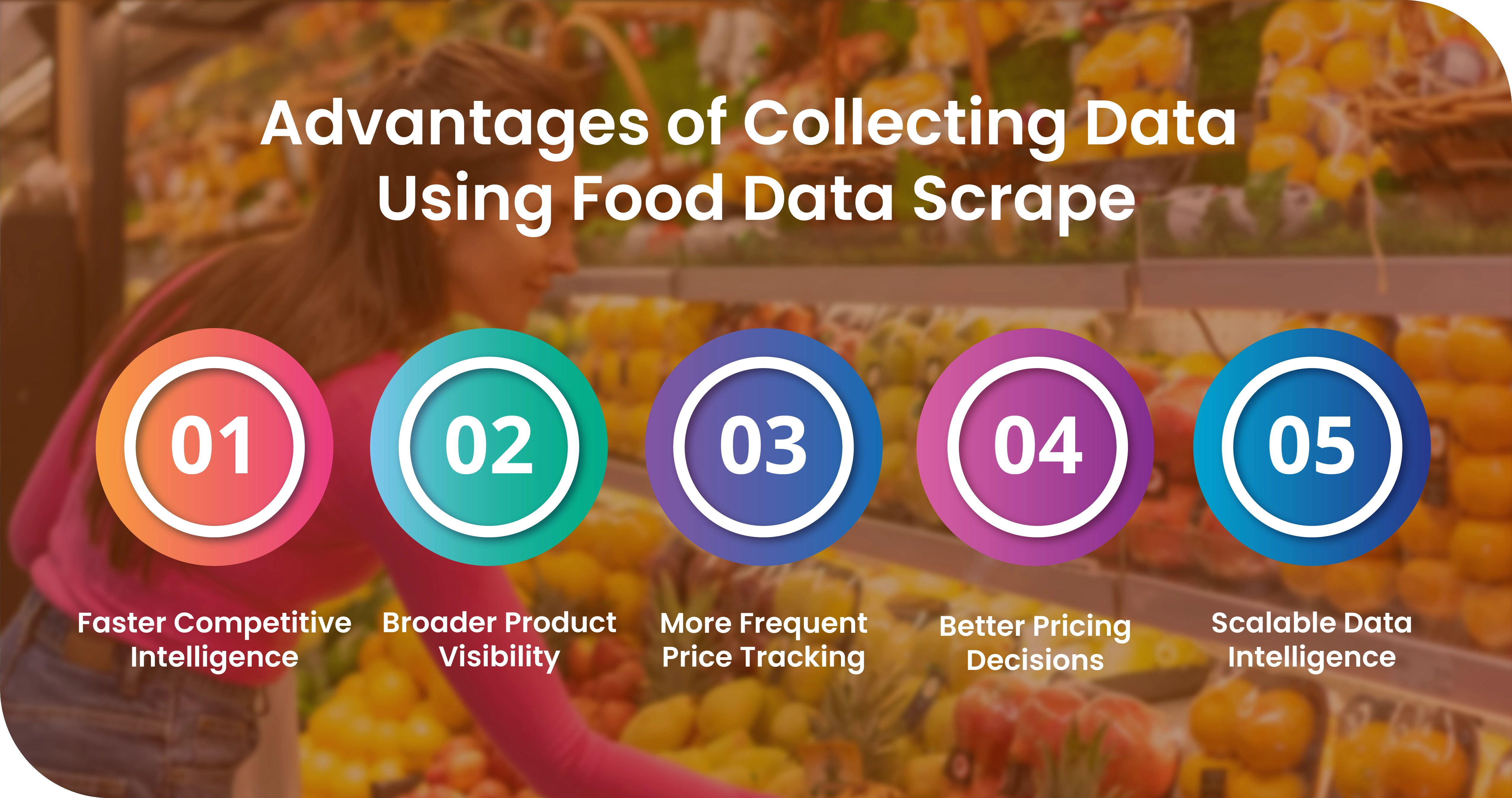
Advantages of Collecting Data Using Food Data Scrape
-
Faster Competitive Intelligence
Our food data scraping services significantly reduce the time required to gather grocery pricing information. Instead of manually checking multiple supermarket websites, businesses receive structured datasets that can be analyzed quickly for pricing and promotional decisions. -
Broader Product Visibility
Automated collection enables businesses to monitor substantially more SKUs and categories than manual research typically allows. This broader coverage helps reveal pricing patterns across essential groceries, beverages, packaged foods, household products, and other high-demand categories. -
More Frequent Price Tracking
Recurring extraction allows businesses to observe pricing changes at regular intervals rather than relying on occasional snapshots. This makes it easier to detect promotions, price increases, reductions, availability changes, and competitor actions while they are commercially relevant. -
Better Pricing Decisions
Clean and standardized competitor data gives pricing teams stronger evidence for adjusting prices, evaluating discounts, developing promotions, and identifying products where competitive positioning may be too high or too low. -
Scalable Data Intelligence
Food data scraping provides a scalable foundation for expanding monitoring across additional retailers, categories, products, and geographic markets. As the client's requirements grow, the same structured methodology can support larger datasets and more sophisticated market intelligence programs.
Client's Testimonial
"The biggest improvement was moving from fragmented manual price checks to a structured competitive intelligence process. We can now compare products across major supermarket platforms with significantly greater speed and coverage. The standardized data makes it easier for our pricing and category teams to identify meaningful changes rather than spending hours collecting information. The recurring monitoring capability has also helped us recognize promotional activity and competitor price movements much earlier. Most importantly, the solution gives our commercial team a consistent dataset that can be used across multiple business decisions. The project has reduced repetitive research work while giving management a clearer view of the competitive grocery landscape."
—Head of Pricing & Category Intelligence, UAE Grocery Retail Business
Final Outcome
The project transformed the client's approach to grocery price intelligence from manual observation into a structured, recurring data-driven process. The resulting dataset provided broader SKU coverage, more frequent price observations, improved product matching, and substantially lower manual research requirements.
The client gained a clearer view of competitor pricing, promotional activity, product availability, and category-level movements across major UAE supermarket platforms. Historical records also enabled the team to compare current prices against previous observations and identify recurring patterns.
By implementing Food Data Scraping in UAE, the business established a scalable foundation for future retailer expansion, automated reporting, and deeper competitive analysis. Pricing teams could focus more time on interpreting market movements instead of collecting raw information. The resulting intelligence supported faster commercial decisions, improved monitoring efficiency, and stronger visibility into the rapidly changing UAE grocery marketplace.