Introduction
The cloud kitchen industry is rapidly transforming the food delivery ecosystem by enabling restaurants to operate without traditional dine-in infrastructure. With increasing competition across online food platforms, cloud kitchen operators need accurate market insights to understand customer preferences, pricing trends, menu structures, and competitor strategies. Scrape Swiggy & Zomato Restaurant Data for Cloud Kitchen helps businesses collect valuable restaurant information from leading food delivery platforms to make data-driven decisions.
Modern cloud kitchens depend heavily on online visibility, customer reviews, delivery performance, and menu optimization. By analyzing competitor offerings, businesses can identify profitable cuisines, improve menu combinations, monitor price changes, and enhance customer satisfaction. Swiggy & Zomato Competitor Data Scraping for Cloud Kitchens enables operators to track similar restaurants, compare market positioning, and discover opportunities for expansion.
The ability to collect detailed restaurant information has become essential for food businesses looking to improve operations. Restaurant Menu & Pricing Data Extraction provides access to crucial details such as menu items, categories, prices, discounts, ratings, delivery fees, and customer feedback, helping cloud kitchens build effective strategies.
Cloud kitchens operate in a highly competitive environment where multiple brands compete for customer attention on food delivery platforms. Extracting restaurant data allows businesses to analyze competitors, identify trending dishes, and understand local food demand. Data-driven insights help cloud kitchen owners optimize their menus, adjust pricing models, and improve their overall digital presence.
Growing Importance of Restaurant Data for Cloud Kitchens
The food delivery market has experienced significant growth due to changing consumer habits and increasing demand for convenient online ordering. Cloud kitchens rely completely on digital platforms, making restaurant data an important asset for growth. Unlike traditional restaurants, cloud kitchens do not have physical storefronts where customers can discover their brands. Their success depends on online rankings, menu quality, pricing strategies, and delivery performance.
Through Swiggy & Zomato Restaurant Intelligence, businesses can gather structured information about restaurants operating in different locations. This intelligence includes restaurant names, cuisines, menu details, ratings, reviews, delivery times, offers, and customer preferences. Such insights allow cloud kitchens to understand market trends and develop better business strategies.
Restaurant data extraction also helps businesses identify gaps in the market. For example, a cloud kitchen can analyze which cuisines are highly demanded in a particular location but have limited competition. This enables them to launch new brands or menu items with higher chances of success.
Understanding Competitor Performance Through Food Delivery Data
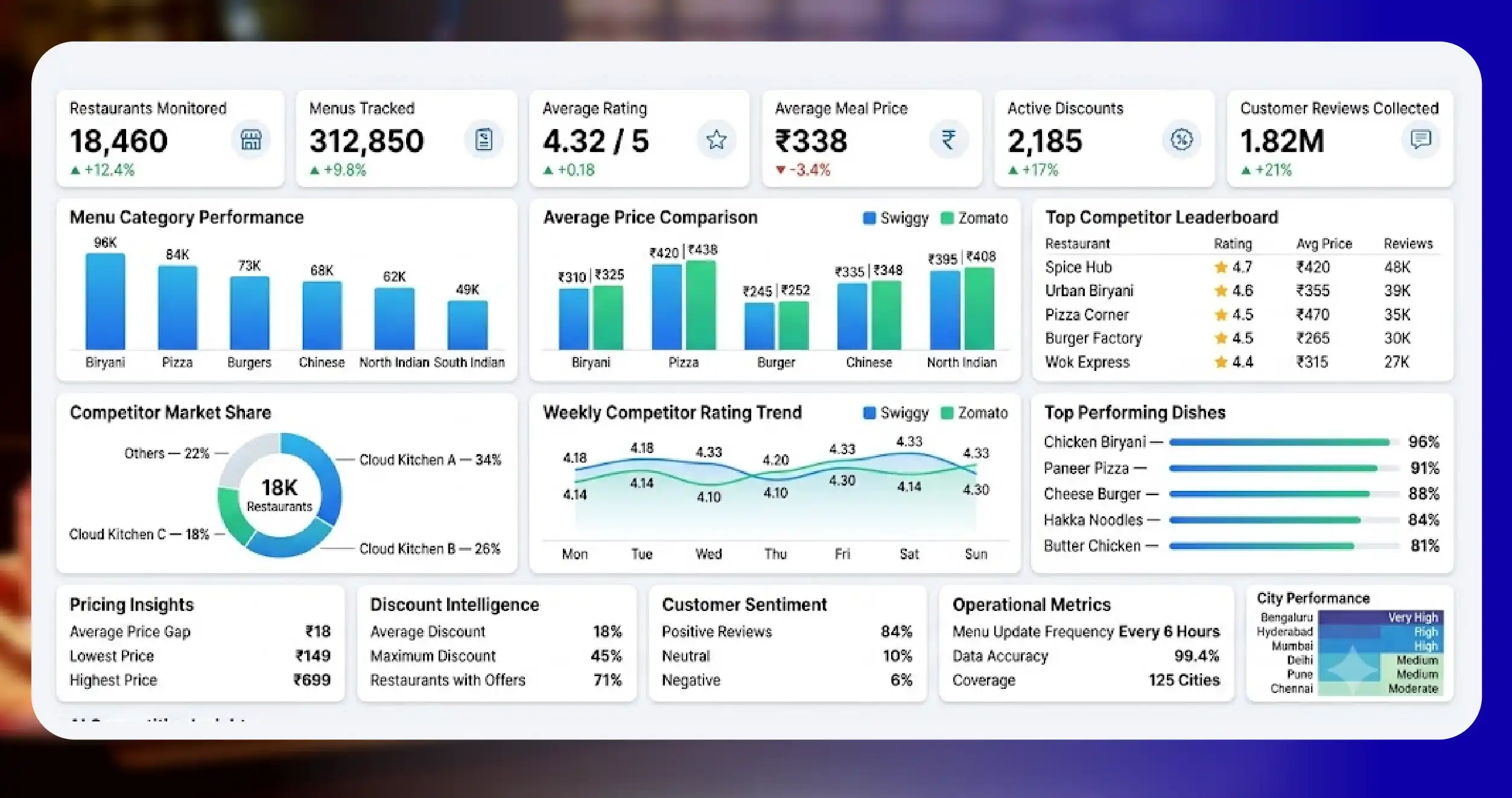
Competition among cloud kitchens has increased as more businesses enter the online food delivery sector. Restaurants need continuous monitoring of competitors to maintain their market position. Extract Swiggy & Zomato Restaurant Data to collect competitor information and analyze how similar brands perform across different areas.
By studying competitor menus, pricing, ratings, and customer reviews, cloud kitchens can identify successful strategies and improve their own offerings. They can determine which dishes receive the highest customer engagement, which price ranges perform better, and how competitors use discounts to attract customers.
A strong competitor analysis approach helps businesses avoid guesswork. Instead of making decisions based on assumptions, cloud kitchens can rely on real-time market information. This improves menu planning, promotional campaigns, and operational efficiency.
Role of Restaurant Menu Data Extraction
Menus are one of the most important factors influencing customer purchase decisions. Customers compare dishes, prices, portion sizes, ratings, and reviews before placing orders. Therefore, cloud kitchens need accurate menu intelligence to stay competitive.
Extract Restaurant Menu Data to collect complete menu information from food delivery platforms. This includes dish names, descriptions, categories, prices, add-ons, availability status, and promotional offers. With this information, cloud kitchens can optimize their own menus and introduce products aligned with customer demand.
Menu analysis also supports pricing decisions. Businesses can compare competitor pricing and adjust their own rates based on market conditions. This helps maintain profitability while offering competitive prices to customers.
Building a Competitive Advantage with Restaurant Datasets
Reliable datasets help cloud kitchens understand customer behavior and market movement. Instead of manually checking hundreds of restaurants, automated extraction methods provide organized information that can be analyzed efficiently.
A comprehensive Swiggy Restaurant Data Dataset contains valuable insights related to restaurant operations, including cuisine trends, customer ratings, delivery performance, and pricing patterns. Similarly, a Zomato Restaurant Data Dataset helps businesses evaluate restaurant visibility, customer engagement, and competitor strategies.
These datasets allow cloud kitchens to identify growth opportunities and make informed decisions. Businesses can analyze regional preferences, compare restaurant performance, and improve their positioning in crowded markets.
How Web Scraping Helps Food Businesses?
Food delivery platforms contain a large amount of valuable information that changes frequently. Prices, availability, discounts, and menu items are constantly updated. Manual tracking of this information is time-consuming and inefficient.
Web Scraping Food Delivery Data enables businesses to collect updated restaurant information automatically. This process helps cloud kitchens monitor market changes, track competitor movements, and maintain accurate business intelligence.
With automated data collection, businesses can monitor thousands of restaurants across multiple locations. This provides a broader understanding of market dynamics and helps create effective strategies for growth.
Using Food Delivery APIs for Scalable Data Collection
For large-scale restaurant analysis, businesses require efficient solutions that can handle huge volumes of information. Automated systems and APIs help collect, process, and organize restaurant data without manual effort.
A reliable Food Delivery Scraping API enables businesses to access structured restaurant information for analysis and decision-making. Cloud kitchens can integrate extracted data into dashboards, analytics platforms, and internal systems to improve operations.
These solutions support real-time monitoring of menus, prices, ratings, and competitor activities. As the food delivery industry continues to evolve, having access to accurate data becomes a major competitive advantage.
Improving Cloud Kitchen Growth with Restaurant Data Intelligence
Cloud kitchens require continuous market analysis to survive in competitive food delivery environments. Access to accurate restaurant information helps businesses understand customer expectations and improve their services. Restaurant Data Intelligence enables food businesses to analyze restaurant performance, menu trends, customer behavior, and competitor strategies from multiple sources.
With structured restaurant insights, cloud kitchens can identify high-performing food categories, optimize their menu offerings, and create targeted marketing strategies. Data-driven decision-making reduces operational risks and allows businesses to focus on areas that generate better revenue opportunities.
Restaurant intelligence also helps in tracking location-based trends. A cloud kitchen operating in multiple cities can compare demand patterns, identify popular cuisines, and adjust menus according to local preferences. This creates a personalized approach that improves customer engagement and brand loyalty.
Cloud Kitchen Competitor Analysis Using Food Delivery Data
Competitor monitoring is one of the most important activities for cloud kitchen success. Businesses need to understand how other restaurants attract customers, what prices they offer, and which dishes receive better responses.
Cloud Kitchen Competitor Analysis Using Food Delivery Data allows businesses to evaluate competitors through detailed restaurant information. By analyzing menu structures, pricing models, ratings, and customer feedback, cloud kitchens can develop stronger strategies.
Competitor data helps businesses discover market opportunities and improve their positioning. For example, if competitors are offering limited options in a popular category, a cloud kitchen can introduce new dishes to capture customer demand.
Benefits of Automated Restaurant Data Extraction
Automated data extraction eliminates the challenges of manually collecting restaurant information. Food delivery platforms contain thousands of restaurants, making manual research difficult and time-consuming. Data scraping solutions help collect information quickly and organize it into usable formats.
Cloud kitchens can use extracted information to monitor competitor activities, identify pricing fluctuations, and understand changing consumer preferences. This improves decision-making and helps businesses respond faster to market changes.
Restaurant data extraction also supports menu optimization. Businesses can analyze which dishes are trending, which items have better customer reviews, and which categories generate higher engagement.
Future of Restaurant Data Analytics for Cloud Kitchens
The future of cloud kitchens will depend heavily on data-driven operations. As food delivery competition increases, businesses that use accurate market insights will have stronger growth opportunities.
Restaurant analytics will continue to influence menu development, pricing strategies, customer engagement, and operational planning. By collecting and analyzing restaurant data, cloud kitchens can improve efficiency and create better customer experiences.
Advanced data solutions will help businesses identify emerging food trends, predict customer demand, and optimize their online presence. This will make restaurant data an essential resource for every successful cloud kitchen.
How Food Data Scrape Can Help You?
Real-Time Competitor Monitoring
Our data scraping services help cloud kitchens track competitor restaurants, menu changes,
pricing updates, and promotional activities. This enables businesses to respond quickly to
market changes and maintain competitive advantages in food delivery platforms.
Accurate Menu and Pricing Insights
We provide structured restaurant information including menu items, prices, discounts, and
availability details. These insights help cloud kitchens optimize their offerings, improve
pricing strategies, and create menus aligned with customer expectations.
Location-Based Market Analysis
Our solutions collect restaurant data across different locations, allowing businesses to analyze
regional food trends. Cloud kitchens can identify profitable areas, understand customer
preferences, and expand operations with better market knowledge.
Improved Business Decision Making
With organized restaurant datasets, businesses can make informed decisions related to menu
planning, competitor positioning, and promotional campaigns. Data-driven insights reduce
uncertainty and support long-term growth strategies.
Scalable Food Delivery Data Solutions
Our scraping solutions handle large-scale restaurant data collection efficiently. Businesses can
access updated information through customized datasets and integrations, helping them manage
multiple locations and brands effectively.
Conclusion
The cloud kitchen industry requires continuous innovation, competitor monitoring, and customer-focused strategies to achieve sustainable growth. Extracting restaurant data from leading food delivery platforms helps businesses understand market conditions and improve their operational performance.
With Food delivery Intelligence, cloud kitchens can analyze customer preferences, competitor movements, and restaurant trends to make smarter decisions. Access to accurate data supports better menu planning, pricing strategies, and business expansion.
A comprehensive Food Price Dashboard allows businesses to monitor pricing changes, compare competitors, and maintain profitable pricing models across locations. These insights help cloud kitchens stay competitive in a rapidly changing food delivery market.
Using structured Food Datasets enables restaurants to transform raw information into valuable business intelligence. With reliable restaurant data collection, cloud kitchens can improve efficiency, enhance customer satisfaction, and build stronger digital food brands.
If you are seeking for a reliable data scraping services, Food Data Scrape is at your service. We hold prominence in Food Data Aggregator and Mobile Restaurant App Scraping with impeccable data analysis for strategic decision-making.