Client
The client was a food-tech and market intelligence company seeking comprehensive US restaurant and food-delivery information for competitive research and analytics. Its existing research process depended heavily on manually checking restaurant listings, menus, prices, promotions, delivery charges, ratings, and availability across different platforms. This approach made it difficult to maintain consistent information across cities and restaurant categories because marketplace data changed frequently. The client specifically required intelligence to conduct DoorDash vs Uber Eats market analysis US, while also evaluating competitive positioning through Uber Eats vs Grubhub market analysis US. It wanted a scalable data acquisition infrastructure capable of continuously collecting information from major delivery platforms and transforming it into structured datasets. The company planned to use the resulting intelligence for benchmarking, competitor monitoring, market research, pricing analysis, and client-facing dashboards. It also required reliable food delivery platform competitive intelligence to support strategic decisions and identify changing marketplace opportunities.
Key Challenges
-
Constantly Changing Platform Data
Food-delivery platforms frequently changed restaurant availability, menu prices, promotions, delivery charges, operating hours, and listing information. The client needed a reliable US food delivery price monitoring platform approach to capture frequent changes and maintain accurate competitive records across multiple markets. -
Fragmented Food Delivery Information
Restaurant and menu information appeared differently across platforms, with variations in names, descriptions, categories, prices, ratings, and availability. The client required standardized Food Delivery Datasets that could bring these fragmented records together for reliable comparisons and downstream analysis. -
Complex Platform-Level Data Collection
Collecting information at scale from multiple delivery platforms required specialized extraction workflows and continuous monitoring. The client needed a dependable DoorDash Food Delivery Scraping API approach to support high-volume collection while maintaining structured, consistent, and regularly refreshed marketplace information.
Key Solutions
-
Automated Grubhub Data Extraction
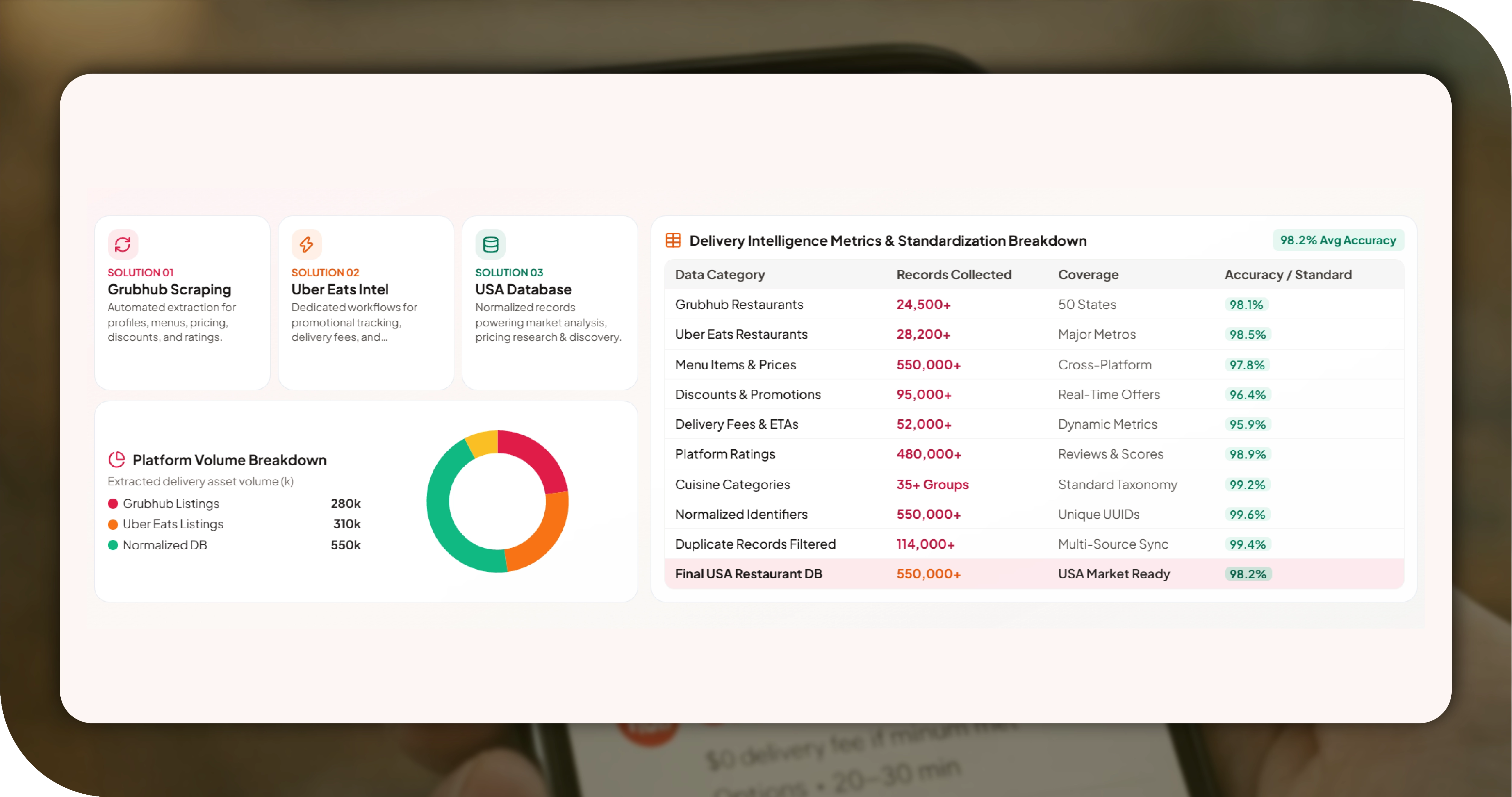
We developed automated workflows for collecting restaurant profiles, menus, prices, discounts, ratings, delivery fees, availability, cuisine categories, and location information. The Grubhub Food Delivery Scraping API supported structured extraction and recurring data collection, reducing manual research and improving marketplace visibility. -
Automated Uber Eats Data Collection
Our solution captured restaurant listings, menu items, prices, promotions, delivery information, ratings, and availability through dedicated workflows. The Uber Eats Food Delivery Scraping API enabled recurring collection and structured delivery of information for competitive benchmarking, pricing analysis, and market intelligence applications. -
Centralized Restaurant Intelligence
We transformed extracted records into normalized datasets containing restaurant identifiers, categories, locations, menus, pricing attributes, and platform references. The resulting USA Restaurant Database provided an organized foundation for market analysis, competitor benchmarking, restaurant discovery, pricing research, and location-based intelligence.
Data Collection Snapshot
| Data Metric | Project Volume | Coverage | Update Frequency | Accuracy Target |
|---|---|---|---|---|
| Restaurants Collected | 125,000+ | 50 US Markets | Daily | 96.5% |
| Menu Items | 2,850,000+ | 12 Cuisine Groups | Daily | 97.1% |
| Price Records | 4,200,000+ | 3 Platforms | Daily | 97.4% |
| Delivery Fee Records | 680,000+ | 50 Markets | Daily | 96.8% |
| Promotional Records | 420,000+ | 3 Platforms | Daily | 95.9% |
| Restaurant Locations | 125,000+ | United States | Weekly | 98.0% |
| Ratings & Review Signals | 1,900,000+ | Major Markets | Weekly | 96.2% |
| Availability Records | 3,600,000+ | Selected Restaurants | Daily | 96.7% |
| Cross-Platform Comparisons | 375,000+ | 3 Platforms | Daily | 95.8% |
| Structured Data Output | 100% | API/CSV/JSON | Automated | 97%+ |
Methodologies Used
-
Automated Web Data Extraction
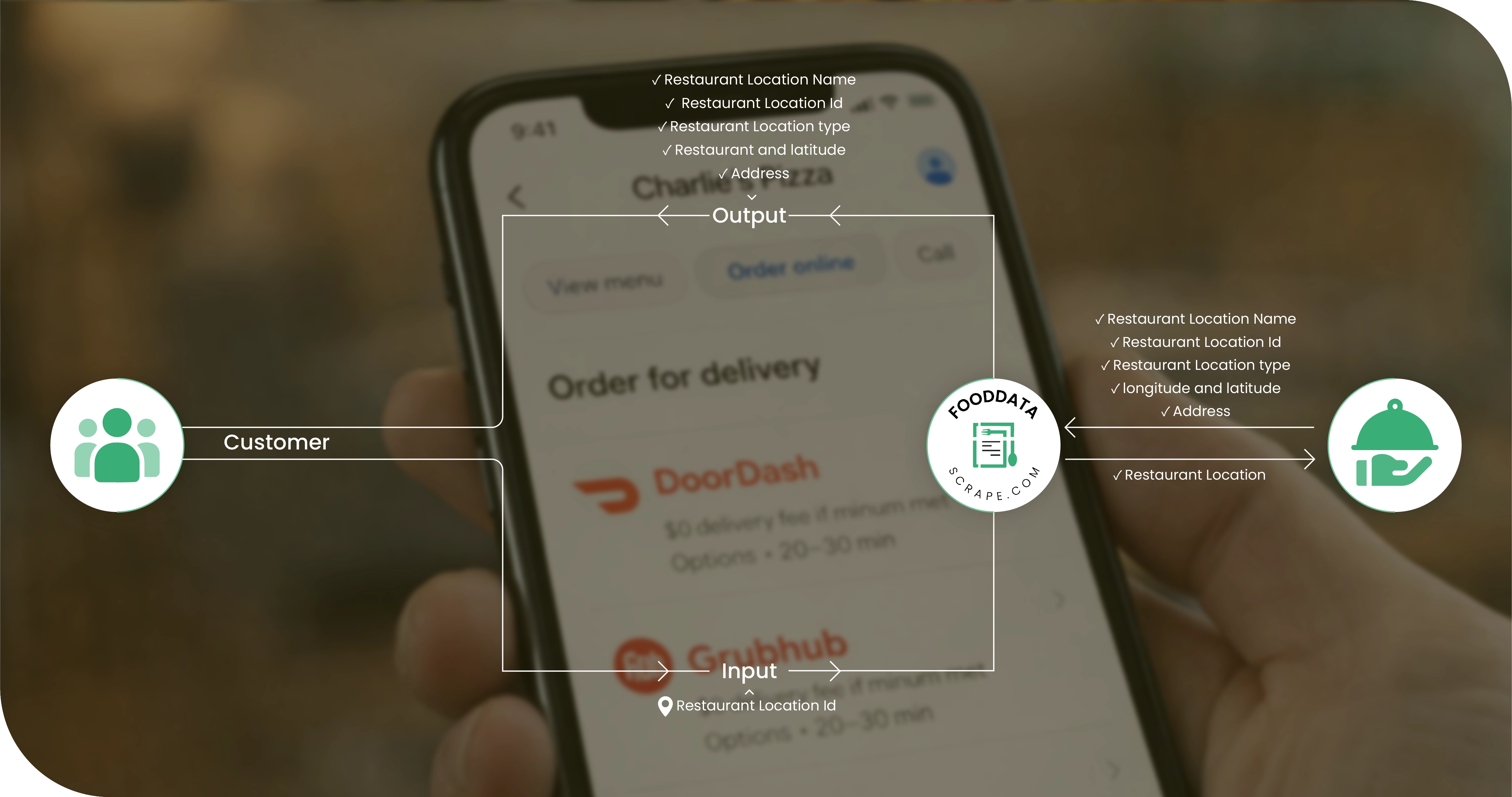
We implemented automated scraping workflows to collect restaurant, menu, pricing, availability, promotion, delivery, and location information at scale. Extraction rules were designed around individual platform structures, allowing relevant fields to be captured consistently while supporting recurring updates as marketplace information changed. -
Location-Based Restaurant Discovery
Restaurant discovery was organized using city, ZIP code, neighborhood, cuisine, and geographic parameters. This methodology enabled market-level coverage and helped identify restaurant availability across different delivery platforms, creating comprehensive geographic coverage for competitive analysis and location intelligence. -
Entity Matching and Deduplication
Restaurant and menu records were standardized using names, addresses, categories, identifiers, and other attributes. Matching algorithms helped connect equivalent restaurant listings across platforms, remove duplicate records, normalize naming variations, and improve the reliability of cross-platform competitive comparisons. -
Price and Promotion Monitoring
Automated workflows captured menu prices, discounted prices, delivery charges, service fees, promotional offers, and other visible pricing signals. Historical snapshots enabled the client to identify price movements, promotional intensity, platform differences, and changing restaurant pricing strategies over time. -
Structured Data Processing and Delivery
Collected information was validated, normalized, categorized, and transformed into structured formats for downstream applications. Data could be delivered through APIs, JSON, CSV, or database-ready outputs, enabling seamless integration with dashboards, analytics systems, reporting tools, and the client's existing data infrastructure.
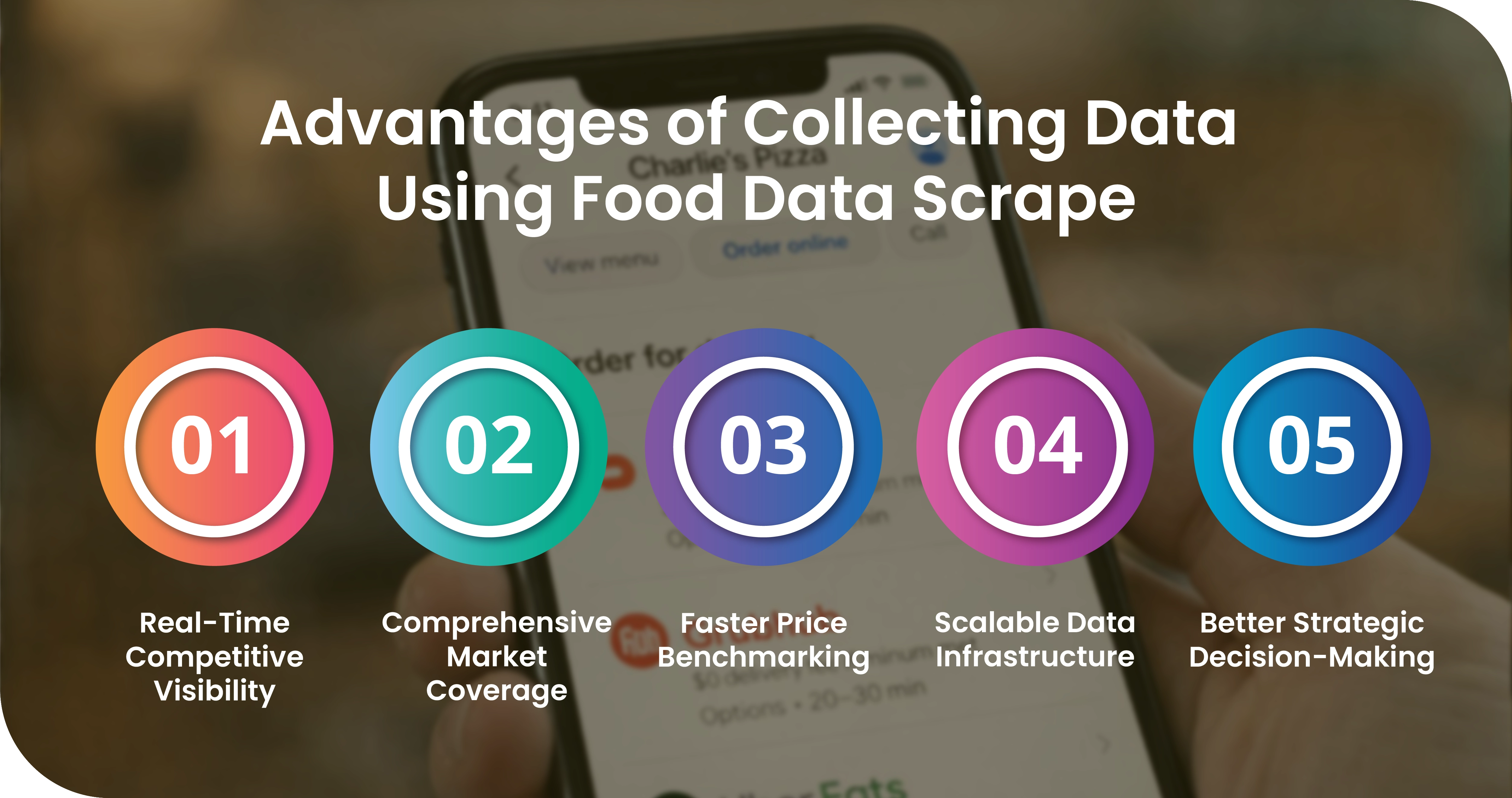
Advantages of Collecting Data Using Food Data Scrape
-
Real-Time Competitive Visibility
Our scraping services provide continuously refreshed restaurant and platform information, helping businesses monitor prices, promotions, availability, delivery charges, and menu changes. This creates stronger competitive visibility and allows decision-makers to respond quickly to marketplace developments. -
Comprehensive Market Coverage
Automated collection can cover thousands of restaurants, cities, cuisines, and platform listings simultaneously. This broad coverage gives businesses a deeper understanding of regional competition and supports reliable market research without requiring large manual research teams. -
Faster Price Benchmarking
Structured pricing information makes it easier to compare identical or similar menu items across delivery platforms. Businesses can identify pricing gaps, promotional differences, delivery-cost variations, and competitive opportunities through automated benchmarking rather than repeatedly conducting manual platform checks. -
Scalable Data Infrastructure
Our data scraping services are designed to scale according to business requirements. Whether the client needs information from hundreds of restaurants or millions of menu records, automated workflows can support expanding coverage, recurring extraction, historical datasets, and multiple output formats. -
Better Strategic Decision-Making
Reliable marketplace data supports pricing optimization, competitor monitoring, restaurant expansion analysis, promotional planning, demand forecasting, and market research. Continuously updated information can convert marketplace activity into actionable insights for strategic and operational decision-making.
Client's Testimonial
"Our previous process required extensive manual research across multiple food-delivery platforms, making it difficult to maintain consistent and current information. The scraping solution significantly improved our ability to monitor restaurants, menus, pricing, promotions, and delivery conditions across US markets. The standardized datasets have made cross-platform comparisons much easier and have strengthened our competitive intelligence capabilities. We particularly valued the scalability of the solution and the ability to receive structured information for our analytics workflows. The resulting data has helped our team reduce repetitive research, improve market visibility, and make faster decisions based on current marketplace information. Overall, the project delivered exactly the data infrastructure we needed for ongoing food-delivery intelligence and competitive market research."
—Head of Market Intelligence
Final Outcome
The project transformed fragmented food-delivery information into a scalable competitive intelligence resource for the client. Automated extraction significantly reduced repetitive manual research while increasing coverage across restaurants, menu items, prices, promotions, delivery fees, availability, and geographic markets. Standardization and entity matching improved the consistency of cross-platform comparisons, allowing the client to evaluate restaurant presence and pricing strategies more efficiently. The resulting datasets supported dashboards, benchmarking systems, historical analysis, and recurring market research workflows. The client gained a structured foundation for comparing competing platforms, identifying pricing differences, monitoring restaurant availability, and evaluating promotional strategies. With automated updates and API-ready outputs, the solution established a sustainable data infrastructure for monitoring competitive movements, identifying pricing opportunities, evaluating platform performance, and expanding food-delivery intelligence across the United States.