Boo-st your food data. Save 20% on scraping services
Menus · Grocery · Alcohol · AI Intelligence, across 40+ countries



Market Growth:Tracks GCC restaurant expansion, digital adoption, pricing, promotions, and competition.
Pricing Intelligence:Monitors menu changes, discounts, delivery fees, ensuring competitive pricing strategies.
Operational Benchmarking:Compares restaurant performance, availability, delivery efficiency, and customer satisfaction metrics.
Consumer Insights:Reveals cuisine preferences, ordering behaviors, regional demand, seasonal consumption patterns.
Strategic Decisions:Supports forecasting, investment planning, expansion, competitive intelligence, informed business decisions.

The Gulf Cooperation Council (GCC) has emerged as one of the world's fastest-growing digital food delivery markets, supported by increasing smartphone penetration, expanding internet accessibility, rapid urbanization, and changing consumer purchasing behavior. Consumers now rely heavily on mobile applications for ordering meals, groceries, beverages, pharmacy products, and convenience items, making digital delivery platforms an essential part of the regional retail ecosystem. As competition intensifies, businesses require continuous market intelligence to monitor pricing strategies, restaurant expansion, menu changes, promotional campaigns, customer engagement, and delivery performance across multiple cities and countries.
Talabat & HungerStation Data Scraping enables enterprises to collect structured marketplace information that supports competitive research and strategic decision-making. Organizations increasingly Scrape Middle East food delivery data platform ecosystems to understand regional market dynamics, restaurant performance, and consumer demand patterns. Likewise, Talabat and HungerStation menu analytics transforms large volumes of restaurant and menu information into actionable insights for pricing optimization, assortment planning, demand forecasting, and operational benchmarking. Rather than relying on traditional surveys that quickly become outdated, automated research provides continuously updated intelligence that reflects the real-time evolution of GCC food delivery markets.
The GCC food delivery industry has experienced remarkable expansion over the last several years due to increasing digital adoption and improvements in logistics infrastructure. Delivery platforms now serve millions of consumers daily while partnering with thousands of restaurants, grocery retailers, cloud kitchens, bakeries, pharmacies, and convenience stores. Saudi Arabia and the United Arab Emirates account for a substantial portion of regional digital food transactions, while Kuwait, Qatar, Bahrain, and Oman continue expanding their online ordering ecosystems.
This rapid evolution has created enormous volumes of structured marketplace data that can be analyzed to understand competitive positioning, regional demand, pricing behavior, cuisine popularity, promotional effectiveness, and restaurant performance. Unlike conventional research methods, automated data collection enables analysts to observe marketplace changes throughout the day, providing organizations with accurate and timely market intelligence.
This research evaluates structured datasets collected from restaurant listings, menu catalogs, pricing records, promotional campaigns, customer ratings, estimated delivery times, cuisine classifications, geographic coverage, grocery availability, and restaurant operational information across multiple GCC markets. Data validation processes remove duplicate records, standardize restaurant names, normalize pricing structures, and synchronize timestamps to ensure analytical consistency.
Researchers monitor historical and real-time marketplace activity to evaluate seasonal demand, pricing trends, restaurant expansion, promotional frequency, and operational performance. Geographic segmentation further enables city-level comparisons that identify localized competitive behavior and emerging growth opportunities throughout the GCC.
The primary goals of this study include:
Modern marketplace intelligence relies on collecting structured information from multiple categories rather than monitoring restaurant listings alone. Comprehensive datasets include menu pricing, promotional offers, delivery fees, estimated delivery times, customer ratings, cuisine classifications, restaurant availability, grocery inventories, geographic coordinates, operating schedules, and seasonal campaign information. Continuous monitoring enables researchers to measure marketplace fluctuations with significantly greater accuracy than manual surveys.
Restaurants modify pricing several times each month, promotional campaigns frequently change during holidays, and delivery availability varies according to operational demand. Consequently, automated collection systems continuously process millions of observations while maintaining consistency across countries, cities, and restaurant categories. These datasets provide a reliable foundation for advanced statistical analysis, demand forecasting, competitive benchmarking, and digital commerce research.
Table 1. Sample Marketplace Dataset
| Data Category | Monthly Records | Daily Updates | Coverage (%) | Validation Accuracy |
|---|---|---|---|---|
| Restaurant Listings | 132,480 | 4,416 | 99.4 | 99.6 |
| Menu Items | 7,285,000 | 242,833 | 98.9 | 99.3 |
| Product Prices | 7,285,000 | 336,000 | 99.1 | 99.5 |
| Promotional Offers | 648,500 | 21,617 | 97.8 | 98.9 |
| Customer Ratings | 3,685,000 | 122,833 | 98.5 | 99.2 |
| Customer Reviews | 1,425,000 | 47,500 | 96.8 | 98.7 |
| Delivery Fees | 985,000 | 32,833 | 99.2 | 99.4 |
| Delivery Time Records | 9,840,000 | 328,000 | 99.5 | 99.6 |
| Grocery Products | 5,180,000 | 172,667 | 98.8 | 99.3 |
| Cuisine Categories | 3,420 | 114 | 100.0 | 100.0 |
| Restaurant Images | 1,675,000 | 55,833 | 97.5 | 98.4 |
| Geographic Locations | 198,400 | 6,613 | 99.6 | 99.8 |
| Operating Hours | 512,600 | 17,087 | 99.0 | 99.4 |
| Availability Status | 8,940,000 | 298,000 | 99.7 | 99.8 |
| Discount Campaigns | 412,000 | 13,733 | 97.4 | 98.8 |
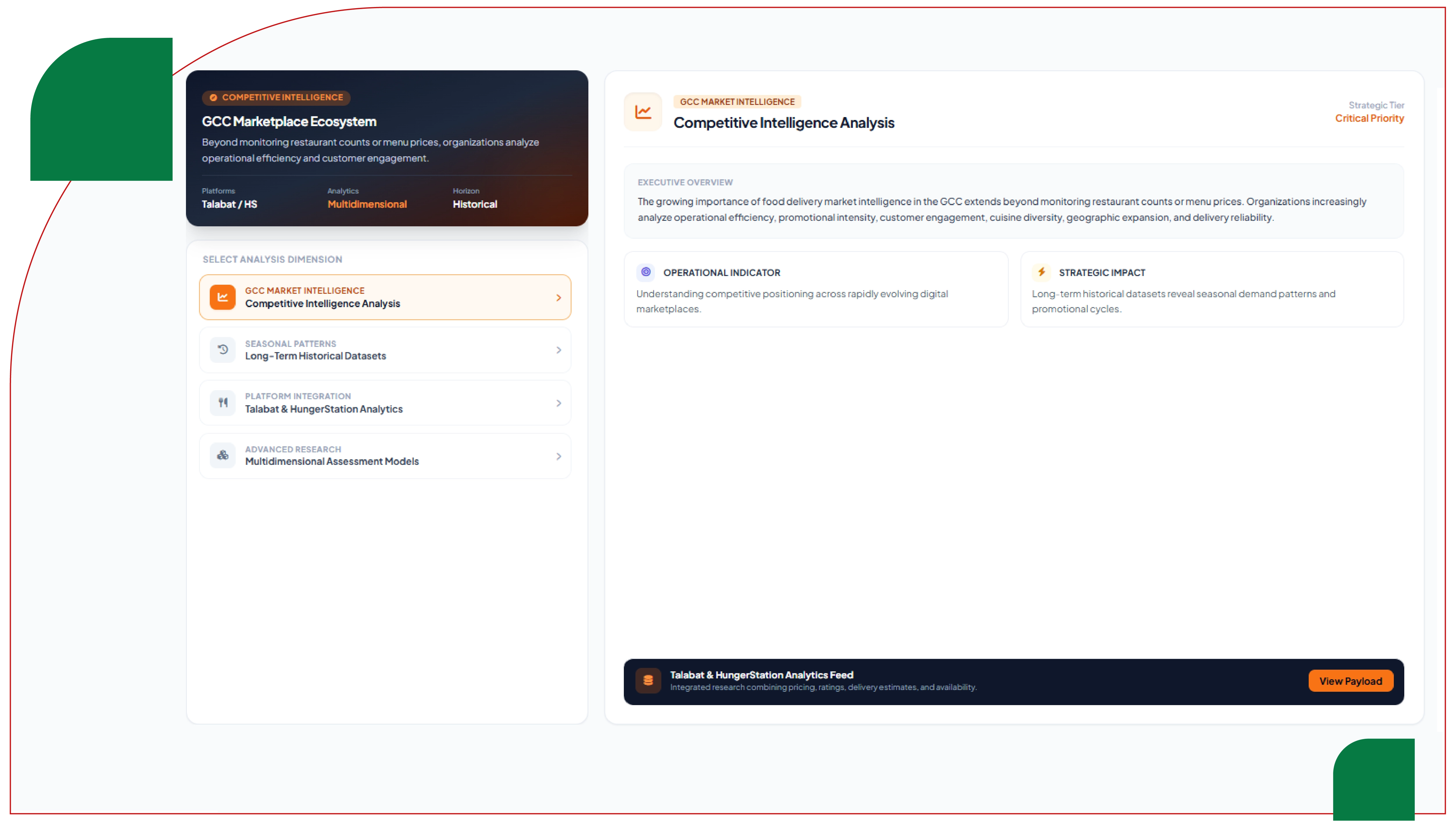
The growing importance of food delivery market intelligence in the GCC extends beyond monitoring restaurant counts or menu prices. Organizations increasingly analyze operational efficiency, promotional intensity, customer engagement, cuisine diversity, geographic expansion, and delivery reliability to understand competitive positioning across rapidly evolving digital marketplaces. Long-term historical datasets reveal seasonal demand patterns, pricing behavior, promotional cycles, and expansion opportunities that directly influence business planning and investment decisions.
Similarly, Talabat and HungerStation restaurant analytics enables organizations to evaluate restaurant performance using multiple operational indicators simultaneously. Rather than examining isolated metrics, integrated research models combine menu pricing, customer ratings, delivery estimates, promotional frequency, restaurant availability, and cuisine diversity to generate comprehensive competitive assessments. These multidimensional evaluations provide significantly deeper insights into marketplace performance than traditional restaurant surveys.
Table 2. Comparative Operational Indicators Across GCC Platforms
| Performance Indicator | Platform A | Platform B | Combined Observation |
|---|---|---|---|
| Active Restaurants | 68,450 | 61,120 | 129,570 |
| Cities Covered | 146 | 112 | 258 |
| Restaurant Categories | 420 | 396 | 816 |
| Average Menu Categories | 42 | 39 | 81 |
| Monthly Menu Updates | 845,000 | 718,000 | 1,563,000 |
| Product Price Changes | 2,265,000 | 1,985,000 | 4,250,000 |
| Delivery Fee Updates | 432,000 | 381,000 | 813,000 |
| Promotional Campaigns | 18,940 | 16,420 | 35,360 |
| Delivery Time Records | 5,480,000 | 4,725,000 | 10,205,000 |
| Customer Rating Updates | 2,620,000 | 2,185,000 | 4,805,000 |
| Grocery Listings | 2,920,000 | 2,260,000 | 5,180,000 |
| Restaurant Availability Checks | 6,220,000 | 5,380,000 | 11,600,000 |
| New Restaurant Additions | 4,180 | 3,460 | 7,640 |
| Seasonal Promotions | 6,540 | 5,420 | 11,960 |
| Indexed Daily Orders | 812,000 | 675,000 | 1,487,000 |
Organizations increasingly deploy a multi-platform restaurant analytics solution to consolidate information from multiple delivery ecosystems into a unified analytical environment. This approach improves restaurant matching, pricing comparison, cuisine classification, promotional monitoring, and geographic analysis while reducing inconsistencies caused by isolated platform evaluations. Unified intelligence also strengthens forecasting models by incorporating broader market coverage and larger historical datasets.
Researchers further perform restaurant benchmarking across Talabat and HungerStation by comparing identical restaurant brands operating across both platforms. Benchmarking evaluates menu consistency, pricing differences, delivery fees, promotional frequency, customer satisfaction, cuisine assortment, and operational availability. These comparative insights enable restaurant chains to optimize digital strategies while supporting consultants, investors, and retailers seeking evidence-based assessments of competitive performance.
Comprehensive marketplace research demonstrates that Talabat Food Delivery App Data Scraping generates valuable intelligence across restaurant listings, menu structures, pricing updates, promotional campaigns, delivery performance, grocery availability, and customer engagement. Continuous monitoring supports predictive analytics, competitive benchmarking, expansion planning, and operational optimization throughout multiple GCC markets.
Similarly, HungerStation Food Delivery App Data Scraping provides structured datasets that reveal changing restaurant ecosystems, consumer purchasing behavior, pricing strategies, promotional trends, cuisine diversity, and geographic expansion throughout Saudi Arabia. Historical analysis enables organizations to identify long-term marketplace developments while improving strategic planning and investment decision-making.
Organizations commonly utilize marketplace intelligence for:
Digital food delivery continues reshaping the GCC retail economy through rapid innovation, expanding restaurant participation, and increasing consumer reliance on mobile ordering platforms. Comprehensive marketplace intelligence enables businesses to monitor competitive movements, pricing fluctuations, promotional strategies, customer engagement, delivery efficiency, and restaurant expansion with far greater accuracy than traditional research methodologies. Continuous data collection also strengthens forecasting models, investment analysis, and long-term strategic planning across the regional digital commerce ecosystem.
Organizations that Scrape Online Talabat Grocery Delivery App Data gain additional visibility into grocery assortment, product availability, pricing behavior, and quick-commerce performance, creating a more complete understanding of evolving consumer purchasing patterns. At the same time, the HungerStation Food Dataset provides structured intelligence that supports restaurant benchmarking, market trend analysis, and operational optimization. Together, these capabilities enable Real-Time Talabat & HungerStation Intelligence, empowering enterprises to make faster, evidence-based decisions while maintaining a sustainable competitive advantage in the rapidly expanding GCC food delivery market.
Are you in need of high-class scraping services? Food Data Scrape should be your first point of call. We are undoubtedly the best in Food Data Aggregator and Mobile Grocery App Scraping service and we render impeccable data insights and analytics for strategic decision-making. With a legacy of excellence as our backbone, we help companies become data-driven, fueling their development. Please take advantage of our tailored solutions that will add value to your business. Contact us today to unlock the value of your data.