Introduction
A UAE supermarket database is a structured list of every hypermarket, supermarket and grocery outlet in the seven emirates. Each row holds the chain, format, emirate, area, coordinates, opening hours and services, plus a source URL and a verification date. You build it from chain store locators and public map listings, then deduplicate, geocode and classify each store.
FMCG brands use it to check distribution coverage. Distributors use it to plan routes. Retail-expansion teams use it to find white space before signing a lease. The challenge is that no single public list is complete, and chains open stores every quarter.
This guide covers the chains that matter, the fields to capture, the sources you can use responsibly, a step-by-step build method, and when buying a maintained dataset makes more sense. It stays at business-listing level: store addresses and services, never owner or staff contact details.
Why does outlet mapping matter in the UAE?
Grocery retail in the UAE is spread across very different formats. A large hypermarket in a mall and a small express store in a residential tower serve different shoppers, and they need different stock and different delivery routes.
- Route-to-market planning. Field-sales and van-sales teams need the real outlet universe per emirate and area to set journey plans and call frequency.
- Distribution coverage. Brands compare where their products are listed against the full outlet list to find gaps by chain, format or community.
- White-space analysis. Expansion teams overlay outlets on residential communities to spot areas with few modern grocery stores nearby.
- Competitor tracking. New openings, refits and closures show where rival chains are investing. Lulu Retail alone reported 121 UAE stores at 31 March 2026, up from 116 at the end of 2025 (Lulu Retail Q1 2026 MD&A).
- Retail outlet mapping GCC-wide. Many brands start with the UAE and then reuse the same schema for Saudi Arabia, Qatar, Oman, Kuwait and Bahrain.
Which supermarket and hypermarket chains matter, and how do they differ?
The table below lists the main modern grocery chains to include. We only quote store counts published by the operator; every other count is a placeholder to confirm from the chain's own website or reports before publishing. Always check that a banner is still trading – chains rebrand, merge and exit.
| Chain | Operator / note | Main formats | Store count |
|---|---|---|---|
| Carrefour UAE | Majid Al Futtaim | Hypermarket, supermarket, market / convenience | – from Majid Al Futtaim's own reports or the Carrefour UAE store finder |
| LuLu | Lulu Retail Holdings (listed on ADX, Nov 2024) | Hypermarket, Express, Mini Market | 121 UAE stores at 31 Mar 2026; 283 across the GCC at 30 Jun 2026 (Q1 2026 MD&A; ESM, Q2 2026) |
| Union Coop | Consumer cooperative, Dubai-focused | Hypermarket, supermarket, community branches | 30 branches across Dubai (Union Coop, Jul 2025) |
| Spinneys | Spinneys 1961 Holding | Premium supermarket | 93 stores across UAE, Oman and KSA, including Waitrose (Q2 2026 results); UAE split |
| Waitrose UAE | Operated within the Spinneys network | Premium supermarket | Included in the Spinneys total; UAE count |
| Choithrams | Independent UAE chain | Supermarket | Around 85 supermarkets across the GCC (Entrepreneur Middle East, Feb 2026); UAE split |
| Viva | Discount banner | Neighbourhood discount supermarket | 100 UAE stores (Oct 2025) |
| Nesto | Regional chain | Hypermarket, supermarket | 151 outlets group-wide (June 2026); UAE split |
| Grandiose, West Zone, Al Maya | Regional and local chains | Supermarket, fresh market | Grandiose: 45+ stores (company site, Oct 2026); Al Maya: 50+ UAE stores (Nov 2025); West Zone: 150+ outlets (Aug 2026) |
Beyond these chains sit thousands of independent groceries and baqalas. Include them if your use case is route-to-market; leave them out if you only track modern trade.
Where can you source UAE grocery store locations?
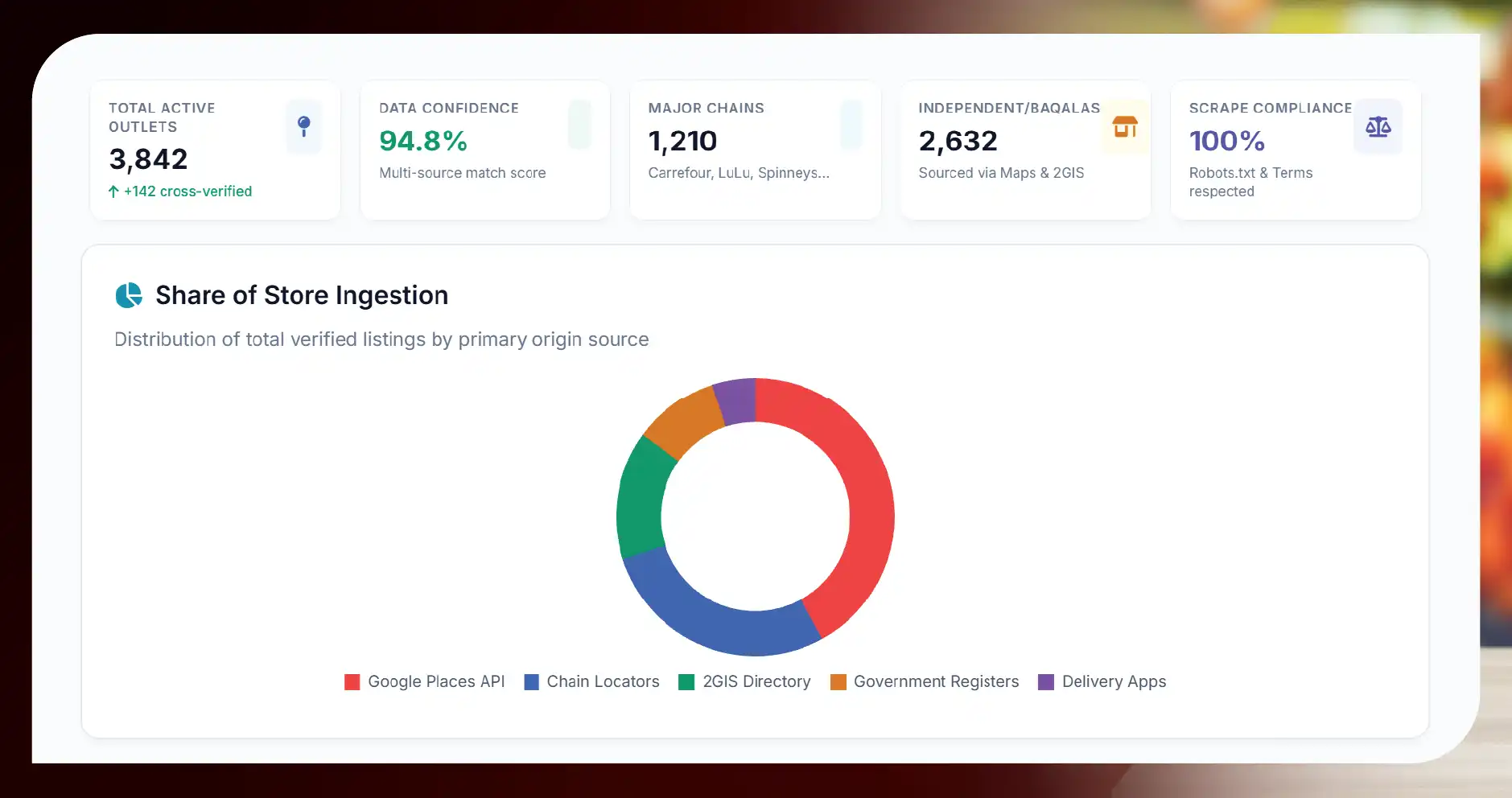
Good outlet data comes from several sources cross-checked against each other. Each has strengths and limits.
- Chain store locators. The most reliable source for name, format, hours and services, because the chain maintains it. Coverage is limited to that chain.
- Google Maps business listings. Wide coverage of independents and small chains, with categories, hours and coordinates. Use the official Places API under Google's terms rather than scraping the map interface.
- Public map directories such as 2GIS. Useful for Dubai and other emirates where they hold building-level detail. Read each directory's terms of use first; some prohibit automated extraction or require a licence.
- Government licence registers. Some emirates publish searchable business-licence look-ups. Use them only where the search is openly public and its terms allow reuse; verify availability for Dubai Economy and Tourism before relying on it.
- Delivery and click-and-collect pages. Grocery apps and chain sites often show which branches serve a delivery zone – a helpful signal for the services field.
For every source, respect robots.txt, the site's terms of service and sensible rate limits. Never log in, bypass a CAPTCHA or collect personal data such as store managers' phone numbers.
What fields should a UAE supermarket database include?
Keep the schema of your UAE supermarket database simple, consistent and auditable. These twelve store-level fields cover most FMCG and site-selection needs.
| Field | Description | Example |
|---|---|---|
| store_id | Stable internal ID, plus the chain's own store code where public | UAE-CRF-0123 |
| chain | Normalised chain or banner name | Carrefour |
| format | Hypermarket, supermarket, express / convenience, discount, cooperative | Hypermarket |
| store_name | Name as shown by the chain | Carrefour |
| emirate | One of the seven emirates | Dubai |
| area_community | Area, district or community | Al Barsha |
| latitude | Decimal degrees, WGS84 | 25.1x |
| longitude | Decimal degrees, WGS84 | 55.2x |
| opening_hours | Weekly hours in a standard format | Mo-Su 08:00-24:00 |
| services | Delivery, click-and-collect, pharmacy, parking, bakery | delivery; click_and_collect |
| source_url | Public page the record was taken from | Chain store-locator URL |
| last_verified_at | Date the record was last checked | 2026-10-19 |
Optional extras include mall name, store size band, opening date and status (open, temporarily closed, permanently closed). Status is important: closed stores left in the file distort coverage numbers.
How do you collect, clean and classify the outlet data?
A repeatable UAE supermarket database build follows five steps. Skipping the cleaning steps is the most common reason outlet files show duplicate stores and wrong emirates.
Step 1: Collect from each source
Pull chain locators first, then fill gaps from map listings. Store the raw record, the source URL and the timestamp, so every row can be traced.
Step 2: Normalise names and addresses
Standardise chain names ("Lulu Hypermarket", "LuLu" and "Lulu Hyper" become one banner). Map Arabic and English area names to a single community list per emirate.
Step 3: Geocode and validate coordinates
Where a source has no coordinates, geocode the address. Then check that each point falls inside the stated emirate. Points in the sea or across an emirate border usually mean a bad address.
Step 4: Deduplicate
Match records that share a chain and sit within a short distance of each other, such as 50–100 metres, then compare names and phone-free attributes like hours. Keep the chain locator as the master record and attach other sources as evidence.
Step 5: Classify the format
Assign one format per store using the chain's own label first. Where the chain gives none, use rules based on name keywords ("Express", "Mini", "Hyper"), listing category and, if available, floor area. Flag uncertain cases for manual review.
Refresh the file on a fixed cadence – monthly suits most FMCG teams, weekly suits expansion teams watching new openings. Update last_verified_at on every check.
What does an outlet count by emirate look like?
Once the UAE supermarket database is clean, a simple pivot gives the outlet universe per emirate and format. The table shows the layout we deliver; values come from our dataset at delivery time and are not estimates.
Add a chain column to the pivot and you can see, for example, how many Lulu hypermarket locations or Carrefour UAE stores serve each emirate, and where a rival chain is absent.
Use cases for UAE supermarket outlet data
- FMCG distribution audits. A beverage or snacks brand matches its listed-store list against the full UAE supermarket database to find chains and communities where it is missing.
- Distributor territory design. A distributor splits the outlet universe into balanced van routes by emirate and area, using coordinates to estimate drive time.
- Site selection. A retail-expansion team maps grocery store locations in Dubai against new residential communities to shortlist under-served areas.
- Price and range studies. Analysts join outlet records to shelf-price data, such as our Noon vs Carrefour vs Lulu price comparison dataset or weekly Carrefour UAE grocery prices, to compare price by format.
- Sales-territory planning for foodservice and retail suppliers. Teams use public business-listing data only – store names, addresses and services – to plan coverage, never personal contacts.
Legal and compliance basics
Outlet data is public business information, but how you collect it still matters. Follow these rules:
- Public pages only. Collect what any visitor can see without logging in. Do not bypass paywalls, CAPTCHAs or other security.
- Respect terms and robots.txt. Check each site's terms of service and robots.txt, and use official APIs or licences where offered.
- Throttle requests. Use modest rate limits and off-peak schedules so you never burden a chain's website.
- No personal data. Exclude owner, manager and staff names, personal phone numbers and emails. The UAE's Federal Decree-Law No. 45 of 2021 on personal data protection applies to personal data, so keep the file at business level.
- Keep provenance. Store source_url and last_verified_at so you can show where each record came from and remove it on request.
Build vs buy: which is right for your team?
| Factor | Build in-house | Buy a maintained dataset |
|---|---|---|
| Set-up time | Weeks to build collectors, matching and QA | Sample in days; full file on agreed schedule |
| Coverage | Depends on sources you can license or access | Multi-source, cross-checked across chains and listings |
| Maintenance | Ongoing fixes when locator pages change | Handled by the provider on a fixed cadence |
| Control | Full control of logic and schema | Custom fields and formats on request |
| Best for | One-off studies or teams with data engineers | Recurring coverage tracking across the UAE and GCC |
If you already use our supermarket store locator database for other markets, the UAE file can follow the same schema. Our UAE and Gulf food data services cover the wider grocery and delivery landscape.
Get a free sample dataset – see a sample of UAE supermarket and hypermarket outlets with emirate, format, coordinates, hours and services, built to your chain list and refresh schedule.
Questions
Frequently Asked Questions
It is a store-level list of hypermarkets, supermarkets and grocery outlets across the seven emirates, with chain, format, location, coordinates, hours, services and a source for each record.
Lulu Retail reported 121 UAE stores across all formats at 31 March 2026. Check the latest quarterly report, as the chain opens stores regularly.
Yes. Carrefour UAE publishes a public store finder. A dataset combines it with map listings, adds validated latitude and longitude, and tags each store's format.
Collecting public business listings is generally acceptable when you follow each site's terms, robots.txt and rate limits and avoid personal data. Take legal advice for your specific use.
Monthly works for most distribution teams. Weekly is better when tracking openings and closures for site selection.
Yes. The same fields and matching rules apply to Saudi Arabia, Qatar, Oman, Kuwait and Bahrain, with local area names and sources.
Get a Free Food Data Sample in 48 Hours.
Tell us your platforms, target markets and required fields — we'll map exactly what's possible with food data scraping, recommend the right approach, and send a working sample so you can verify quality before any commitment.
Request a strategy call
Thanks — our data team will reach out within 48 hours with your sample.