Introduction — Why Wine Retail Pricing Precision Matters in 2026
The US wine retail market has entered a phase where pricing precision is no longer a luxury for wineries — it is a survival requirement. Between store-specific promotions at Kroger, aggressive weekly repricing at Total Wine, and Publix's regional pricing corridors that shift with local demand, a single premium wine SKU can be priced at four different points on any given Tuesday across the same metro. For wineries selling into these chains, the traditional monthly retail audit is now structurally obsolete — by the time the audit is compiled, prices have already moved twice.
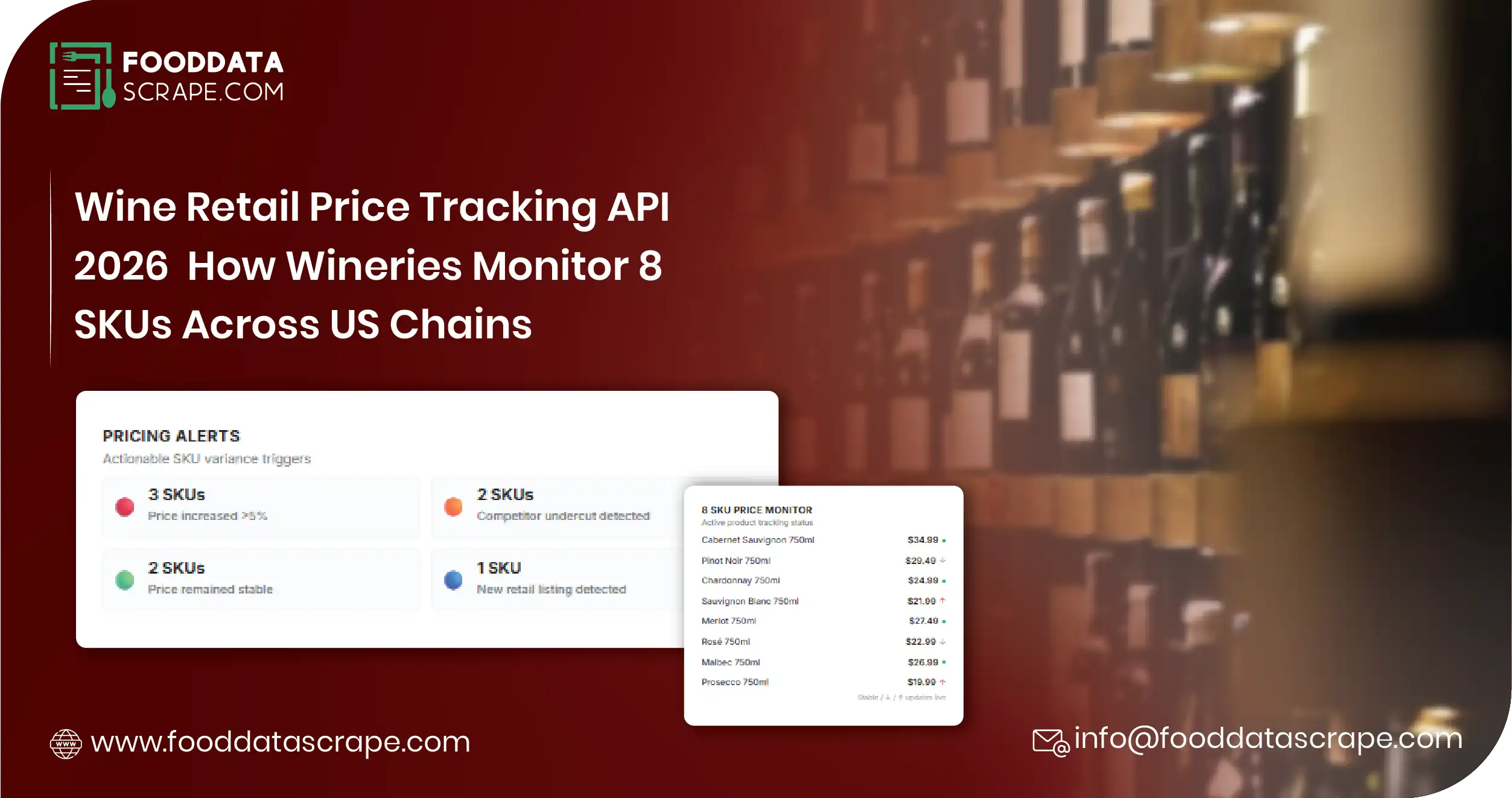
This is exactly the problem that a modern Wine Retail Price Tracking API solves. When wineries deploy structured wine data scraping services across major channels, they gain the daily-refreshed visibility their pricing teams need to protect margin, catch minimum advertised price (MAP) violations, and respond to competitive moves within hours instead of weeks.
This guide breaks down how leading wineries and beverage brands monitor 8 SKUs across US chains in 2026, with real sample data structures, chain-specific pricing dynamics, buyer archetypes, and the alcohol retail data scraping architecture that powers wine retail intelligence programs at scale.
The 2026 Wine Retail Landscape — What Changed
Three structural shifts have made continuous wine retail intelligence essential in 2026, and each one increases the value of a properly designed wine price monitoring API.
1. Chain-specific pricing has become chain-specific promotions. Total Wine's private-label positioning has pushed all major wine chains toward frequent, targeted promotions on premium SKUs — often week-over-week 12-18% price swings on the same SKU. Kroger's Boost membership program adds a second pricing layer that varies by ZIP code and shopper segment. Publix's regional pricing means the same California Cabernet can retail at $18.99 in Atlanta and $22.99 in Miami on the same day. Without daily scraping and continuous wine competitor price tracking, wineries lose visibility on what their retail partners are actually charging shoppers.
2. Direct-to-consumer (DTC) wine sales are reshaping retail power dynamics. As wineries build stronger DTC channels, they need US wine retail intelligence to negotiate wholesale contracts, protect brand positioning, and avoid the race to the bottom that happens when one chain undercuts another. Continuous wine e-commerce data extraction from chain digital shelves gives wineries the evidence base to have grown-up conversations with retail partners.
3. Regional demand shifts create pricing arbitrage opportunities. Sun Belt population growth has moved wine demand — the Twin Cities market (Minneapolis-St. Paul) has become a bellwether for premium Midwest wine demand, and wineries with a clear view of Minneapolis pricing at Total Wine, Kroger banners, and independent chains can spot trends 4-6 weeks before national analytics catches up.
The wineries winning in 2026 are not necessarily the ones with the best product — they are the ones with the best real-time visibility into what their product is being sold for, where, and against which competitors.
What a Wine Retail Pricing Feed Delivers
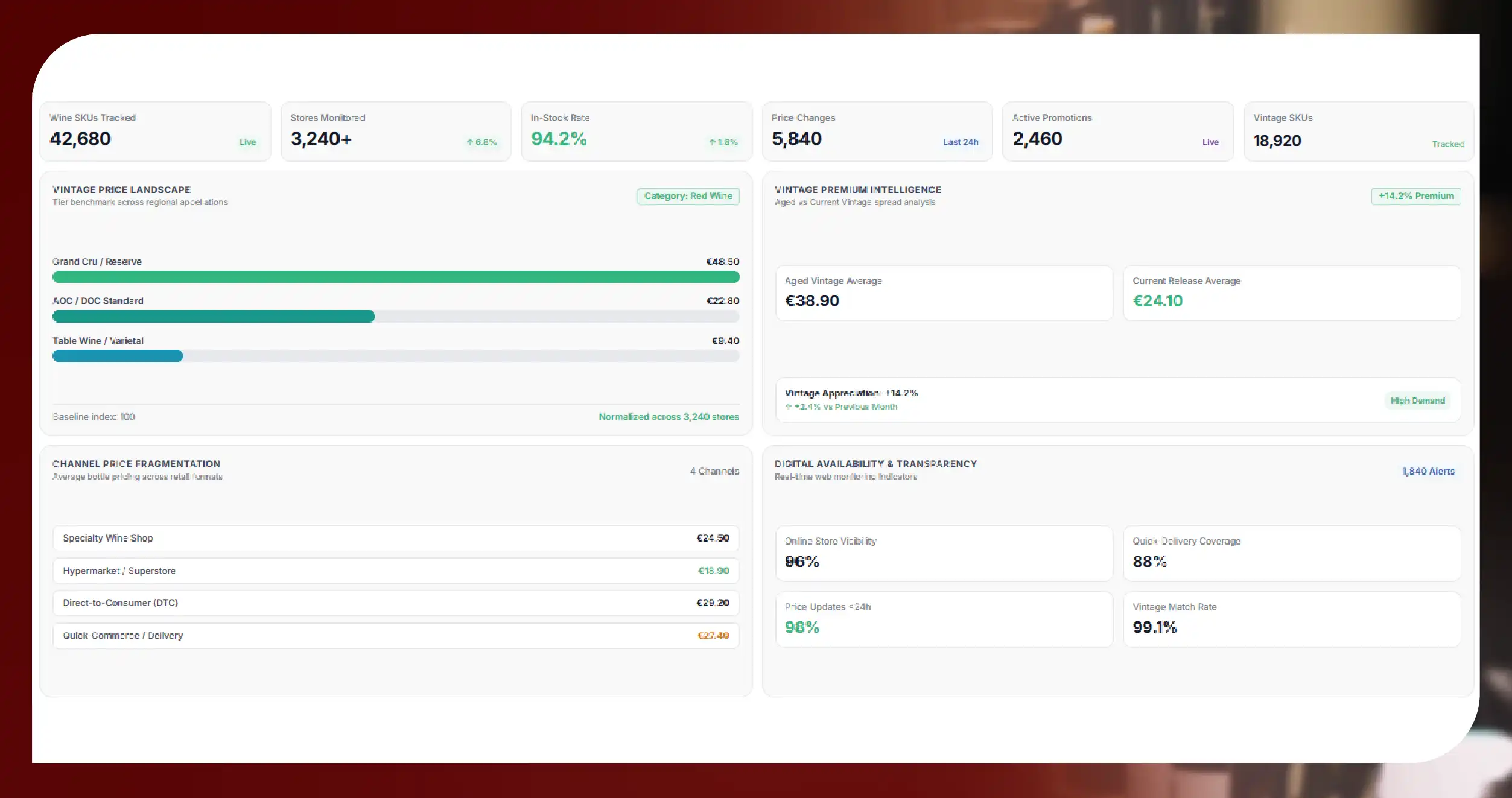
A modern wine retail pricing intelligence feed is a data pipeline that continuously scrapes wine SKU pricing, availability, promo overlays, and shelf metadata from major retail chains — and delivers the structured, normalized data to the winery's analytics system via API, CSV, or dashboard integration.
A well-designed wine SKU pricing data pipeline captures:
- Per-SKU shelf price in USD across every monitored store
- Promotional overlays (buy-one-get-one, Boost prices, weekly ad prices)
- Availability and stock status per store
- Pack size and unit-price normalization (750ml, 1.5L, 4-pack, case)
- Vintage year identification for wines where vintage matters to pricing
- Store-level and ZIP-level attribution
- 24-hour, 12-hour, or 4-hour refresh cadence depending on client needs
- Historical price time-series for trend analysis and elasticity modeling
The output is a clean, deduplicated data stream that plugs directly into a winery's pricing team's decision workflow — no more manual retail visits, no more delayed distributor reports, no more surprise week-over-week competitor moves. This is the operational value that alcohol retail data scraping delivers at scale.
Sample Data — Real Output Structure
Below is a sample of the structured output a properly designed beverage retail price API produces for a winery monitoring 8 premium SKUs across three major US chains in the Minneapolis metro.
Sample 1 — Daily Wine SKU Price Snapshot
| SKU | Vintage | Chain | ZIP | Shelf $ | Promo $ | Availability |
|---|---|---|---|---|---|---|
| Napa Cabernet 750ml | 2022 | Total Wine | 55402 | $34.99 | $29.99 | In stock |
| Napa Cabernet 750ml | 2022 | Kroger (Cub) | 55408 | $36.99 | $32.99 | In stock |
| Napa Cabernet 750ml | 2022 | Publix | — | — | — | Not carried |
| Sonoma Chardonnay 750ml | 2023 | Total Wine | 55402 | $22.99 | $19.99 | In stock |
| Sonoma Chardonnay 750ml | 2023 | Kroger (Cub) | 55408 | $24.49 | — | In stock |
| Willamette Pinot 750ml | 2022 | Total Wine | 55402 | $28.99 | $26.99 | Low stock |
| Willamette Pinot 750ml | 2022 | Kroger (Cub) | 55408 | $30.99 | — | In stock |
| Willamette Pinot 750ml | 2022 | Publix | — | — | — | Not carried |
The sample shows the immediate value: within a single view, the winery's pricing team can see that their Napa Cabernet is priced $2 lower at Total Wine than at Kroger in the same ZIP, that Publix is not carrying two of their three SKUs (an assortment gap the sales team needs to address), and that Willamette Pinot is currently in a promotion at Total Wine — a promo the winery either co-funded or should have been notified about. This kind of granular per-store visibility is what separates modern US wine chain data services from legacy monthly audits.
Sample 2 — 8-SKU Weekly Price Movement Panel
| SKU | Chain | Wk 1 | Wk 2 | Wk 3 | Wk 4 | Pattern |
|---|---|---|---|---|---|---|
| Napa Cabernet | Total Wine | $34.99 | $29.99 | $34.99 | $32.99 | Volatile |
| Napa Cabernet | Kroger | $36.99 | $36.99 | $32.99 | $34.99 | Steady |
| Sonoma Chard | Total Wine | $22.99 | $22.99 | $19.99 | $22.99 | Promo cycle |
| Sonoma Chard | Kroger | $24.49 | $24.49 | $24.49 | $23.99 | Slight drop |
| Willamette Pinot | Total Wine | $28.99 | $28.99 | $26.99 | $28.99 | Promo cycle |
| Willamette Pinot | Kroger | $30.99 | $30.99 | $30.99 | $30.99 | Flat |
| Central Coast Merlot | Total Wine | $19.99 | $17.99 | $19.99 | $19.99 | Promo cycle |
| Prosecco Rosé | Total Wine | $16.99 | $14.99 | $16.99 | $14.99 | Bi-weekly |
Four weeks of data reveals the pattern immediately — Total Wine runs a bi-weekly promotional cadence on premium wines, Kroger runs steadier pricing with occasional monthly promotions, and the winery's Prosecco Rosé is being used as a traffic driver at Total Wine every second week. This kind of pattern recognition is impossible from monthly audits — it requires the continuous refresh that comprehensive wine data scraping services provide.
The 8-SKU Wine Retail Price Tracking Use Case
Wineries monitoring 8 SKUs across US chains typically fall into one of four archetypes, each with a distinct set of decisions the pricing intelligence supports.
The Boutique Winery (2,000-15,000 cases annually). Boutique wineries usually have 6-10 SKUs in national retail rotation, with premium positioning that cannot survive aggressive discounting. For these wineries, wine price monitoring is primarily a defensive tool — daily monitoring to catch any chain that has repriced below the minimum advertised price (MAP) or is running an unauthorized promotion that damages brand positioning. A single MAP violation on a $40 Cabernet at Total Wine can trigger a cascade across other chains within 72 hours, and boutique wineries need to catch it in day one, not day seven.
The Mid-Market Winery (50,000-500,000 cases annually). Mid-market wineries typically have 8-15 SKUs across value, mid-tier, and premium price bands, competing directly with 20-40 other domestic and imported labels in the same shelf zone. For these wineries, wine competitor price tracking enables active positioning — daily comparison against 3-5 direct competitors' pricing at each chain, identifying when a competitor has repriced, when to match or hold, and when to reallocate promotional spend across chains.
The Large Winery (500,000+ cases annually). Large wineries operating national brands need chain-by-chain pricing intelligence across all 50 states to inform trade marketing, sales incentive structures, and quarterly pricing reviews with retail partners. Multi-state, multi-chain US wine chain data services at store-level granularity give large wineries the evidence they need to negotiate national contracts with data, not anecdote.
The Wine Distributor. Wine distributors sitting between wineries and chains need retail pricing data to advise supplier partners, protect their own margins, and negotiate promotional support commitments. A distributor covering the Minneapolis market monitoring 8 SKUs across Kroger banners, Total Wine, and Publix uses the pipeline to inform both upstream (winery pricing recommendations) and downstream (chain negotiation prep) conversations.
Kroger, Total Wine, and Publix — Chain-Specific Pricing Dynamics
Each of the three major US wine chains has structurally different pricing behavior — and a robust extraction pipeline captures each chain's specific pricing signature.
Kroger's Wine Pricing. Kroger operates dozens of banner names — Kroger, Ralphs, King Soopers, Fred Meyer, Harris Teeter, Fry's, Cub Foods, and others — each with independent pricing authority at the store level within regional guardrails. Boost membership pricing adds a second layer that varies by shopper segment and geography. For a winery selling into multiple Kroger banners, Kroger wine price scraping captures both the standard shelf price and the Boost-member price at each store, revealing effective net pricing that varies by 15-20% across banners in the same metro.
Total Wine's Wine Pricing. Total Wine operates 260+ stores across 27 states with an aggressive private-label strategy that puts significant pricing pressure on branded wines. Weekly ad promotions rotate through a subset of premium SKUs, and store managers have some latitude on regional adjustments. Continuous Total Wine data extraction captures the weekly ad calendar as it evolves, enabling wineries to see promotional cadence patterns 6-8 weeks in advance based on historical rotation.
Publix's Wine Pricing. Publix operates 1,400+ stores primarily across the Southeast with a distinct pricing philosophy — steadier pricing corridors, fewer aggressive promotions, and regional price differences reflecting local demand and demographics. Publix's wine assortment is more curated than either Kroger or Total Wine, which means the assortment-gap intelligence from Publix wine data scraping is often as valuable as the pricing intelligence — knowing which SKUs Publix does not carry in your target markets tells the sales team where to focus.
The Minneapolis metro specifically is an instructive market. Cub Foods (a Kroger banner) operates 30+ stores across the Twin Cities with premium wine positioning. Total Wine operates flagship stores in Minnetonka and Roseville. Publix does not have Minneapolis presence — which itself is intelligence a wine brand needs to know when planning distribution. A properly scoped pipeline captures all of this in one integrated view.
How the Pipeline Architecture Works
FoodDataScrape builds wine retail pricing intelligence pipelines on a five-layer architecture designed for wine retail's specific data challenges — pipelines built specifically for wine retail price tracking api us chains 2026 requirements at production scale.
Layer 1: Chain and Store Mapping. For each client engagement, the team identifies the exact set of stores to monitor — by chain, banner, ZIP code, or metro. For an 8-SKU monitoring engagement in Minneapolis, this typically means 30-50 stores across Cub Foods (Kroger), Total Wine, and any relevant independent chains.
Layer 2: SKU Cross-Chain Matching. Wine SKUs are notoriously hard to match across chains — the same wine can appear with different vintage listings, different product name conventions, and different pack size descriptions. An AI SKU matching layer pairs the same wine across Kroger's product page, Total Wine's listing, and Publix's catalog, producing a canonical wine SKU ID that ties all chain-specific listings together.
Layer 3: Continuous Daily Scraping. Per-chain extractors pull shelf price, promo overlay, availability, and metadata daily (or more frequently for high-value engagements). Data is normalized into consistent schema and deduplicated before delivery.
Layer 4: API Delivery and Integration. The pipeline delivers structured JSON via REST endpoints, with optional CSV export, S3 delivery, or direct Snowflake integration. Most wineries plug the feed into their pricing dashboard within 24 hours of go-live.
Layer 5: Alerts and Anomaly Detection. Optional layer for wineries that want proactive notification — the pipeline flags MAP violations, unusual price movements, competitor promotional launches, or availability gaps in real time via email, Slack, or webhook.
The build timeline from kickoff to production API delivery is typically 4-6 weeks for an 8-SKU, 3-chain engagement, including a free proof-of-concept sample delivered in the first week.
Why Wineries Choose a Specialized Wine Data Scraping Company
Wineries and beverage brands select a specialized wine data scraping company over generic scraping vendors for six specific reasons.
- Wine-specific SKU matching accuracy. An AI product matching layer tuned for wine's specific data challenges — vintage year sensitivity, pack size variance, appellation naming, varietal cross-references — reaches match accuracy where generic engines fail. Generic scraping services miss 20-30% of wine SKU matches; a purpose-built pipeline achieves 96%+ match accuracy on wine catalogs.
- Multi-chain coverage out of the box. Kroger and its banners, Total Wine, Publix, plus regional wine chains (BevMo, Spec's, Binny's) and independent liquor chains — all covered with consistent schema.
- Compliance-aware sourcing. Alcohol data has specific state-by-state regulatory constraints. Purpose-built sourcing with awareness of state alcohol regulations delivers only compliantly-collected data.
- Daily refresh with historical time-series. 24-hour refresh cadence with 24-month historical time-series depth for trend analysis, elasticity modeling, and promotional pattern detection.
- Direct API integration. REST API, CSV, S3, or Snowflake — plug directly into the winery's existing analytics stack without middleware.
- Dedicated wine industry analyst support. Every engagement includes a dedicated beverage retail analyst to help define scope, interpret data, and refine tracking as the winery's needs evolve.
Sample Use Cases — How Wineries Actually Use the Data
Use Case 1: MAP Compliance Monitoring. A boutique Napa winery monitors all 6 of their SKUs across every Total Wine and Kroger banner nationally. Any store pricing below $32.99 on their premium Cabernet triggers an immediate alert. The winery's trade compliance team addresses each violation within 24 hours instead of discovering them 3 weeks later in a quarterly review.
Use Case 2: Competitor Pricing Intelligence. A mid-market Sonoma winery monitors 8 of their own SKUs plus 12 competitor SKUs across Total Wine, Kroger, and Publix in 15 metro markets. The daily competitive view informs weekly pricing decisions and quarterly promotional planning with retail partners.
Use Case 3: Assortment Gap Analysis. A large California winery uses the pipeline to identify Publix stores in the Southeast that carry competitor brands but not their own SKUs — building a data-anchored target list for the sales team's next distribution push into Publix.
Use Case 4: Promotional Effectiveness Measurement. A large winery measures whether Q3 promotional support at Total Wine actually resulted in sustained retail pricing benefit or if the chain absorbed the trade spend into margin. The 24-month historical time-series makes this analysis possible.
Use Case 5: Distributor Reporting. A wine distributor covering the Twin Cities uses the pipeline to deliver monthly retail pricing reports to their winery partners — pricing intelligence the wineries used to source manually from field reps.
Getting Started — The 5-Week Roadmap
Getting a wine retail pricing intelligence engagement live with FoodDataScrape follows a straightforward process designed to minimize risk and prove value before scope expansion.
Week 1: Scoping and proof-of-concept. The winery defines the SKU list, target chains, geographies, and refresh cadence. A free proof-of-concept sample is delivered within 5 business days showing the exact data structure the winery will receive.
Weeks 2-4: Production build. Chain-specific extractors are configured, SKU matching is tuned to the winery's catalog, and API integration is tested with the winery's analytics team.
Week 5: Live production delivery. The pipeline goes live with daily data delivery. The winery's pricing team begins receiving structured, normalized wine retail intelligence.
Ongoing: Refinement and expansion. As the winery's monitoring needs evolve — new SKUs, additional chains, deeper competitor tracking, alert customization — the engagement adjusts continuously.
Conclusion — Wine Retail Intelligence Is the 2026 Winning Edge
The US wine retail market in 2026 is faster, more fragmented, and more competitive than at any point in its history. Wineries that continue to rely on monthly retail audits, field-rep anecdotes, and delayed distributor reports are structurally disadvantaged against wineries that have moved to continuous, structured pricing intelligence.
The 8-SKU, 3-chain monitoring pattern in a market like Minneapolis is the entry point — most wineries expand within 6 months to 12-20 SKUs across 6-10 chains and multiple metros once they see the operational lift from real-time pricing intelligence.
FoodDataScrape builds the pipelines that deliver this intelligence — covering Kroger, Total Wine, Publix, and every other major US wine chain with daily refresh, wine-specific SKU matching, and dedicated beverage industry analyst support.
If you are a winery, a beverage brand, or a wine distributor and pricing precision has become a survival requirement in your 2026 strategy — a purpose-built Wine Retail Price Tracking API is the fastest path to closing the visibility gap.
Ready to See Sample Data for Your SKUs? Tell us your 8 SKUs, target chains, and metros. Get a free proof-of-concept sample of the wine retail pricing intelligence output on your actual product catalog within 5 business days — no commitment required.
Contact FoodDataScrape today for wine retail intelligence that turns pricing volatility from a threat into a competitive advantage.
Questions
Frequently Asked Questions
A well-designed pipeline delivers per-SKU shelf pricing, promotional overlays, availability, pack size, vintage year identification, store-level and ZIP-level attribution, and historical time-series across major US wine chains including Kroger banners, Total Wine, Publix, and regional chains.
Kroger and all its banners (Cub Foods, Ralphs, King Soopers, Fred Meyer, Harris Teeter, and more), Total Wine (260+ stores across 27 states), Publix (Southeast), plus regional wine chains including BevMo, Spec's, Binny's Beverage Depot, and select independent liquor chains as required by the client's scope.
The wine SKU matching layer treats vintage as a first-class attribute — the same wine label with different vintages is tracked as related-but-distinct SKUs, allowing wineries to see when a chain has transitioned from one vintage to the next and how pricing differs between vintages at retail.
Matching is backtested against manually verified wine catalogs on a rolling basis. Current wine-catalog match accuracy is 96%+ across the client base, versus 70-80% typical for generic product matching engines applied to wine data.
Yes — the retail price tracking pipeline architecture extends to beer, spirits, and non-alcoholic beverages with format-specific SKU matching tuning. Beer requires pack-size normalization (6-pack, 12-pack, case); spirits require volume normalization (750ml, 1L, 1.75L); non-alcoholic requires flavor-variant matching.
Yes — sourcing is compliance-aware with respect to state-by-state alcohol regulations, and only compliantly-collected retail price data is delivered.
Get a Free Food Data Sample in 48 Hours.
Tell us your platforms, target markets and required fields — we'll map exactly what's possible with food data scraping, recommend the right approach, and send a working sample so you can verify quality before any commitment.
Request a strategy call
Thanks — our data team will reach out within 48 hours with your sample.