Introduction
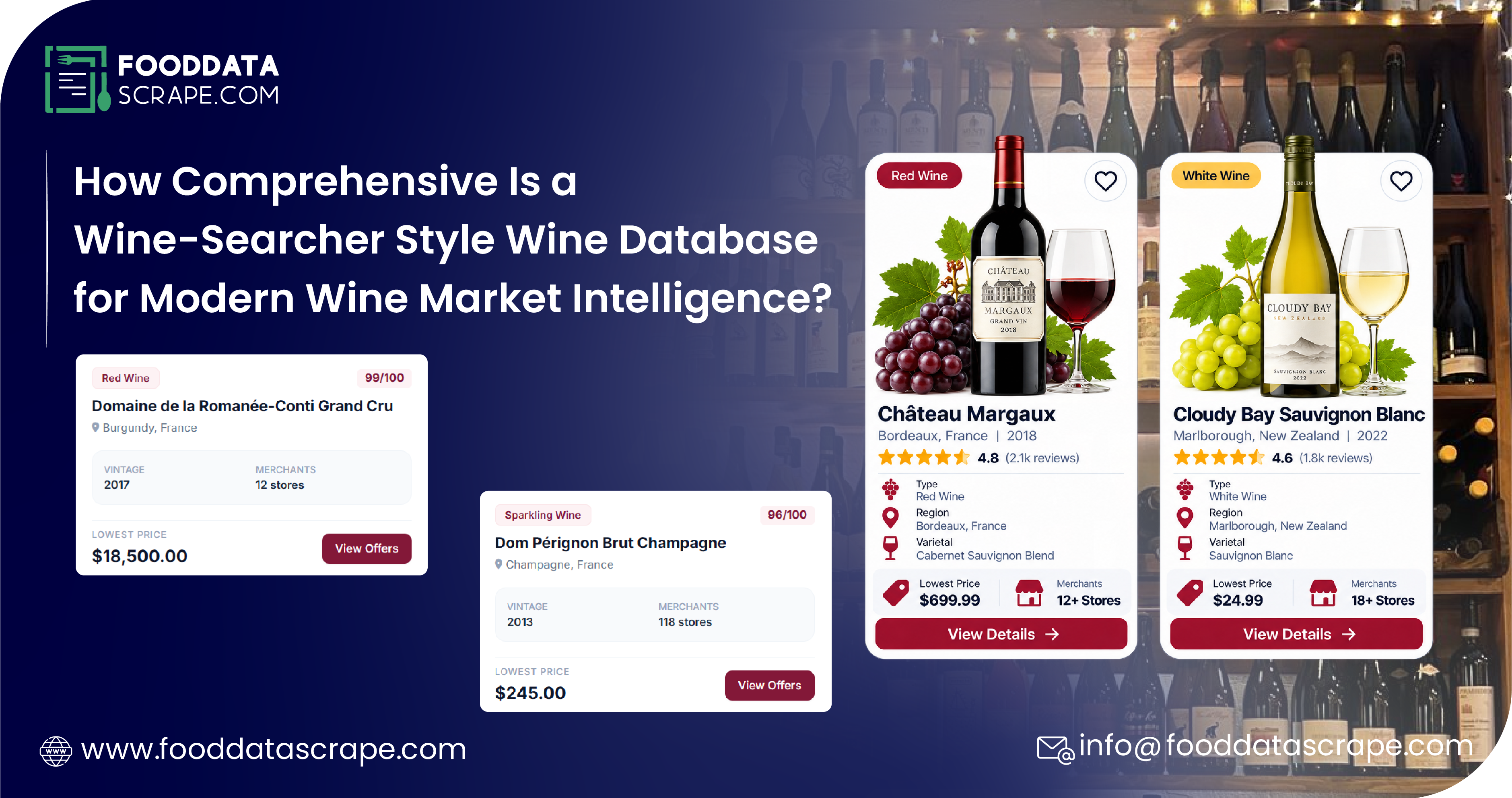
The global wine market is highly diverse, with thousands of producers, regions, grape varieties, vintages, bottle sizes, retailers, and price points competing across markets. A well-structured Wine-Searcher Style Wine Database can bring this fragmented information together, making it easier for businesses to monitor products, prices, availability, and market movements.
For retailers, distributors, marketplaces, investors, hospitality companies, and market researchers, the ability to Scrape Wine Database Data can create a continuously updated view of the wine ecosystem. Instead of relying on manually collected information, businesses can analyze large volumes of structured records covering wines, merchants, pricing, locations, ratings, and product attributes.
Modern Wine Product And Pricing Data Scraping further expands this intelligence by collecting product-level information from online wine stores, marketplaces, specialist retailers, and other publicly accessible sources. When properly organized, the resulting dataset becomes more than a product catalogue—it becomes a market intelligence resource for understanding competition and consumer-facing pricing.
Why a Comprehensive Wine Database Matters?
Wine is not a standardized category like many everyday consumer products. Two bottles with similar names may differ significantly because of producer, vintage, appellation, grape composition, bottle size, region, or production method.
A comprehensive database therefore needs to capture much more than a wine's name and price.
For example, a useful record may contain:
- Wine name and producer
- Winery or brand
- Vintage
- Country and wine region
- Appellation
- Grape variety
- Bottle size
- Alcohol percentage
- Wine type
- Merchant name
- Current selling price
- Previous or reference price
- Availability status
- Retailer location
- Product URL
- Ratings and review counts
- Currency
- Promotional information
- Shipping details where available
- Collection or category information
This depth enables businesses to move from simple product discovery toward systematic market analysis.
What Does a Wine-Searcher Style Dataset Typically Include?
A Wine-Searcher style dataset is best understood as a structured representation of the information consumers and businesses need when comparing wines across merchants and markets.
At the product level, the database can identify individual wines and distinguish between similar products. Producer-level information can then connect multiple products to a winery or brand.
At the merchant level, the dataset can show which sellers offer a particular wine, where they operate, and how their prices compare.
The result is a multi-dimensional database rather than a flat spreadsheet.
A strong dataset may organize information into interconnected layers:
- Product Layer: Wine name, producer, vintage, type, size, grapes, and region.
- Merchant Layer: Retailer name, location, marketplace presence, and product listing.
- Pricing Layer: Current price, historical price, promotional price, currency, and price differences.
- Availability Layer: In-stock, out-of-stock, limited availability, preorder, or unavailable status.
- Market Layer: Geographic distribution, price positioning, competitive offers, and market trends.
This structure makes the data useful for analytics platforms, business intelligence systems, recommendation engines, pricing applications, and research projects.
Track wine prices, competitor offers, product availability, and market trends with tailored wine data solutions. Partner with Food Data Scrape to turn wine market data into actionable intelligence for smarter pricing, inventory, assortment, and growth decisions.
The Importance of Wine Market Intelligence
Wine companies operate in an environment where pricing and availability can change rapidly. A retailer may reduce the price of a popular vintage to clear inventory, while another seller may increase its price because stock is becoming scarce.
This makes Wine Market Intelligence Data valuable for identifying patterns that are difficult to recognize through occasional manual research.
Businesses can use structured datasets to investigate questions such as:
- Which wine categories have the highest price variation?
- Which regions command premium prices?
- Which producers have the widest merchant distribution?
- How does pricing differ between countries?
- Which vintages are becoming harder to find?
- Which retailers consistently offer competitive prices?
- How frequently do competitors change prices?
Over time, these observations can support purchasing, pricing, assortment, inventory, and expansion decisions.
Understanding Wine-Searcher Wine Data Extraction
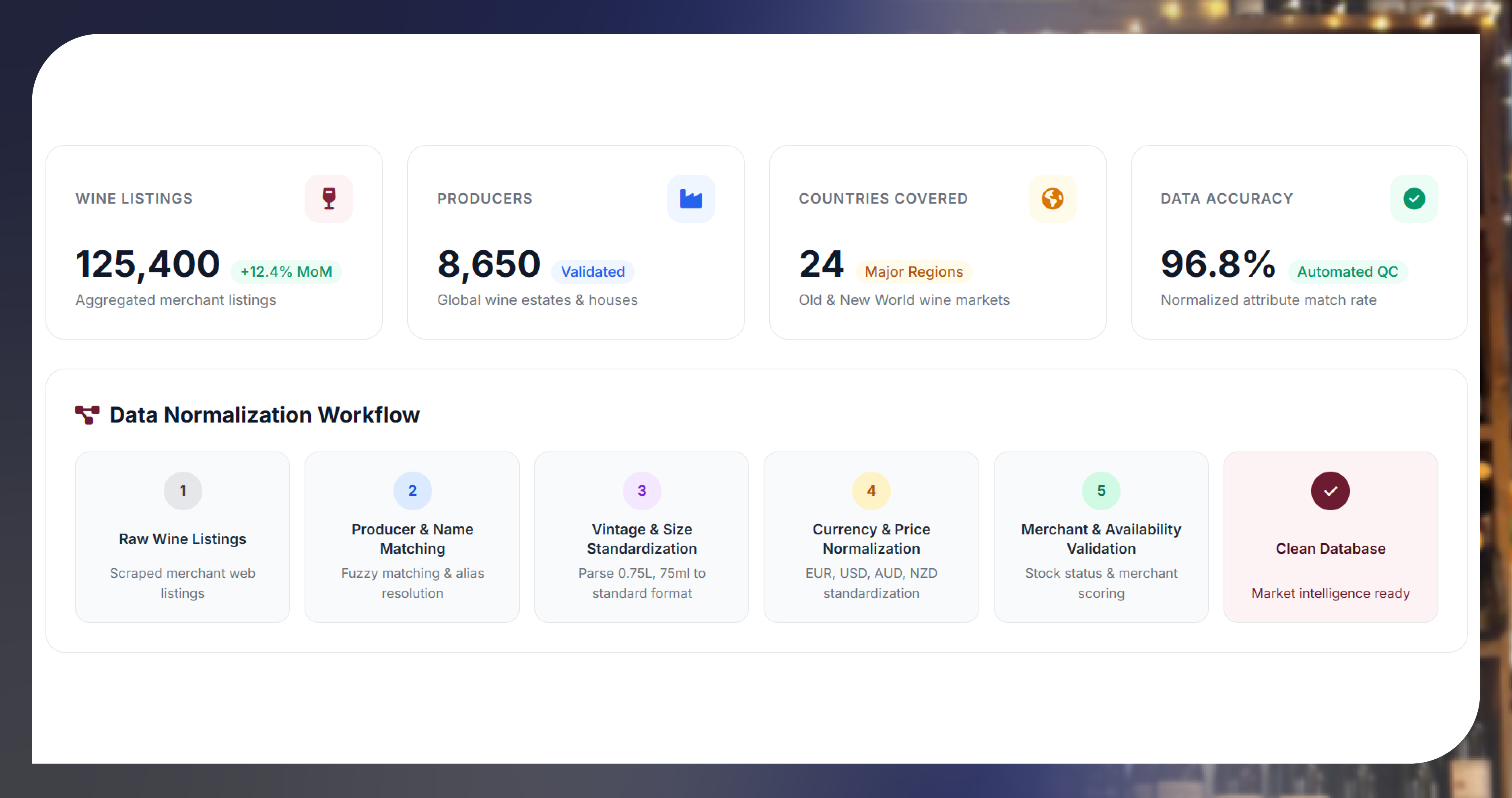
Large wine databases require systematic collection, normalization, and validation. Wine-Searcher Wine Data Extraction can involve gathering information from wine listings, merchant offers, product pages, categories, and related publicly accessible data sources.
The challenge is not simply collecting records. Wine information frequently contains inconsistencies.
A producer may appear under slightly different names. A wine can have multiple vintages. Bottle sizes may be represented differently. Currency formats can vary. Retailers can use different naming conventions for the same product.
Data normalization is therefore essential.
A robust workflow can standardize:
- Producer names
- Wine names
- Regions
- Countries
- Vintage formats
- Bottle sizes
- Currency
- Price formats
- Availability labels
- Merchant identities
This creates cleaner records that can be compared across thousands or millions of listings.
What Wine Offer Data Reveals About Competition
One of the most valuable components of a wine database is offer-level information. Wine-Searcher Wine Offer Data can provide a detailed view of how different merchants position the same or comparable wines.
Imagine a particular Bordeaux wine appearing across 30 retailers. Each retailer may have a different price, stock status, shipping policy, or promotional offer.
A business can compare those offers to determine the market price range.
For example:
| Wine Intelligence Metric | What It Reveals |
|---|---|
| Lowest Listed Price | Most aggressive market offer |
| Highest Listed Price | Premium pricing position |
| Average Market Price | General market benchmark |
| Number of Merchants | Distribution breadth |
| Available Offers | Current market accessibility |
| Price Spread | Competitive pricing variation |
| Regional Availability | Geographic market reach |
| Promotional Pricing | Discounting activity |
Such information can help retailers understand whether their pricing is competitive or whether their assortment is positioned too high or too low.
Availability Is Just as Important as Price
Price alone does not tell the entire story.
A wine priced at $100 but available from only two merchants represents a very different market situation from a $100 wine offered by 50 retailers.
This is why businesses increasingly need to Scrape Wine Availability Data alongside pricing information.
Availability monitoring can identify:
- Products entering stock
- Products going out of stock
- Limited-stock listings
- Regional availability differences
- New product introductions
- Declining merchant coverage
- Seasonal assortment changes
For collectors, distributors, and retailers, availability can become an important indicator of market scarcity.
When combined with price movements, availability data can reveal potential relationships between inventory levels and pricing behavior.
Building Wine Competitive Intelligence
The next step is transforming raw information into actionable insights. Wine Competitive Intelligence Data can help businesses benchmark their offerings against competing retailers and marketplaces.
A retailer could compare its prices with competitors across hundreds of products. A distributor could identify regions where particular wine categories have strong merchant coverage. A marketplace could monitor which products attract the most competitive offers.
Competitive intelligence can also support assortment planning.
If competitors increasingly stock wines from a particular region, for example, that may indicate growing consumer interest or a strategic market opportunity.
Similarly, if premium wines are consistently discounted across multiple retailers, businesses may identify changing demand patterns or excess inventory.
Key Data Fields to Expect From a Comprehensive Wine Dataset
A professional wine dataset should be flexible enough to support multiple analytical requirements.
Important fields can include:
| Category | Example Data Points |
|---|---|
| Product | Wine name, product ID, SKU |
| Producer | Winery, brand, producer country |
| Wine Profile | Type, grapes, vintage, alcohol |
| Geography | Country, region, appellation |
| Packaging | Bottle size, case quantity |
| Merchant | Retailer, marketplace, location |
| Pricing | Current, original, discounted price |
| Availability | In stock, unavailable, limited |
| Reviews | Rating, review count |
| Market | Currency, country, region |
| Listing | Product URL, category, collection |
| Tracking | Timestamp, scrape date, update status |
The precise fields can be customized according to the business objective.
A pricing intelligence project may prioritize merchant prices and historical changes, while a wine discovery database may emphasize product characteristics, ratings, regions, and grape varieties.
How Data Collection Can Support Historical Wine Analysis?
One of the biggest advantages of structured wine data is the ability to create historical snapshots.
A single dataset shows what the market looks like today. Repeated data collection creates a timeline.
Businesses can then track:
- Weekly price movements
- Monthly availability changes
- Seasonal promotions
- New product introductions
- Vintage transitions
- Merchant assortment changes
- Regional pricing differences
Historical records can help distinguish temporary promotions from long-term market changes.
For example, a 10% price reduction observed once may simply be a short-term promotion. If similar reductions occur repeatedly across multiple retailers, however, the pattern could indicate broader competitive pressure.
From Raw Wine Listings to Business Intelligence
The real value of a comprehensive wine database lies in what businesses can do after collection.
Raw records can be transformed into dashboards showing average prices, price ranges, merchant coverage, regional availability, product counts, and competitive movements.
Advanced systems can also create alerts.
A retailer might receive an alert when a competitor undercuts its price. A distributor could be notified when a specific product disappears from several merchants. A market researcher could monitor emerging categories across geographic markets.
This transforms data collection from a one-time research activity into an ongoing intelligence process.
How Food Data Scrape Can Help You?
Comprehensive Wine Data
Food Data Scrape can collect structured wine information across products, producers, merchants, regions, vintages, bottle sizes, prices, ratings, and availability for detailed market analysis.
Competitive Price Monitoring
Its Liquor Data Scraping Services can help businesses monitor competitor prices, promotions, product assortment, and merchant offers, supporting more informed pricing and positioning decisions.
Availability Intelligence
Automated collection can track product availability across multiple sellers, helping identify stock changes, limited offers, regional differences, and emerging opportunities within competitive wine markets.
Customized Datasets
Businesses can receive tailored datasets containing selected wine attributes, merchant information, pricing fields, product identifiers, and geographic details according to specific research or analytics requirements.
Dashboard-Ready Insights
Collected data can support dashboards and analytical systems that transform extensive wine listings into practical insights for pricing optimization, assortment planning, competitive benchmarking, and market research.
Conclusion
A comprehensive wine database is far more than a list of wine names and prices. Its real strength comes from combining product attributes, producers, vintages, regions, merchants, offers, pricing, availability, ratings, and historical observations into a structured information system.
For retailers, distributors, marketplaces, researchers, and investors, this level of detail can reveal how wines are positioned across markets and how competitive conditions evolve over time.
A carefully designed Liquor & Beverage Dataset can provide the foundation for monitoring thousands of products and offers across multiple markets, while a Liquor Price Web Scraping API can make continuously updated pricing information easier to integrate into business applications and analytics platforms.
Organizations can further convert these datasets into a Liquor Trend Analytics Dashboard, enabling teams to visualize pricing movements, product availability, competitive positioning, and emerging market patterns.
Ultimately, the most valuable wine database is not necessarily the one containing the greatest number of records. It is the one that delivers accurate, structured, timely, and business-relevant information that organizations can turn into measurable decisions.
Are you in need of high-class scraping services? Food Data Scrape should be your first point of call. We are undoubtedly the best in Food Data Aggregator and Mobile Grocery App Scraping service and we render impeccable data insights and analytics for strategic decision-making. With a legacy of excellence as our backbone, we help companies become data-driven, fueling their development. Please take advantage of our tailored solutions that will add value to your business. Contact us today to unlock the value of your data.
Get a Free Food Data Sample in 48 Hours.
Tell us your platforms, target markets and required fields — we'll map exactly what's possible with food data scraping, recommend the right approach, and send a working sample so you can verify quality before any commitment.
Request a strategy call
Thanks — our data team will reach out within 48 hours with your sample.