Introduction
India's online food delivery industry has transformed the way consumers discover restaurants, compare menus, and order meals. Every day, millions of users browse restaurant listings, explore menu options, compare prices, check ratings, and evaluate delivery times before placing an order. This enormous amount of publicly available information has become a valuable resource for restaurants, FMCG brands, market researchers, investors, and technology companies seeking actionable business intelligence. Rather than relying solely on surveys, businesses increasingly analyze publicly accessible marketplace data to understand customer preferences, pricing dynamics, and competitive positioning.
A detailed Zomato vs Swiggy market analysis helps businesses evaluate restaurant coverage, customer demand, and regional expansion across India's leading food delivery platforms.
Similarly, Zomato vs Swiggy restaurant Scraping enables organizations to collect structured public information related to restaurant listings, menus, ratings, delivery estimates, and promotional campaigns.
Conducting a comprehensive Zomato vs Swiggy pricing comparison further reveals how menu pricing, delivery fees, discounts, and platform strategies differ across cities and restaurant categories. These insights allow businesses to make informed decisions based on measurable market trends rather than assumptions.
The Growing Importance of Public Food Delivery Data
Food delivery platforms have evolved far beyond simple ordering applications. Today, they function as extensive digital marketplaces where thousands of restaurants continuously update their menus, prices, promotional offers, and operating hours. Every listing contributes valuable public information that reflects changing consumer preferences and business strategies.
For restaurant owners, this information helps evaluate competitors within the same locality. Investors can identify rapidly growing food categories, while market analysts use aggregated datasets to monitor pricing movements and geographic expansion. Even FMCG companies benefit by understanding which cuisines, meal combinations, or beverage categories receive higher visibility across delivery platforms.
Publicly available marketplace data also enables businesses to observe long-term trends instead of relying on isolated observations. Monitoring thousands of restaurants over several months provides a much clearer picture of market evolution than analyzing a single day's data.
Restaurant Coverage Reflects Market Penetration
One of the first aspects businesses evaluate is restaurant availability. While both platforms operate across hundreds of Indian cities, their marketplace coverage often differs depending on geography, restaurant partnerships, and local demand.
For example, metropolitan cities usually have significant overlap in restaurant listings, whereas Tier-2 and Tier-3 cities often show noticeable differences in platform penetration. These differences influence customer choice and restaurant visibility.
| City | Restaurants Listed on Platform Zomato | Restaurants Listed on Platform Swiggy | Common Restaurants |
|---|---|---|---|
| Delhi NCR | 15,450 | 16,080 | 13,940 |
| Mumbai | 13,120 | 13,760 | 12,180 |
| Bengaluru | 11,980 | 12,440 | 11,050 |
| Hyderabad | 10,280 | 10,710 | 9,520 |
| Pune | 8,340 | 8,620 | 7,460 |
Such comparisons help restaurant chains determine where additional marketplace partnerships could increase customer reach while also identifying underserved regions with expansion opportunities.
Public Data Reveals Pricing Strategies
Menu prices are among the most frequently analyzed public data points because pricing directly influences customer purchasing decisions. Restaurants often maintain similar menus across platforms, but differences can appear due to promotional campaigns, delivery economics, or platform-specific pricing strategies.
A detailed Zomato vs Swiggy competitive analysis allows businesses to evaluate these variations at both the restaurant and city levels. Instead of comparing only individual meals, analysts examine thousands of menu items to identify broader pricing patterns across cuisines and restaurant categories.
These insights become especially valuable during festive seasons, weekends, and high-demand periods when promotional offers and dynamic pricing change rapidly. Historical tracking also helps distinguish temporary discounts from long-term pricing strategies.
Comparing Menu Prices Across Platforms
Public marketplace data enables organizations to compare identical menu items listed across both food delivery applications. This comparison highlights pricing consistency, promotional tactics, and customer savings opportunities.
| Menu Item | Platform Zomato (₹) | Platform Swiggy (₹) | Difference |
|---|---|---|---|
| Veg Burger | 149 | 155 | +6 |
| Chicken Burger | 229 | 235 | +6 |
| Paneer Wrap | 189 | 182 | -7 |
| Margherita Pizza | 349 | 359 | +10 |
| Chicken Biryani | 289 | 279 | -10 |
| Cold Coffee | 139 | 145 | +6 |
| Veg Momos | 169 | 164 | -5 |
Although individual price differences may appear small, analyzing thousands of products across hundreds of restaurants reveals larger competitive trends that influence consumer behavior.
Market Trends Become Clear Through Continuous Monitoring
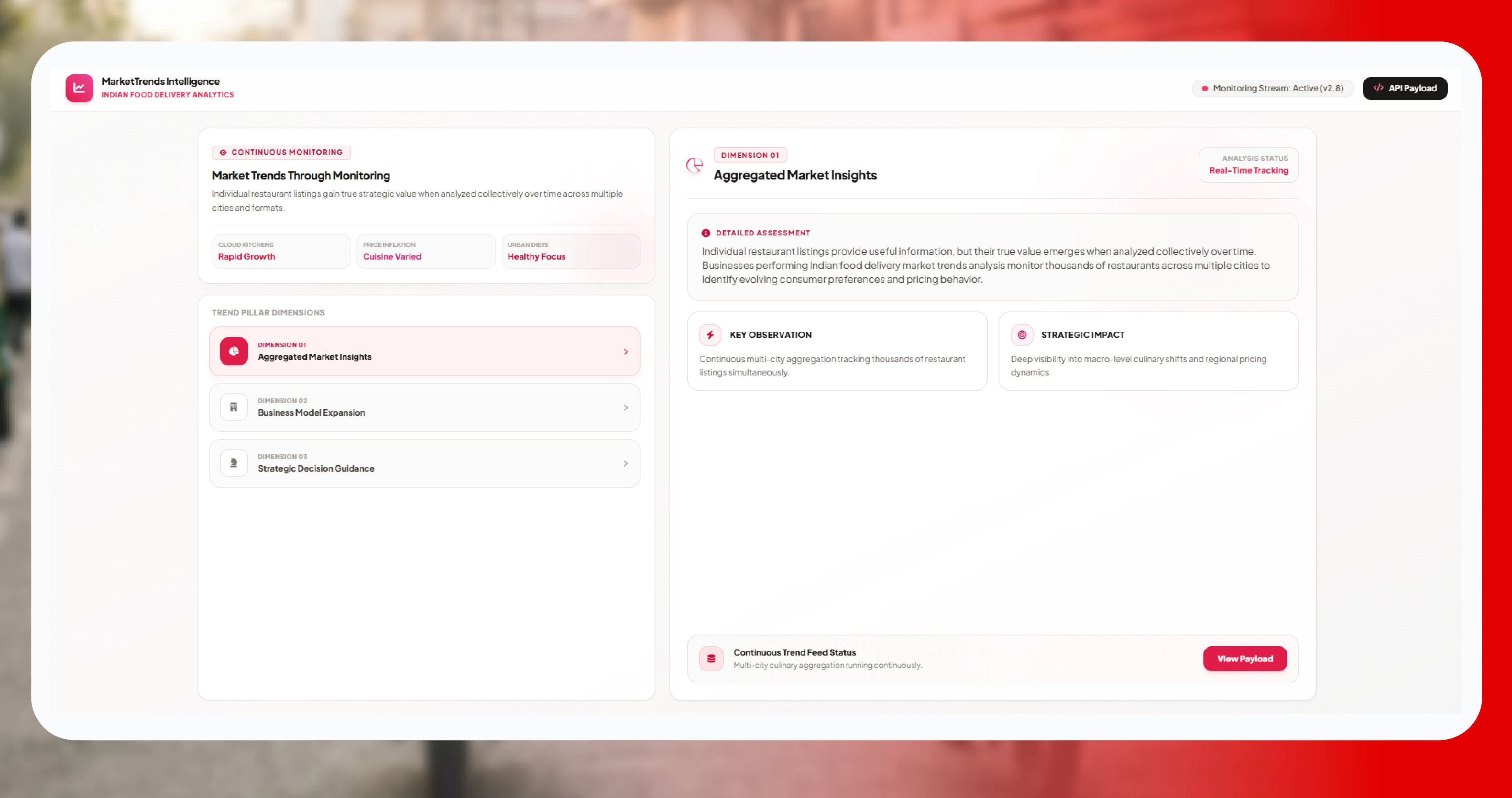
Individual restaurant listings provide useful information, but their true value emerges when analyzed collectively over time. Businesses performing Indian food delivery market trends analysis monitor thousands of restaurants across multiple cities to identify evolving consumer preferences and pricing behavior.
For instance, analysts may observe that cloud kitchens expand more rapidly than traditional restaurants in certain metropolitan regions. Similarly, premium cuisines may experience slower price inflation compared to fast-food categories, while healthy meal options continue gaining popularity among urban consumers.
Tracking these long-term patterns helps restaurants optimize menu strategies, investors identify emerging opportunities, and food brands understand changing consumption habits.
Customer Reviews Offer Valuable Business Intelligence
Ratings and customer reviews represent another significant source of publicly available information. Beyond simple star ratings, review text provides insights into food quality, packaging, delivery performance, portion sizes, and overall customer satisfaction.
Using Zomato and Swiggy data insights, businesses can identify recurring customer complaints, recognize highly appreciated dishes, and measure improvements following operational changes. Restaurants often discover that consistent delivery experiences contribute as much to customer loyalty as food quality itself.
Sentiment analysis of review content further enables businesses to categorize customer opinions into positive, neutral, and negative themes, allowing management teams to prioritize operational improvements.
Promotional Campaigns Influence Consumer Decisions
Discounts remain one of the strongest drivers of customer acquisition within India's food delivery ecosystem. Public data reveals frequent changes in promotional campaigns, coupon availability, free delivery offers, and loyalty program benefits.
Performing a food delivery platform comparison India enables businesses to understand how promotional strategies vary between platforms throughout the year. Seasonal campaigns during festivals, sporting events, and holidays often generate noticeable changes in pricing behavior and customer ordering patterns.
Restaurants also use this intelligence to determine whether participation in platform-specific promotions results in higher visibility or improved order volumes without significantly affecting profitability.
Historical Price Tracking Creates Competitive Advantage
One-time price comparisons provide only a limited view of marketplace dynamics. Organizations increasingly Scrape Swiggy vs Zomato Price Comparison datasets over weeks and months to understand pricing evolution rather than isolated snapshots.
Historical datasets reveal how frequently restaurants revise menu prices, introduce promotional offers, or respond to inflationary pressures. They also highlight seasonal pricing behavior during holidays, festivals, and weekends.
Continuous monitoring enables businesses to anticipate pricing movements instead of merely reacting to them, supporting more informed strategic decisions.
Monitoring Thousands of Menu Items Simultaneously
Modern analytics platforms can Scrape Zomato and Swiggy Food Prices across thousands of restaurants simultaneously. Instead of reviewing menus manually, businesses automate data collection to monitor price updates, newly introduced products, discontinued items, and category expansion.
This large-scale approach helps identify which cuisines are becoming more competitive, where premium pricing succeeds, and which cities demonstrate the fastest menu growth. Restaurant chains can also benchmark franchise pricing consistency across multiple locations.
Ready to Turn Food Delivery Data into Business Insights? Contact Food Data Scrape to access reliable restaurant listings, menu pricing, customer ratings, and competitive food delivery data for smarter decision-making.
Tracking Menu Changes Over Time
Beyond pricing, organizations are increasingly Tracking Swiggy vs Zomato Menu Prices alongside menu additions, product removals, seasonal specials, and promotional bundles.
Monitoring these updates helps businesses evaluate menu innovation, identify emerging food trends, and compare competitive positioning across different restaurant segments. Such insights support pricing optimization, marketing strategies, and expansion planning while reducing reliance on manual market research.
How Food Data Scrape Can Help You
1. Comprehensive Restaurant Data Collection
Food Data Scrape gathers publicly available restaurant listings, menus, pricing, ratings, delivery estimates, and availability from leading food delivery platforms.
2. Real-Time Price Monitoring
Track menu prices, discounts, delivery charges, and promotional offers continuously to support competitive pricing strategies and informed business decisions.
3. Market and Competitor Intelligence
Analyze competitor performance, restaurant expansion, cuisine trends, customer preferences, and regional demand using structured, high-quality food delivery datasets.
4. Custom Data Delivery Solutions
Receive tailored datasets through APIs, CSV, JSON, Excel, cloud storage, or scheduled feeds that integrate seamlessly with existing analytics workflows.
5. Scalable Data Extraction Services
Collect large-scale food delivery marketplace data across multiple cities and platforms with reliable, automated scraping solutions built for enterprise needs.
Conclusion
India's food delivery ecosystem generates an enormous volume of publicly available marketplace information that extends far beyond restaurant menus. Restaurant listings, menu prices, customer reviews, delivery estimates, promotional offers, and geographic coverage collectively provide a detailed picture of market competition and consumer behavior.
Organizations seeking deeper competitive intelligence increasingly rely on Web Scraping Restaurant Listing Data from Swiggy and Zomato to build structured datasets for market research, pricing analysis, restaurant benchmarking, and demand forecasting.
Solutions such as the Zomato Food Delivery Scraping API enable automated collection of restaurant listings, menu details, ratings, pricing information, and delivery metrics from publicly available sources. Likewise, the Swiggy Food Delivery Scraping API supports continuous monitoring of marketplace data, helping businesses transform large-scale public information into actionable insights that drive smarter business decisions.
If you are seeking for a reliable data scraping services, Food Data Scrape is at your service. We hold prominence in Food Data Aggregator and Mobile Restaurant App Scraping with impeccable data analysis for strategic decision-making.