Introduction
South Korea has one of the world’s most digitally advanced food delivery ecosystems, supported by high smartphone penetration, dense urban populations, sophisticated logistics networks, and consumers accustomed to ordering meals through mobile applications. Platforms such as Baemin, Yogiyo, and Coupang Eats have become important channels for restaurants and consumers, creating a large and continuously changing source of pricing, menu, availability, restaurant, promotion, and delivery intelligence.
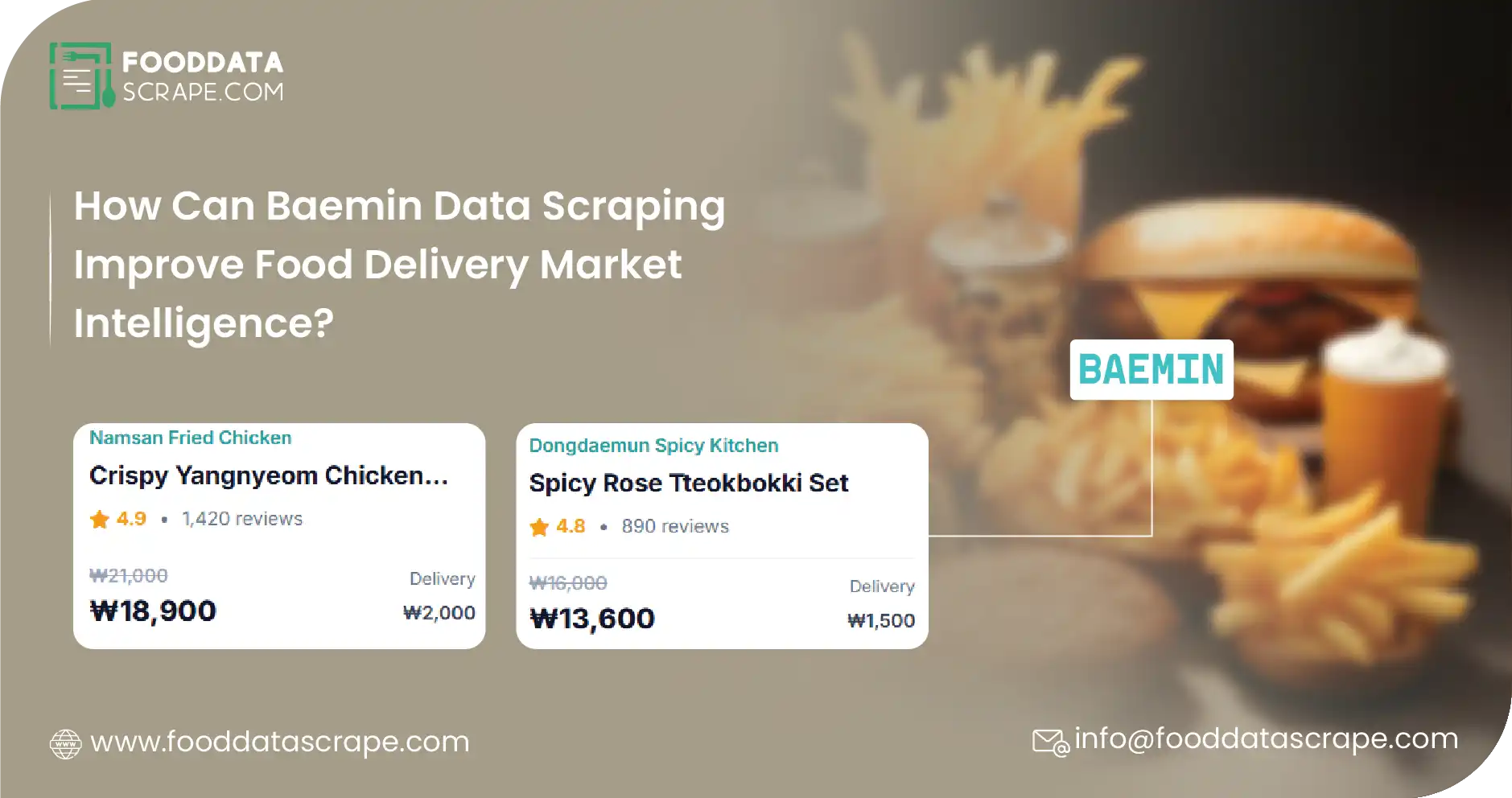
For businesses, Baemin data scraping provides a structured way to monitor restaurant listings, menu prices, delivery information, discounts, ratings, cuisines, and location-level availability across Korean markets. Similarly, Scrape Korean Food Delivery App Data to enable researchers, aggregators, restaurant chains, and market intelligence teams to collect comparable information from multiple platforms.
The growing importance of Baemin Food Delivery Data Scraping comes from the need to understand how restaurants perform across different delivery ecosystems. A restaurant may offer different prices, promotions, menus, delivery charges, or availability depending on the platform and location. Tracking these variations can reveal competitive gaps and market opportunities.
Why Scrape Korean Food Delivery Apps?
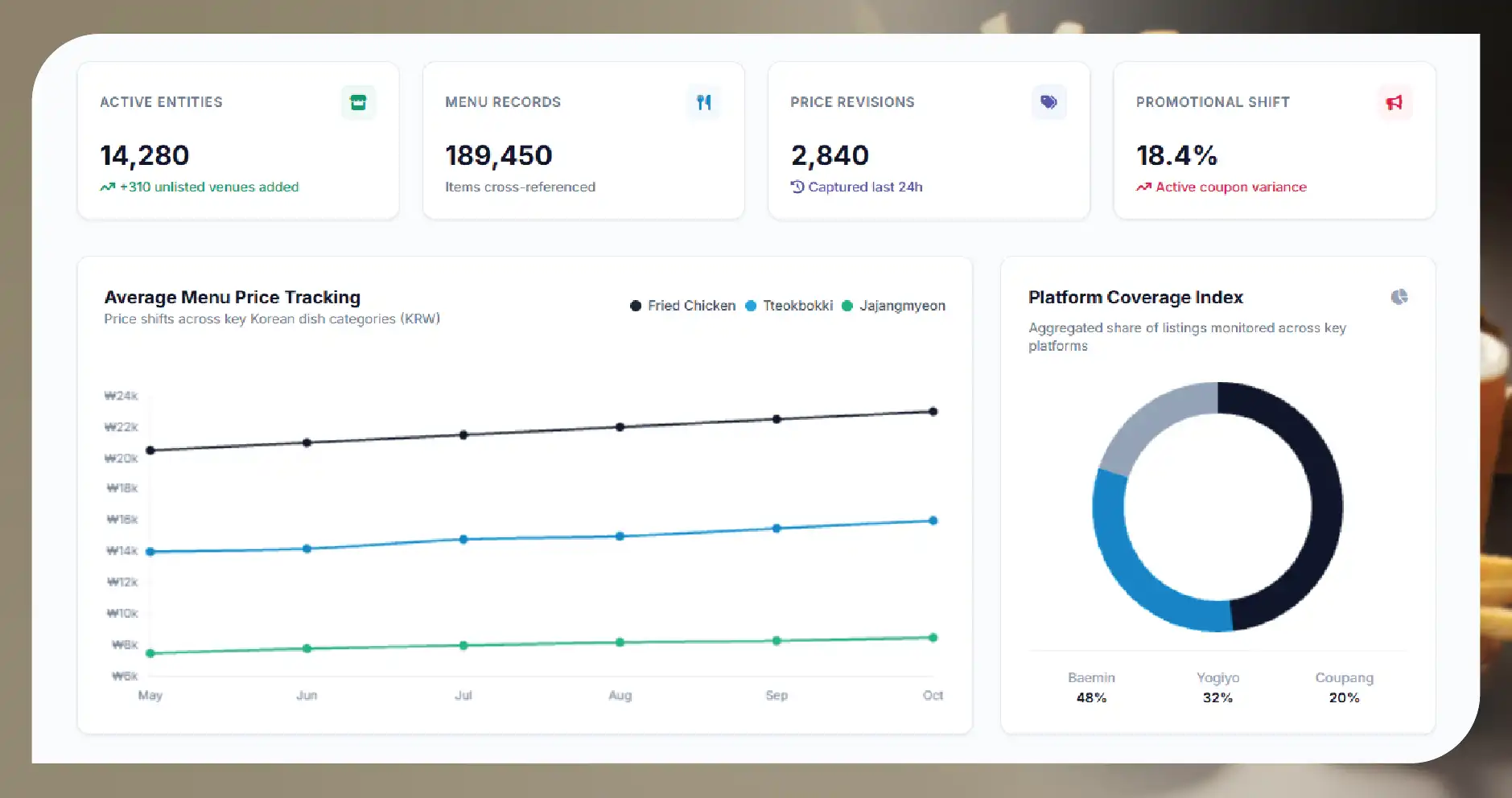
Food delivery applications generate enormous volumes of dynamic information every day. Restaurants add new dishes, modify prices, launch promotions, change operating hours, update delivery zones, and temporarily become unavailable. Capturing these changes manually is difficult, particularly when businesses need data from hundreds or thousands of restaurants.
Automated data collection can transform these constantly changing app listings into structured datasets. Businesses can organize restaurant names, categories, addresses, menus, prices, ratings, review counts, delivery fees, estimated delivery times, promotional offers, and availability into standardized records.
This creates a reliable foundation for competitor monitoring and market research. A food aggregator can identify restaurants missing from its marketplace, while restaurant operators can compare their prices against competing establishments.
Baemin Data Scraping for Restaurant and Pricing Intelligence
Baemin is a major part of South Korea’s food delivery landscape, making its marketplace valuable for restaurant intelligence and competitive analysis. Scraped datasets can capture restaurant-level information and menu attributes across selected Korean cities and neighborhoods.
A typical dataset can include restaurant name, cuisine type, address, operating status, menu item, description, price, options, discounts, rating, review volume, delivery fee, minimum order value, and estimated delivery time.
Businesses can use this information to evaluate menu positioning. For example, a restaurant selling fried chicken can compare its menu prices with nearby competitors and determine whether its pricing sits above, below, or close to the local market average.
Historical snapshots can be particularly valuable. Comparing datasets collected at different intervals makes it possible to identify price increases, new restaurant launches, menu changes, promotional campaigns, and shifts in availability.
Yogiyo Data for Competitive Benchmarking
Yogiyo adds another important layer to Korean food delivery intelligence. Collecting its restaurant and menu information alongside Baemin data enables cross-platform comparisons that would otherwise require extensive manual research.
Researchers can compare the same restaurant across platforms and identify differences in menu pricing, promotional offers, delivery fees, estimated delivery times, and product availability.
For restaurant brands operating across several locations, this can reveal geographic pricing strategies. A menu item may be priced differently in Seoul, Busan, Incheon, or other markets because of local competition, operating costs, demand patterns, or platform-specific promotions.
Cross-platform monitoring can also identify restaurants appearing on one marketplace but not another. These gaps can help food delivery businesses identify potential onboarding opportunities.
Coupang Eats Data and Market Monitoring
Coupang Eats represents another valuable source for understanding Korea’s rapidly evolving food delivery market. Its listings can provide information about restaurants, menus, prices, delivery conditions, promotions, and local availability.
When collected alongside Baemin and Yogiyo datasets, this information creates a broader competitive landscape. Businesses can investigate how restaurants position themselves across different delivery platforms and determine where pricing or availability differs.
Scrape Food Delivery Availability Data In Korea can help businesses understand which restaurants are active within particular locations and which menu items are available at specific times. Availability monitoring is especially important because restaurants may appear in a marketplace but become temporarily unavailable during busy periods.
Location-level availability can also support expansion analysis. A company planning to enter a Korean city can analyze restaurant density, cuisine concentration, delivery coverage, and marketplace penetration before making strategic decisions.
What Data Can Be Scraped?
A well-designed food delivery dataset can contain multiple layers of information. Restaurant-level fields may include restaurant name, address, cuisine, category, rating, review count, operating status, delivery zone, and marketplace presence.
Menu-level information can include item names, descriptions, prices, sizes, add-ons, meal combinations, dietary labels, promotional pricing, and availability. Delivery-level information may include estimated delivery time, delivery charges, minimum order thresholds, and service availability.
Promotional data can capture discounts, coupons, special bundles, percentage reductions, free-delivery campaigns, and platform-specific offers.
This structured information allows businesses to build comprehensive Korean Food Delivery Competitor Data repositories for ongoing analysis rather than relying on isolated screenshots or manually maintained spreadsheets.
Understanding Korean Food Delivery Market Intelligence
The real value of scraping does not come simply from collecting large quantities of records. It comes from turning those records into actionable insights.
Korean Food Delivery Market Intelligence can help businesses understand restaurant density, cuisine trends, average menu prices, promotional intensity, delivery costs, customer ratings, and platform competition.
For example, an analyst could calculate the average price of Korean fried chicken across Seoul or identify the most common price range for popular noodle dishes. Another analysis could compare delivery fees between neighborhoods or identify restaurants offering aggressive discounts.
Time-series datasets can provide even deeper insights. By comparing historical records, analysts can detect price inflation, promotional cycles, restaurant closures, new launches, and changes in platform availability.
Baemin, Yogiyo and Coupang Eats Data Extraction
Collecting data from three major platforms creates a unified view of the market. Baemin, Yogiyo & Coupang Eats Data Extraction can standardize information from different application structures into common fields.
A normalized dataset might use consistent fields such as:
| Data Category | Example Fields | Business Use |
|---|---|---|
| Restaurant | Name, cuisine, address, rating | Competitor discovery |
| Menu | Item, category, description | Menu benchmarking |
| Pricing | Regular price, discount price | Price intelligence |
| Delivery | Fee, ETA, availability | Delivery comparison |
| Promotion | Coupon, discount, bundle | Campaign monitoring |
| Reviews | Rating, review count | Reputation analysis |
| Location | City, district, coordinates | Geographic analysis |
| Platform | Baemin, Yogiyo, Coupang Eats | Cross-platform benchmarking |
This unified structure makes it easier to compare restaurants and marketplaces without manually reconciling different formats.
Mobile App Data Collection at Scale
Mobile applications frequently use dynamic interfaces, changing APIs, location-based content, and personalized results. Consequently, collecting app information requires an approach designed around structured extraction, monitoring, validation, and normalization.
Baemin Food Delivery App Data Scraping can support recurring collection schedules so businesses can monitor changes instead of receiving only a one-time dataset.
Mobile App Scraping for Food can cover restaurant discovery, menu monitoring, pricing intelligence, promotions, availability, ratings, and location-level marketplace information.
The collected records can then be transformed into CSV, JSON, database-ready tables, dashboards, or API-accessible formats depending on business requirements.
Building a Korean Food Delivery Data API
Companies that require continuous access to updated information can convert extracted records into an API-driven data pipeline. A Korean Food Delivery Data API can provide standardized restaurant, menu, price, availability, and competitive information to internal applications and analytics systems.
For example, a food intelligence platform could request restaurant records for a specific city, retrieve menu prices for a cuisine category, or compare delivery fees across marketplaces.
API delivery reduces the need for teams to repeatedly process raw files. Instead, structured information can flow directly into dashboards, business intelligence systems, recommendation engines, pricing platforms, or research databases.
Use Cases Across the Food Industry
The applications extend well beyond restaurant owners. Food delivery aggregators can identify missing restaurants and monitor competitors. Restaurant chains can benchmark menu pricing across neighborhoods. Investors can study restaurant density and marketplace activity.
Consumer research companies can track food pricing trends, while market researchers can analyze cuisine popularity and promotional strategies.
Cloud kitchens can identify underserved locations by studying restaurant concentration and delivery availability. FMCG and food brands can also monitor restaurant menus to understand how products and cuisines are positioned across delivery marketplaces.
How Food Data Scrape Can Help You?
1. Competitive Price Monitoring
Food Data Scrape can monitor restaurant menu prices, discounts, delivery charges, and promotions across Korean platforms, helping businesses identify pricing gaps and respond quickly to competitor changes.
2. Restaurant Discovery
Automated datasets can identify restaurants, cuisines, locations, ratings, and marketplace presence across cities, supporting expansion teams seeking high-potential restaurant partners and underserved delivery zones.
3. Menu Intelligence
Structured menu datasets enable businesses to compare dishes, categories, prices, combinations, and promotions, helping restaurant brands optimize menus and understand changing consumer-facing competitive positions.
4. Availability Tracking
Continuous monitoring can reveal restaurant availability, delivery coverage, temporary closures, and changing service conditions, helping businesses understand where food delivery supply expands or contracts.
5. Market Analytics
Food Data Scrape can transform large marketplace datasets into market intelligence, supporting demand analysis, geographic benchmarking, competitor research, pricing strategies, and long-term food delivery planning.
Conclusion
Scraping Korean food delivery applications can provide a powerful foundation for understanding one of Asia’s most sophisticated digital food marketplaces. Baemin, Yogiyo, and Coupang Eats collectively provide extensive information about restaurants, menus, prices, promotions, delivery conditions, ratings, and geographic availability.
Restaurant Menu Data Scraping allows businesses to transform constantly changing marketplace listings into structured intelligence that can support competitive benchmarking, pricing analysis, restaurant discovery, and menu optimization.
Likewise, Korean Food Delivery Menu Data can help researchers analyze cuisine trends, price movements, promotional intensity, and restaurant positioning across Korean cities.
A structured Coupang Eats Food Dataset from South Korea can further strengthen cross-platform research by providing another layer of marketplace intelligence. When combined with Baemin and Yogiyo information, these datasets can support dashboards, APIs, research reports, competitor monitoring systems, and food delivery analytics platforms.
For companies seeking scalable, repeatable, and data-driven visibility into South Korea’s food delivery ecosystem, automated data collection offers a practical route from fragmented marketplace information to actionable intelligence.
If you are seeking for a reliable data scraping services, Food Data Scrape is at your service. We hold prominence in Food Data Aggregator and Mobile Restaurant App Scraping with impeccable data analysis for strategic decision-making.