Introduction
India's bakery and patisserie industry is experiencing significant transformation, driven by changing food preferences, growing disposable incomes, digital ordering habits, and increasing demand for customised desserts. From neighbourhood bakeries and home-based cake businesses to premium patisseries and established bakery chains, businesses are expanding their digital presence to reach customers across metropolitan cities and emerging markets. Platforms such as Zomato and Swiggy have become important discovery and ordering channels, providing valuable information about bakery businesses, product offerings, menus, prices, ratings, and customer preferences.
Bakery data scraping In India provides businesses with a systematic approach to collecting publicly accessible information from online food delivery platforms. It helps transform scattered restaurant listings into organised datasets that support competitor analysis, market research, pricing intelligence, and expansion planning.
Businesses looking to Scrape India Bakery and Patisserie Data can collect information about bakery names, locations, product categories, delivery availability, customer ratings, and menu variations. Combining these attributes creates a comprehensive market overview that helps brands understand their competitive positioning.
Effective Bakery and Patisserie Data Intelligence also enables companies to identify emerging product categories, evaluate regional demand, and understand how bakery offerings differ across cities. With organised information from multiple platforms, businesses can make informed decisions about product development, pricing strategies, and market opportunities.
Why Build an India Bakery and Patisserie Database?
A structured bakery database provides a centralised view of India's fragmented bakery ecosystem. Unlike traditional market research, which may depend on manual surveys and limited business directories, platform-based data collection enables businesses to examine numerous digital listings through a consistent methodology.
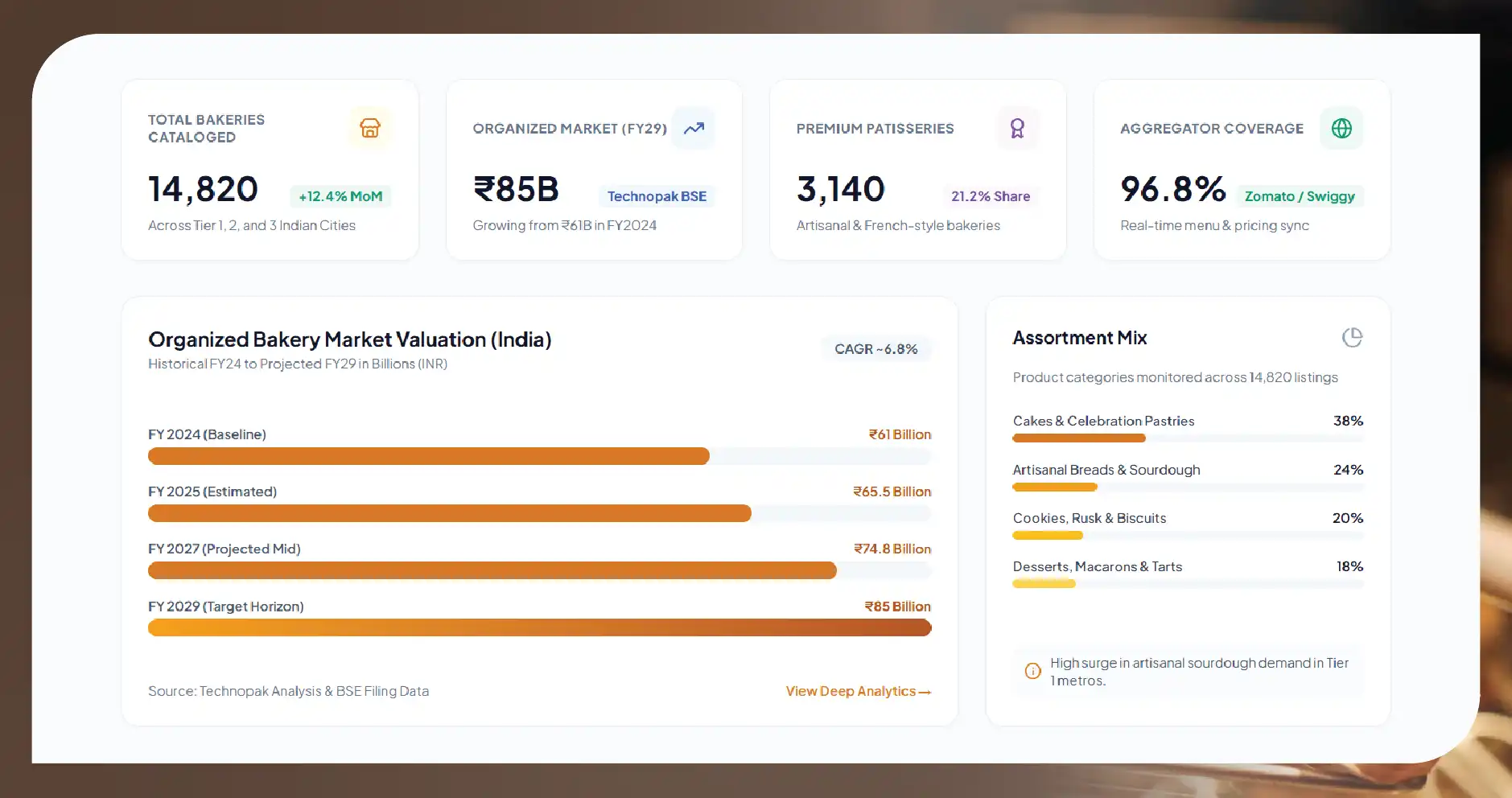
The organised bakery market is also evolving. A Technopak analysis included in a 2024 BSE filing estimated that India's organised bakery market would grow from ₹61 billion in FY2024 to a projected ₹85 billion by FY2029. This indicates the commercial importance of organised bakery businesses and the opportunities available to expanding brands.
A comprehensive database can help businesses:
- Identify independent bakeries, premium patisseries, and national bakery chains.
- Compare product availability across different locations.
- Monitor cakes, pastries, breads, cookies, and dessert categories.
- Evaluate menu prices and promotional strategies.
- Identify competitors operating within specific delivery areas.
- Discover underserved cities and neighbourhoods.
- Track changes in product assortments and business visibility.
Such intelligence is particularly valuable for bakery manufacturers, ingredient suppliers, food aggregators, restaurant consultants, investors, and market research companies.
1. Identify the Right Data Sources: Zomato and Swiggy
The first step is selecting suitable digital sources. Zomato and Swiggy provide extensive restaurant discovery and food ordering interfaces through which customers explore bakeries, dessert outlets, cake shops, and patisseries.
Both platforms should be considered separately because their merchant coverage, menus, prices, promotional offers, and listing information may differ.
Zomato listings can help identify bakery businesses through restaurant categories, search results, cuisine classifications, locations, ratings, and available menu information.
Swiggy listings provide another perspective on bakery availability, product assortments, pricing, restaurant visibility, and delivery coverage.
Combining these sources creates broader market coverage than relying on a single platform.
Businesses should establish relevant search categories before collecting information. These may include:
- Bakeries
- Cake shops
- Patisseries
- Dessert outlets
- Cupcake stores
- Artisan bakeries
- French bakeries
- Bread and confectionery shops
- Home bakers
- Customised cake businesses
Search terms should also account for regional variations and different business descriptions. For example, a business selling croissants and macarons may be classified as a bakery, dessert outlet, or café.
2. Define the Essential Bakery Database Fields
A successful database requires a standardised structure. Collecting business names alone provides limited analytical value. Instead, every bakery record should contain multiple attributes that describe the business, its location, digital presence, and product portfolio.
A recommended database structure includes:
| Data Category | Information to Collect |
|---|---|
| Business Information | Bakery name, restaurant ID, brand name, business category |
| Location Information | City, state, neighbourhood, locality, postal code |
| Platform Information | Zomato presence, Swiggy presence, listing URL |
| Contact Information | Publicly displayed phone number and business details |
| Performance Indicators | Customer rating, review count, platform availability |
| Menu Information | Product names, descriptions, categories, prices |
| Product Attributes | Flavours, sizes, variants, dietary labels |
| Promotional Information | Discounts, combo offers, promotional prices |
| Delivery Information | Delivery availability, estimated delivery time, service area |
| Tracking Information | Collection date, last updated date, listing status |
These fields make it possible to compare bakeries using consistent parameters.
For example, a bakery operating on both platforms should ideally have one master business record with separate platform-specific attributes. This prevents duplicate counting while retaining differences between its Zomato and Swiggy listings.
3. Collect Detailed Bakery and Patisserie Product Information
Product-level information is one of the most valuable components of a bakery database. Business listings identify competitors, but menu-level information reveals what those competitors actually sell.
Patisserie Product Data Extraction helps organise individual products into meaningful categories. These may include:
- Celebration cakes
- Chocolate cakes
- Cheesecakes
- Pastries and mousse desserts
- Cupcakes and muffins
- Croissants and Danish pastries
- Macarons and tarts
- Brownies and cookies
- Breads and savoury bakery products
- Seasonal and festive desserts
Each product should be connected to its parent bakery and platform listing.
Additional fields can include product name, description, listed price, category, available variants, serving size, flavour, and dietary information where displayed.
For instance, a chocolate truffle cake may have multiple size options, such as half kilogram, one kilogram, and two kilograms. Recording these variants separately allows businesses to compare prices at equivalent product and size levels.
Similarly, distinguishing between eggless, vegan, gluten-free, and sugar-free products helps identify specialised product segments.
4. Extract Menu Prices and Compare Bakery Offerings
Pricing intelligence is essential for understanding competitive positioning. Bakeries may offer similar products at different prices depending on ingredients, brand positioning, product size, location, and customer segment.
Bakery Menu and Pricing Data enables businesses to compare these differences systematically.
For meaningful comparisons, prices should be captured alongside their associated product attributes. A ₹500 chocolate cake and a ₹500 chocolate pastry cannot be treated as equivalent products.
A structured pricing analysis should consider:
- Product-Level Pricing: Compare the prices of similar cakes, pastries, breads, and desserts.
- Variant-Level Pricing: Record differences between product sizes, weights, and flavours.
- Platform-Level Pricing: Compare the same bakery's listed prices on Zomato and Swiggy.
- Promotional Pricing: Capture displayed discounts, offer prices, and combo deals separately from standard listed prices.
- Location-Based Pricing: Identify price variations across different neighbourhoods and cities.
Historical price collection can further reveal when bakeries introduce new products, modify prices, or launch seasonal promotions.
5. Extract Zomato and Swiggy Bakery Listing Data
After defining the required fields, the next stage involves collecting publicly accessible listing and menu information through an appropriate, authorised data collection process.
Extract Zomato and Swiggy Bakery Listing Data using structured collection workflows that organise platform information into consistent records.
The process generally involves the following stages:
- Identify bakery-related search categories and relevant city locations.
- Retrieve accessible business listings and their associated identifiers.
- Collect publicly displayed business information and menu details.
- Capture product names, categories, prices, and available variants.
- Record ratings, review counts, and promotional information.
- Associate each listing with its source platform.
- Store the collected information in structured formats.
Data collection should respect platform terms, access restrictions, applicable privacy requirements, and technical limitations. Where direct access is restricted, authorised APIs, licensed datasets, or approved collection methods should be considered.
The collected information can be exported into CSV, Excel, JSON, or database-ready formats, depending on the intended analytical application.
6. Develop a City-Wise Bakery Database
Geographical segmentation is essential because bakery preferences, product availability, and competitive intensity vary significantly across Indian markets.
A City-Wise Bakery Database In India enables businesses to understand the distribution of bakery outlets across metropolitan, tier-2, and emerging cities.
The database can cover major markets such as:
| City | Bakery Research Opportunities |
|---|---|
| Mumbai | Premium patisseries, celebration cakes, artisan desserts |
| Delhi NCR | Customised cakes, premium bakeries, confectionery |
| Bengaluru | Artisan breads, speciality desserts, modern patisseries |
| Hyderabad | Celebration cakes, traditional bakery products |
| Pune | Café bakeries, pastries, customised desserts |
| Chennai | Regional bakery chains, cakes, savoury products |
| Kolkata | Traditional confectionery, pastries, premium desserts |
| Ahmedabad | Eggless cakes, vegetarian bakery products |
| Jaipur | Celebration cakes, local bakery businesses |
| Lucknow | Traditional bakeries, breads, desserts |
Neighbourhood-level classification can make this information even more useful. For example, businesses can compare bakery availability across Bandra and Andheri in Mumbai or Koramangala and Indiranagar in Bengaluru.
Geographical tagging also supports expansion research, competitor mapping, and territory-level sales planning.
7. Clean, Standardise, and Deduplicate the Database
Raw platform information often contains inconsistencies. The same bakery may appear under slightly different names, spellings, or addresses across Zomato and Swiggy.
Therefore, data cleaning is essential before analysis.
Important quality checks include:
- Standardising business names and location formats.
- Removing duplicate restaurant and product records.
- Matching businesses across platforms using names, addresses, and available identifiers.
- Normalising product categories and descriptions.
- Converting prices into consistent numerical formats.
- Identifying missing or outdated information.
- Separating active listings from unavailable or discontinued listings.
- Preserving platform-specific differences instead of overwriting them.
For example, a bakery named ABC Patisserie may appear as ABC Bakery on another platform. Matching its address and other available business attributes can help determine whether both listings represent the same outlet.
However, outlets belonging to the same brand should not automatically be merged. Each physical location should retain its own outlet-level record.
8. Analyse Bakery Market Trends and Competitive Opportunities
Once the database is cleaned, businesses can use it to identify market patterns and commercial opportunities.
A Food Delivery Dataset from Zomato can support comparisons of bakery listings, product assortments, pricing structures, and competitive visibility.
Swiggy data can complement this information by providing another platform perspective. An authorised Swiggy Food Delivery Scraping API or other permitted data integration method can help automate structured data collection and updates.
Businesses can examine several analytical dimensions:
- Category Popularity: Identify frequently listed products such as brownies, cheesecakes, cupcakes, and chocolate pastries.
- Price Segmentation: Classify bakeries into budget, mid-range, premium, and luxury segments using consistent price benchmarks.
- Brand Competition: Compare national bakery chains with regional businesses and independent patisseries.
- Product Gaps: Identify cities or neighbourhoods with limited specialised offerings.
- Platform Coverage: Measure how many identified businesses appear on one or both platforms.
- Promotional Activity: Compare displayed discounts and promotional strategies across competitors.
These insights can support decisions about new product launches, pricing adjustments, distribution partnerships, and geographical expansion.
9. Maintain and Update the Database Regularly
A bakery database should be treated as an evolving business intelligence resource rather than a one-time research exercise.
Restaurant listings, menus, prices, promotional offers, and business availability can change frequently. A regular update schedule helps maintain data accuracy and analytical relevance.
A practical refresh framework may include:
- Frequent updates for product prices and promotional information.
- Weekly checks for listing availability and menu changes.
- Monthly reviews of new bakery openings and closures.
- Quarterly assessments of city-level market coverage.
- Historical snapshots for tracking long-term competitive changes.
Each record should include a collection timestamp and source reference. This helps analysts distinguish newly collected information from older observations.
Automated validation can also flag unusual price changes, missing menu categories, duplicate records, and inconsistent business identifiers.
How Food Data Scrape Can Help You?
1. Comprehensive Market Coverage
Food Data Scrape collects structured bakery listings across multiple cities, helping businesses identify competitors, compare market presence, and understand India's expanding bakery ecosystem.
2. Product-Level Intelligence
Analyse cakes, pastries, breads, cookies, and speciality desserts through organised product records, enabling businesses to identify assortment gaps and emerging consumer preferences across different markets.
3. Competitive Price Monitoring
Compare bakery menu prices, product variants, promotional offers, and platform-level differences to evaluate competitor positioning and develop informed pricing strategies for different customer segments.
4. City-Level Market Research
Build geographically segmented bakery databases covering business locations, neighbourhoods, ratings, and product availability to support expansion opportunities and regional competitive analysis.
5. Automated Data Integration
Access structured datasets through flexible delivery formats and authorised integrations, helping research teams streamline collection, improve data consistency, and maintain updated bakery intelligence.
Conclusion
Building an India bakery and patisserie database from Zomato and Swiggy listings requires more than collecting restaurant names. It involves integrating business information, product-level details, menu prices, geographical attributes, platform presence, and competitive indicators into a standardised research framework.
A well-maintained database enables businesses to understand regional bakery markets, identify popular product categories, compare competitor offerings, and discover expansion opportunities. It also supports manufacturers, ingredient suppliers, food delivery companies, and market research teams in making data-driven decisions.
Implementing Web Scraping Bakery Trends analysis can further reveal changing product preferences, premium dessert opportunities, regional pricing differences, and evolving competitive patterns. An authorised Food Data Scraping API can help streamline structured collection and recurring updates, while comprehensive Food Delivery Datasets provide the foundation for deeper bakery and patisserie market intelligence.
Ultimately, transforming Zomato and Swiggy listings into structured datasets helps businesses move beyond scattered online information and develop a measurable understanding of India's bakery and patisserie landscape.
If you are seeking for a reliable data scraping services, Food Data Scrape is at your service. We hold prominence in Food Data Aggregator and Mobile Restaurant App Scraping with impeccable data analysis for strategic decision-making.
Get a Free Food Data Sample in 48 Hours.
Tell us your platforms, target markets and required fields — we'll map exactly what's possible with food data scraping, recommend the right approach, and send a working sample so you can verify quality before any commitment.