
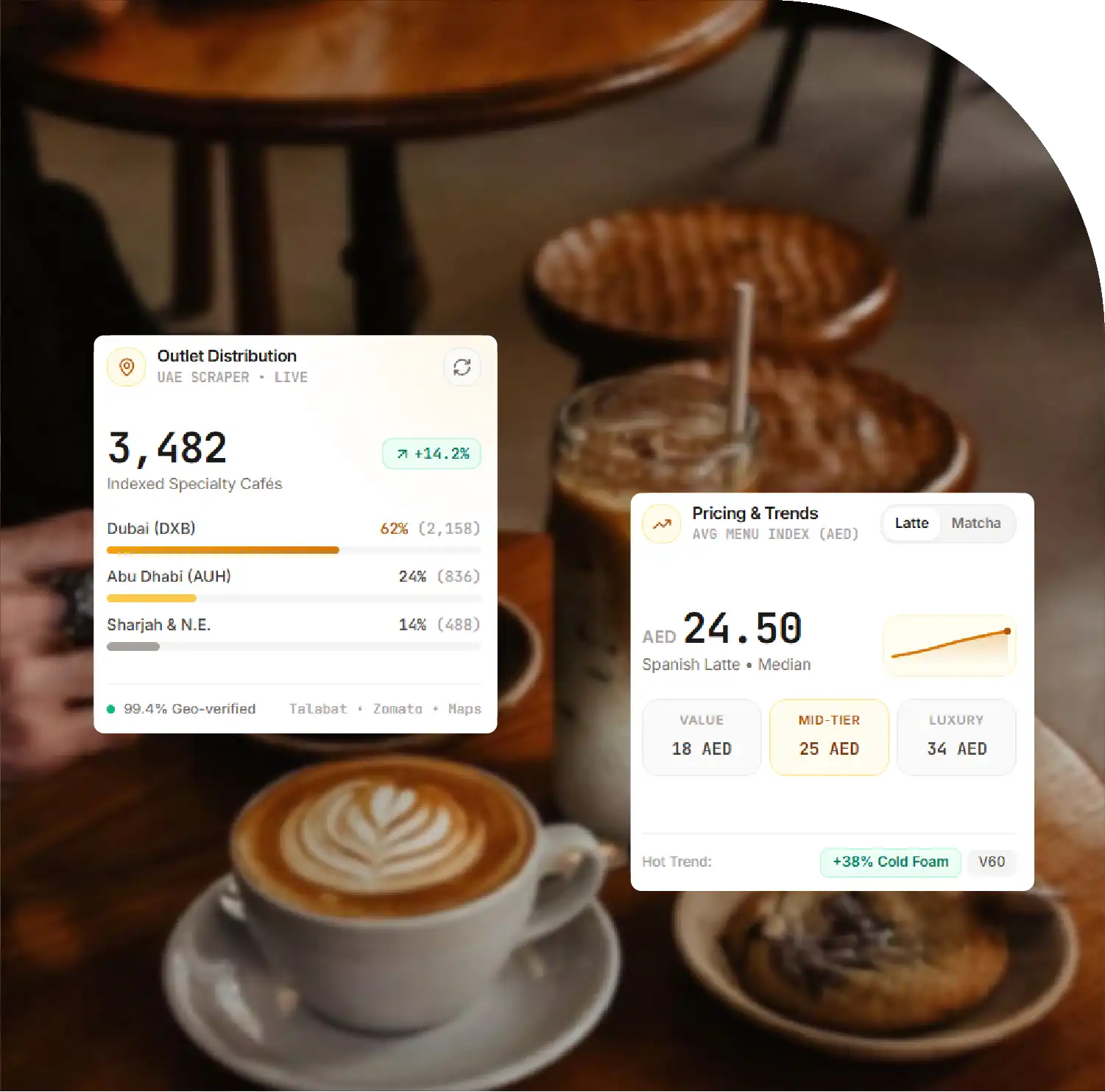
1. Market Mapping: Analyse café distribution across Dubai, Abu Dhabi, Sharjah and other emirates to identify geographical concentration and expansion opportunities.
2. Outlet Intelligence: Build structured databases containing café names, addresses, contact information, business categories, operating hours and customer ratings.
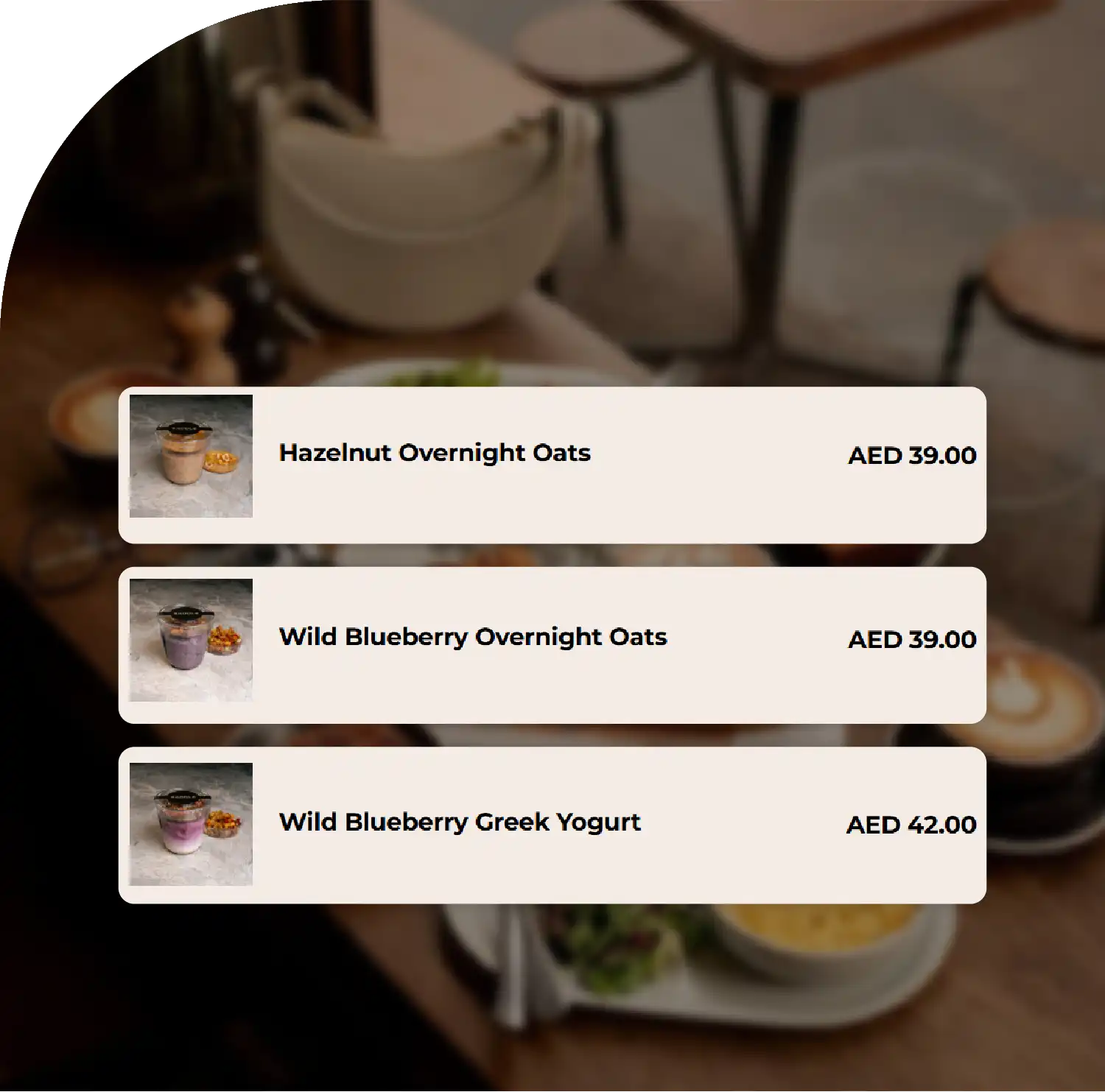
3. Menu Benchmarking: Extract food items, coffee varieties, beverage categories, product descriptions and prices to evaluate competitive menu positioning.
4. Geolocation Analytics: Examine neighbourhood-level café density, competitor proximity and outlet distribution across residential, commercial and tourism-focused locations.
5. Delivery Intelligence: Monitor digital café listings, delivery charges, promotional offers, menu availability and platform-level pricing to understand online foodservice competition.

The United Arab Emirates has developed into one of the Middle East's most competitive café and coffee shop markets, supported by international tourism, a multicultural population, premium coffee consumption, expanding residential communities and a strong dining-out culture. Dubai and Abu Dhabi are particularly important markets, attracting international coffee chains, independent specialty cafés, bakery cafés, neighbourhood coffee shops and emerging beverage brands.
In this environment, café data scraping UAE provides businesses with a systematic way to collect, organise and analyse information about café outlets, menus, prices, ratings, locations and competitors across different emirates. The resulting information can support market research, franchise expansion, supplier prospecting and location-based investment decisions.
Businesses looking to Scrape Dubai and Abu Dhabi Cafe Data can combine information from online business directories, restaurant discovery platforms, mapping services, café websites and food delivery applications. This creates a more comprehensive picture of outlet distribution, customer preferences and competitive positioning.
The growing importance of UAE Cafe Market Mapping Data is also connected to the expansion of premium coffee experiences, speciality beverages, international café franchises and digitally enabled ordering. However, an important research consideration is that UAE outlet counts vary depending on whether a source includes coffee shops, cafeterias, bakery cafés, juice bars or all foodservice establishments. Therefore, datasets should preserve their original outlet classifications instead of combining different categories into one misleading total.
According to the USDA Foreign Agricultural Service's 2025 Dubai foodservice report, Dubai's coffee shop and cafeteria segment represents a substantial part of the city's foodservice infrastructure. Other industry estimates also identify significant opportunities across Abu Dhabi and the Northern Emirates.
The UAE café industry operates within a rapidly developing foodservice ecosystem. The USDA Foreign Agricultural Service's December 2025 report estimated the UAE foodservice market at USD 8.5 billion in 2024, with a projected value of USD 14.2 billion by 2032. Its broader consumer foodservice analysis also recorded more than 17,300 foodservice outlets in 2024.
The café and bar segment is particularly relevant to this expansion. According to the same report, its foodservice sales increased from USD 2,388 million in 2020 to USD 4,324.9 million in 2024. This demonstrates the growing commercial importance of cafés, bars and beverage-led establishments.
| Market indicator | Reported value | Year |
|---|---|---|
| UAE foodservice market | USD 8,500 million | 2024 |
| Projected foodservice market | USD 14,200 million | 2032 |
| UAE foodservice outlets | 17,300+ | 2024 |
| Café and bar sales | USD 2,388 million | 2020 |
| Café and bar sales | USD 2,961.7 million | 2021 |
| Café and bar sales | USD 3,727.8 million | 2022 |
| Café and bar sales | USD 4,184.4 million | 2023 |
| Café and bar sales | USD 4,324.9 million | 2024 |
| UAE population | 11,400,000 | 2024/25 report |
| Dubai international visitors | 18,700,000 | 2024 |
| UAE agricultural products imported | 80%+ | 2024 |
Source: USDA Foreign Agricultural Service, UAE Food Service – Hotel Restaurant Institutional Annual, December 2025. Figures retain the source's reporting periods and definitions.
These indicators demonstrate why café intelligence is increasingly valuable for food suppliers, coffee distributors, restaurant consultants, franchise operators and investment companies.
Dubai and Abu Dhabi represent two major centres of café activity, although their commercial characteristics differ.
Dubai combines international tourism, shopping destinations, business districts, residential developments and entertainment venues. This creates demand for specialty coffee shops, international franchises, independent cafés, takeaway counters and premium dessert establishments.
According to Dubai Municipality figures reproduced in the USDA 2025 report, Dubai had 5,240 coffee shops and cafeterias. The figure includes a wider category than specialty cafés alone and should not be interpreted as a count of independent coffee shops.
Abu Dhabi offers another significant opportunity through its residential communities, office districts, hospitality developments and expanding retail infrastructure. Grant Thornton's October 2026 UAE F&B report records 24,594 active F&B licences in Abu Dhabi as of September 2025. This is an all-F&B licensing figure, not a café-only count.
For wider geographical coverage, commercial business-listing datasets can supplement municipal information.
The following figures are from a 2026 commercial café-listing dataset. They represent classified business listings rather than verified municipal licence totals.
| Geographical category | Café listings | Share of national dataset |
|---|---|---|
| Dubai | 2,807 | 35.3% |
| Abu Dhabi | 1,995 | 25.1% |
| Sharjah | 719 | 9.0% |
| Ajman | 474 | 6.0% |
| Ras Al Khaimah | 335 | 4.2% |
| Fujairah | 206 | 2.6% |
| Umm Al Quwain | 81 | 1.0% |
| Other and separately classified locations | 1,346 | 16.9% |
| Total | 7,963 | 100% |
Source: POIData, UAE café business listing report, 2026. Minor differences in displayed percentages arise from rounding. Separately classified localities and duplicate geographic labels may affect the distribution.
The dataset indicates that Dubai and Abu Dhabi together account for approximately 60.4% of the listed UAE café businesses. This concentration makes both emirates important starting points for commercial prospecting and competitive benchmarking.
A robust UAE Cafe Market Intelligence project should go beyond outlet totals. It should identify active businesses, distinguish branded chains from independent operators, capture geographical coordinates and monitor changes in operating status.
A reliable Cafe Outlet Database should contain standardised records for individual establishments. Each outlet should receive a unique identifier to prevent duplicate entries across business directories, maps and food delivery applications.
Important data fields include:
| Data category | Information collected | Analytical purpose |
|---|---|---|
| Business identity | Café name, outlet ID, brand | Identification |
| Ownership | Independent, franchise, chain | Competition analysis |
| Address | Building, street, area, emirate | Location mapping |
| Contact | Phone, website, email where public | Supplier outreach |
| Business classification | Specialty café, bakery café, cafeteria | Segmentation |
| Operating details | Opening hours, active status | Operational research |
| Customer indicators | Rating, review count | Reputation analysis |
| Digital presence | Website, social links | Brand research |
| Delivery presence | Platform and listing status | Channel analysis |
| Commercial indicators | Menu prices, discounts | Price benchmarking |
Records should also capture collection dates and original source references. This makes historical comparisons more reliable and allows researchers to identify outdated business information.
Location intelligence is one of the most valuable components of café market research. Cafe Geolocation Data Extraction enables businesses to identify the precise geographical distribution of cafés and understand how outlets are positioned around shopping centres, residential developments, offices, hotels and tourist attractions.
Dubai neighbourhoods such as Downtown Dubai, Business Bay, Jumeirah, Dubai Marina, Deira and Al Barsha offer different customer profiles and commercial opportunities. In Abu Dhabi, Al Reem Island, Khalifa City, Al Khalidiyah, Yas Island and Al Maryah Island provide useful geographical segments for comparison.
Neighbourhood-Wise Cafe Density Analysis can combine outlet coordinates with neighbourhood boundaries, population estimates, commercial activity and competitor locations.
For example, a franchise operator can identify neighbourhoods with a high concentration of specialty coffee shops and compare them with areas experiencing residential or commercial development. A supplier can use the same analysis to plan sales territories and prioritise high-potential outlet clusters.
Density calculations should use a consistent geographical unit, such as cafés per square kilometre or cafés per 10,000 residents. This avoids misleading comparisons between neighbourhoods with significantly different sizes and populations.
Beyond outlet intelligence, menu information provides valuable insights into consumer preferences, product positioning and pricing strategies.
Scrape Food Data from Cafes to collect detailed menu information across independent cafés, speciality coffee shops, bakery cafés and international franchises. This information can help businesses understand product availability, pricing differences and menu diversification.
Relevant menu attributes include:
Coffee & Beverage Data Scraping provides another important research dimension. UAE cafés offer diverse beverage portfolios, ranging from traditional Arabic coffee and espresso to cold brew, matcha, speciality tea and flavoured iced drinks.
Collecting beverage-level information helps businesses compare pricing, identify popular product categories and evaluate how different brands position premium beverages.
For instance, a researcher can compare the prices of cappuccino, latte, americano, Spanish latte, iced coffee and matcha across several café brands. Tracking these products over time can reveal changes in pricing, menu innovation and competitive positioning.
Historical market information provides a useful foundation for understanding the UAE's café ecosystem. The following table combines reported industry figures from the USDA's 2025 report and Grant Thornton's October 2026 analysis.
| Research parameter | Numerical value | Unit / measurement | Reference period |
|---|---|---|---|
| UAE café and bar sales | 2,388.0 | USD million | 2020 |
| UAE café and bar sales | 2,961.7 | USD million | 2021 |
| UAE café and bar sales | 3,727.8 | USD million | 2022 |
| UAE café and bar sales | 4,184.4 | USD million | 2023 |
| UAE café and bar sales | 4,324.9 | USD million | 2024 |
| Café and bar sales growth | 81.1 | % increase | 2020–2024 |
| Dubai coffee shops and cafeterias | 5,240 | Establishments | 2025 |
| Dubai restaurants | 8,617 | Establishments | 2025 |
| Dubai international visitors | 18.7 | Million visitors | 2024 |
| Dubai international visitors | 19.6 | Million visitors | 2025 |
| Abu Dhabi active F&B licences | 24,594 | Licences | September 2025 |
| Abu Dhabi F&B licence growth | 42.2 | % increase in new registrations | H1 2025 |
| UAE F&B market value | 23.2 | USD billion | 2025 |
| UAE F&B market forecast | 61.2 | USD billion | 2031 |
| UAE food delivery growth expectation | 18.7 | % | 2026 report forecast |
Sources: USDA Foreign Agricultural Service, December 2025, and Grant Thornton UAE, October 2026. The 81.1% sales increase is calculated from the reported 2020 and 2024 values. The F&B figures represent the wider foodservice industry, not the café segment alone.
The figures demonstrate the importance of combining multiple datasets instead of relying on a single market indicator. Café and bar sales provide a financial perspective, outlet counts reveal market infrastructure, and visitor statistics help explain demand from tourism.
For investment and expansion research, these metrics should be supplemented with neighbourhood-level information, average menu prices, rental benchmarks and outlet-level competition.
Food delivery has become an important sales and customer acquisition channel for UAE cafés. Platforms such as Talabat, Deliveroo, Careem and noon Food provide digital visibility for restaurants, coffee shops and bakery businesses.
Extracting publicly accessible delivery listing information can help researchers understand the digital performance and commercial positioning of café outlets.
Important delivery-related attributes include:
Comparing the same café across multiple platforms can reveal differences in menu pricing, product availability, promotional strategies and delivery positioning.
For example, a café may offer a different promotional price on Talabat compared with Deliveroo. A consolidated dataset allows researchers to compare these differences while retaining the original platform, collection timestamp and location.
A structured data collection process is essential for developing dependable café market intelligence.
Step 1: Source identification
Identify relevant business directories, mapping platforms, café websites, public menu pages and food delivery applications. Define the geographical scope and café classifications before collection begins.
Step 2: Outlet discovery
Collect café listings across Dubai, Abu Dhabi, Sharjah, Ajman, Fujairah, Ras Al Khaimah and Umm Al Quwain. Record business names, addresses, categories and available contact information.
Step 3: Menu extraction
Capture food and beverage information, prices, descriptions, product categories, photographs and promotional details from accessible sources.
Step 4: Data standardisation
Normalise outlet names, neighbourhood labels, menu categories, currencies and address formats. Use unique outlet identifiers to identify repeated listings.
Step 5: Verification and deduplication
Cross-check records against available business websites and other reliable sources. Distinguish permanently closed outlets from temporarily unavailable businesses.
Step 6: Continuous monitoring
Schedule periodic collection to capture new openings, closures, menu revisions, price adjustments and promotional changes.
Data collection should respect applicable platform terms, privacy requirements, copyright restrictions and access controls. Public business information should not be treated as permission to collect private personal information.
Structured café datasets can support several commercial activities across the UAE foodservice industry.
Franchise expansion: Café chains can identify neighbourhoods with strong commercial activity, assess competitor concentration and shortlist potential locations for new outlets.
Supplier prospecting: Coffee bean distributors, dairy suppliers, bakery ingredient manufacturers and packaging companies can build targeted prospect lists based on café type, location and brand size.
Competitive benchmarking: Restaurant consultants can compare menu prices, beverage portfolios, promotional strategies and customer ratings across competing businesses.
Investment research: Investors can evaluate café density, brand expansion, geographical coverage and market concentration before assessing potential franchise or acquisition opportunities.
Product development: Food and beverage manufacturers can analyse menu trends, identify emerging beverage categories and understand demand for speciality coffee, alternative milk, desserts and healthier food options.
Digital market analysis: Aggregated outlet and delivery information can help technology companies evaluate platform coverage, digital ordering penetration and café participation in online food marketplaces.
The UAE café industry offers substantial opportunities for businesses seeking reliable outlet intelligence, menu information, competitive pricing and geographical market analysis. Dubai and Abu Dhabi remain important commercial centres, while Sharjah and the Northern Emirates provide additional opportunities for market expansion.
Developing structured Food Delivery Datasets can help businesses connect café outlet information with digital ordering activity, product availability, delivery pricing and promotional performance.
Companies looking to Scrape Food Delivery API Data can consolidate accessible platform information into standardised datasets for competitor analysis, operational monitoring and foodservice research.
Ultimately, Food Data Scraping in UAE enables businesses to transform fragmented café listings, menus and delivery information into actionable market intelligence. With regular updates, accurate geographical classification and consistent data validation, organisations can make better-informed decisions about expansion, supplier relationships, pricing strategies and emerging consumer preferences.
A comprehensive UAE café intelligence solution should therefore combine outlet discovery, geolocation, menu extraction, beverage analysis, competitor monitoring and delivery-channel research to provide a complete view of the country's evolving café ecosystem.
If you are seeking for a reliable data scraping services, Food Data Scrape is at your service. We hold prominence in Food Data Aggregator and Mobile Restaurant App Scraping with impeccable data analysis for strategic decision-making.