Introduction
Online food delivery has transformed how consumers discover restaurants, compare menus, evaluate prices, and order meals. Platforms such as Uber Eats, DoorDash, Deliveroo, Zomato, and Swiggy have created competitive digital marketplaces where restaurant visibility, menu pricing, delivery fees, ratings, and estimated delivery times influence customer decisions. For restaurants, food brands, market researchers, and technology companies, understanding these changing dynamics is essential for sustainable growth.
Delivery aggregator website scraping helps businesses collect publicly accessible information from food delivery platforms and convert it into structured, actionable datasets. Instead of manually checking multiple applications and websites, businesses can systematically gather restaurant listings, menu items, product prices, customer ratings, promotional offers, and delivery availability across selected markets.
Using Delivery aggregator website scraping enables organizations to monitor market developments, identify emerging consumer preferences, and understand how competitors position their offerings. Meanwhile, Delivery Aggregator Data Scraping supports data-driven decision-making by organizing information from multiple sources into consistent formats suitable for analytics, dashboards, and business intelligence applications.
As the food delivery industry becomes increasingly competitive, reliable data collection can help businesses identify opportunities, improve operational planning, and develop more effective pricing and customer acquisition strategies.
What Is Delivery Aggregator Website Scraping?
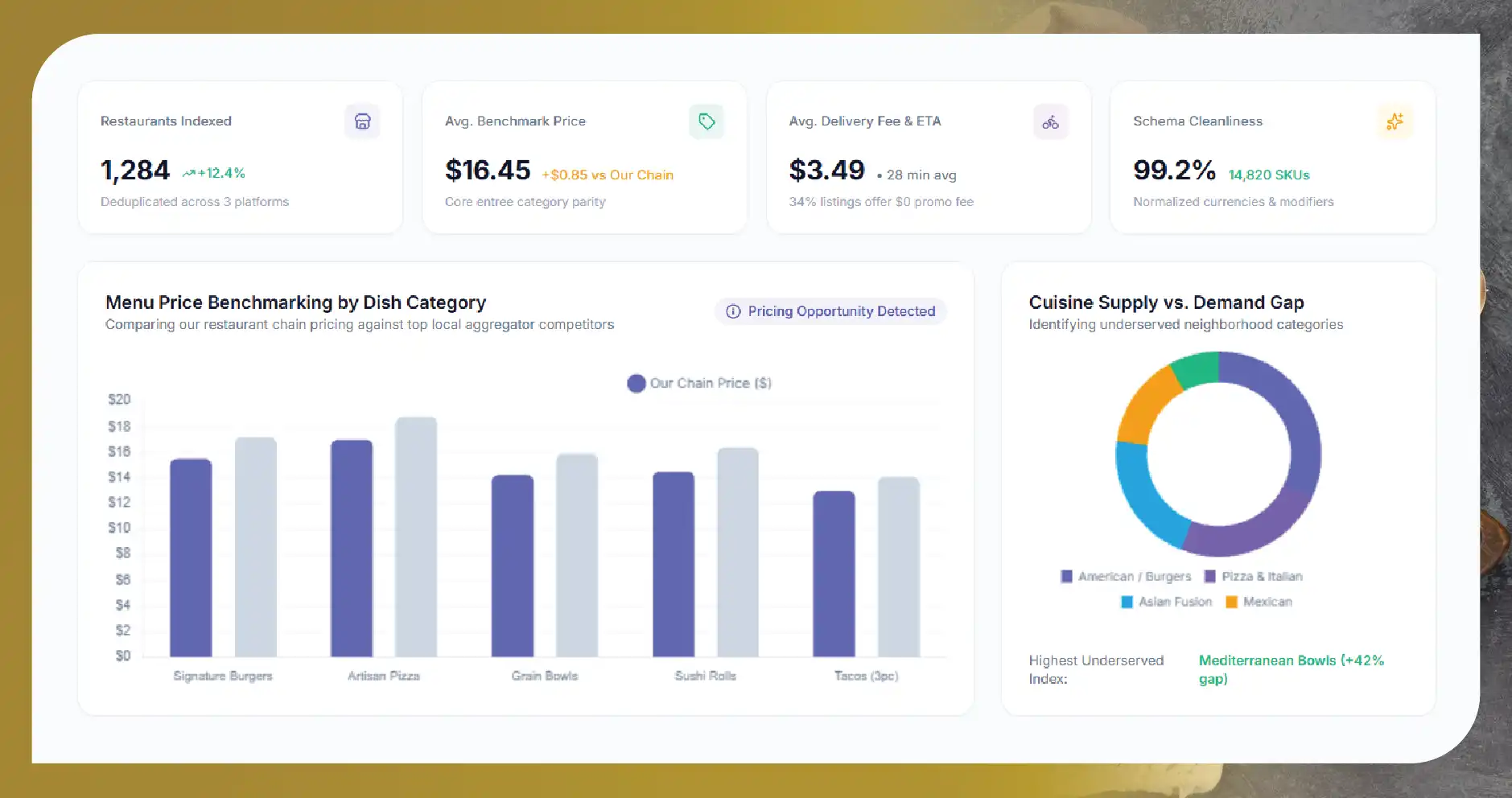
Delivery aggregator website scraping is the process of collecting relevant information from online food ordering platforms and converting it into structured data for analysis. Depending on the platform, location, and permitted access methods, collected information may include restaurant profiles, cuisine categories, menu descriptions, item prices, discounts, ratings, delivery charges, estimated arrival times, and availability indicators.
The process generally involves identifying relevant data sources, defining the required fields, collecting accessible information, cleaning inconsistencies, and delivering the resulting datasets in formats such as CSV, JSON, Excel, or database tables.
For example, a restaurant chain operating across several cities may want to understand how its menu prices compare with competing restaurants. A structured dataset can help the chain evaluate similar dishes, compare promotional strategies, monitor delivery fees, and identify differences in customer ratings.
Similarly, a food technology company may use delivery marketplace information to understand restaurant coverage across neighborhoods or identify underserved cuisine categories.
The primary objective is not simply to collect large volumes of information. It is to transform fragmented marketplace data into reliable insights that support specific business decisions.
Why Food Delivery Aggregator Data Matters?
Food delivery platforms provide a valuable window into digital restaurant competition. Their listings reveal how businesses present their offerings, compete for visibility, and adapt to customer expectations.
1. Understanding Restaurant Pricing
Restaurant prices can vary between locations, platforms, menu categories, and promotional periods. Tracking comparable dishes helps businesses identify pricing differences and assess whether their offerings remain competitive.
A restaurant may discover that competitors offer discounted lunch combinations while maintaining regular dinner prices. Such observations can inform promotional planning without requiring the restaurant to imitate every competitor's strategy.
2. Monitoring Promotions and Discounts
Delivery platforms frequently display promotional offers, including percentage discounts, reduced delivery fees, bundled meals, and minimum-order incentives.
Monitoring these publicly displayed promotions helps businesses understand competitive discounting patterns, seasonal campaigns, and the potential influence of offers on customer acquisition.
Historical records are particularly useful because they allow analysts to distinguish temporary promotional activity from recurring pricing strategies.
3. Measuring Restaurant Visibility
Restaurant visibility can influence customer discovery and ordering opportunities. Relevant indicators include listing presence, category placement, promotional labels, ratings, and the number of competing restaurants serving a particular cuisine.
Because platform rankings can vary by location, account, personalization, and time, businesses should treat observed placement as a contextual indicator rather than a universal ranking.
4. Identifying Consumer Preferences
Menu availability, cuisine categories, meal combinations, and customer ratings can provide indirect signals about consumer preferences. When analyzed across locations and time periods, these indicators may reveal growing interest in vegetarian meals, healthy options, regional cuisines, or value-oriented combinations.
However, listing counts and ratings alone do not establish actual demand. Businesses should combine marketplace observations with order data, surveys, and other reliable evidence wherever possible.
Essential Data Fields to Collect
An effective data collection project begins with a clearly defined set of fields. The exact requirements depend on the business objective, source availability, and platform access conditions.
Restaurant Profile Information
Restaurant-level fields establish the foundation for market analysis. Common attributes include restaurant name, platform identifier, cuisine type, address or service area, location coordinates where available, listing status, operating hours, and displayed ratings.
These fields help analysts compare restaurant coverage across neighborhoods, identify competing businesses, and detect changes in marketplace participation.
Menu and Pricing Information
Menu-level data supports product comparisons and pricing intelligence. Relevant fields may include item name, category, description, listed price, portion size, customization options, meal combinations, and availability status.
Accurate product matching is essential. Two dishes with similar names may differ in ingredients, portion size, or serving configuration. Normalizing these attributes improves the quality of price comparisons.
Delivery and Availability Information
Delivery-related information can include displayed delivery fees, estimated delivery times, minimum order values, serviceability, and temporary unavailability indicators.
These observations should be recorded with timestamps and relevant location or search conditions because delivery estimates and availability can change throughout the day.
Ratings and Customer Feedback
Where permitted access allows, businesses may collect aggregate ratings, review counts, and relevant review information. These indicators can help assess customer sentiment and identify recurring service concerns.
Review analysis should account for language differences, duplicate content, sampling limitations, and platform-specific rating systems.
How the Data Collection Process Works?
A well-designed scraping workflow combines technical reliability with clear data governance.
Step 1: Define the business objective. Determine whether the project focuses on competitor pricing, restaurant discovery, promotional monitoring, delivery coverage, or market expansion. This decision establishes which fields and platforms are relevant.
Step 2: Select suitable data sources. Identify the delivery platforms, target cities, cuisine categories, and geographic coverage required. Confirm applicable terms, permissions, privacy requirements, and available official APIs or licensed data access methods.
Step 3: Collect accessible information. Use permitted APIs, authorized integrations, licensed datasets, or other compliant collection methods. Where website extraction is permitted, configure collection around the specific fields and geographic areas required.
Step 4: Clean and standardize records. Normalize currencies, restaurant names, timestamps, cuisine labels, and menu categories. Remove duplicate records and flag missing or inconsistent values before analysis.
Step 5: Validate the dataset. Check sample records against authorized source views, measure field completeness, and identify unexpected changes in formats or collection coverage.
Step 6: Deliver structured data. Supply validated records through dashboards, spreadsheets, databases, or API integrations, depending on the needs of analysts and operational teams.
A repeatable workflow makes ongoing comparisons more meaningful and helps businesses maintain consistency as platforms update their interfaces and data structures.
Building Restaurant Market Intelligence
Restaurant Market Intelligence Data can help businesses understand how restaurants compete across locations, cuisine categories, and customer segments. When datasets are standardized and refreshed appropriately, analysts can compare market conditions rather than relying on isolated observations.
For example, a restaurant group considering expansion into a new city could evaluate the number of listed competitors, common cuisine categories, menu price ranges, delivery availability, and displayed customer ratings. This information may highlight locations with strong competition or reveal categories that warrant additional investigation.
Food manufacturers can also examine restaurant menus to understand where particular ingredients, meal formats, or product categories appear in the marketplace. Such observations can inform product development, restaurant partnerships, and foodservice distribution strategies.
However, online listings should not be treated as a complete representation of the restaurant market. Some establishments may be absent from specific platforms, and listed availability does not necessarily indicate actual sales volume.
Combining delivery marketplace observations with demographic, geographic, and transaction-level information creates a more balanced foundation for business decisions.
Improving Competitive Analysis Across Platforms
Delivery Aggregator Data Extraction helps consolidate information that might otherwise remain scattered across individual websites and applications. A standardized dataset enables analysts to compare restaurant offerings, menu prices, discounts, and delivery conditions using consistent definitions.
Multi-Platform Delivery Data Scraping expands this analysis by examining multiple aggregators within the same geographic market. This is particularly useful when restaurants operate across several platforms and display different prices, offers, or delivery conditions.
For example, an analyst could compare the listed price of a comparable burger meal across three delivery services. After accounting for portion size, discounts, delivery charges, and service fees where available, the business can identify meaningful differences in the customer-facing cost.
Delivery Aggregator Competitor Analysis can also support ongoing monitoring of menu additions, restaurant openings, promotional activity, and changes in customer ratings. Historical observations help teams understand whether a change is temporary or part of a longer-term pattern.
A strong comparison framework should account for differences in platform coverage, location settings, personalization, and collection times. Without these controls, apparent differences may reflect inconsistent observation conditions rather than genuine competitive changes.
Key Business Applications
Restaurant Chains
Multi-location restaurant groups can benchmark menu prices, compare competitor density, identify promotional patterns, and assess differences in online presentation between markets.
Food Brands and Manufacturers
Food brands can investigate menu trends, discover restaurants offering relevant product categories, and identify potential partnership opportunities using permitted, appropriately scoped marketplace data.
Delivery Technology Companies
Technology providers can analyze restaurant coverage, menu completeness, and geographic availability to support product development, market planning, and service improvement.
Market Research Firms
Research teams can use structured datasets to evaluate market positioning, monitor category development, and prepare evidence-based competitive reports.
Investors and Consultants
Analysts can combine restaurant listing trends, location coverage, pricing indicators, and ratings with financial and operational evidence to develop more informed assessments of the foodservice sector.
Challenges and Best Practices
Delivery aggregator data collection requires careful planning. Websites and applications may change layouts, introduce new fields, update access controls, or display different results depending on location and user context.
Food Aggregator Data Scraping projects should therefore prioritize data quality, responsible collection, and transparent methodology.
First, businesses should confirm that their collection methods comply with applicable laws, platform terms, contractual restrictions, and privacy obligations. Official APIs and authorized data partnerships are preferable when available.
Second, they should establish clear refresh schedules. Frequently changing fields, such as prices and availability, may require more frequent observation than relatively stable restaurant profile attributes.
Third, organizations should implement validation rules to detect missing values, duplicated restaurants, unusual price changes, and inconsistent menu identifiers.
Fourth, analysts should maintain timestamps and source identifiers so that records remain traceable. They should also distinguish unavailable data from genuinely unavailable products or services.
Finally, businesses should avoid collecting unnecessary personal information and should use appropriate security controls when storing and sharing datasets.
These practices help improve reliability while reducing the risks associated with inaccurate comparisons and inappropriate data handling.
How Food Data Scrape Can Help You?
1. Monitor Competitor Pricing
Food Data Scrape helps businesses compare restaurant menu prices, promotional offers, and delivery fees across selected platforms, supporting informed pricing decisions and competitive positioning across target markets.
2. Analyze Restaurant Markets
Structured restaurant listings help teams evaluate cuisine distribution, competitor density, location coverage, and menu diversity, revealing potential expansion opportunities and areas requiring deeper market research.
3. Track Promotional Strategies
Consistent observations of publicly displayed discounts and meal bundles help businesses identify recurring promotional patterns, compare campaign positioning, and develop more targeted customer acquisition strategies.
4. Improve Menu Intelligence
Standardized menu datasets support product matching, category analysis, portion comparisons, and identification of emerging meal formats, helping restaurant groups refine their offerings using relevant marketplace evidence.
5. Support Data-Driven Decisions
Clean, timestamped datasets enable analysts to build dashboards, monitor market changes, benchmark competitors, and communicate findings across pricing, marketing, operations, and business development teams.
Conclusion
Delivery aggregator website scraping gives businesses a structured approach to understanding the digital food delivery marketplace. By organizing restaurant listings, menu information, prices, promotions, ratings, and delivery conditions, organizations can develop a clearer picture of competitive activity and changing market conditions.
The value of this approach depends on relevant data fields, consistent collection methods, careful validation, and appropriate interpretation. Businesses should establish clear objectives, use authorized access methods, maintain reliable historical records, and combine marketplace observations with additional evidence before making significant commercial decisions.
Companies seeking scalable solutions can Scrape Food Delivery API data through suitable authorized interfaces and integrations to streamline collection and analysis. Curated Food Delivery Datasets can provide standardized information for benchmarking, research, and dashboard development. Professional Food Data Scraping Services can further support businesses that require tailored collection workflows, data cleaning, scheduled updates, and delivery in formats suited to their analytical infrastructure.
With a well-defined strategy, delivery marketplace data can become a valuable resource for improving competitive awareness, evaluating restaurant markets, and supporting smarter decisions across the food industry.
If you are seeking for a reliable data scraping services, Food Data Scrape is at your service. We hold prominence in Food Data Aggregator and Mobile Restaurant App Scraping with impeccable data analysis for strategic decision-making.
Get a Free Food Data Sample in 48 Hours.
Tell us your platforms, target markets and required fields — we'll map exactly what's possible with food data scraping, recommend the right approach, and send a working sample so you can verify quality before any commitment.