Introduction
Google Maps has become an important platform for discovering restaurants, evaluating dining experiences, and understanding customer preferences. Millions of users rely on restaurant ratings, written feedback, photographs, and business information before choosing where to eat. For restaurant chains, food aggregators, market researchers, and hospitality businesses, these signals offer valuable opportunities to understand customer satisfaction and market positioning.
Businesses exploring method to Extract Google Maps Restaurant Reviews and Ratings Data should begin by identifying the information they need, the permitted collection methods, and the intended analytical applications. A structured approach to Google Maps Restaurant Review Data Scraping can help organizations design scalable review intelligence workflows while respecting Google's platform policies and applicable data regulations.
The objective is not simply to collect large volumes of information. It is to organize permitted restaurant information, evaluate customer feedback, identify recurring service issues, and develop actionable insights that support better business decisions.
1. Understanding Google Maps Restaurant Review Data
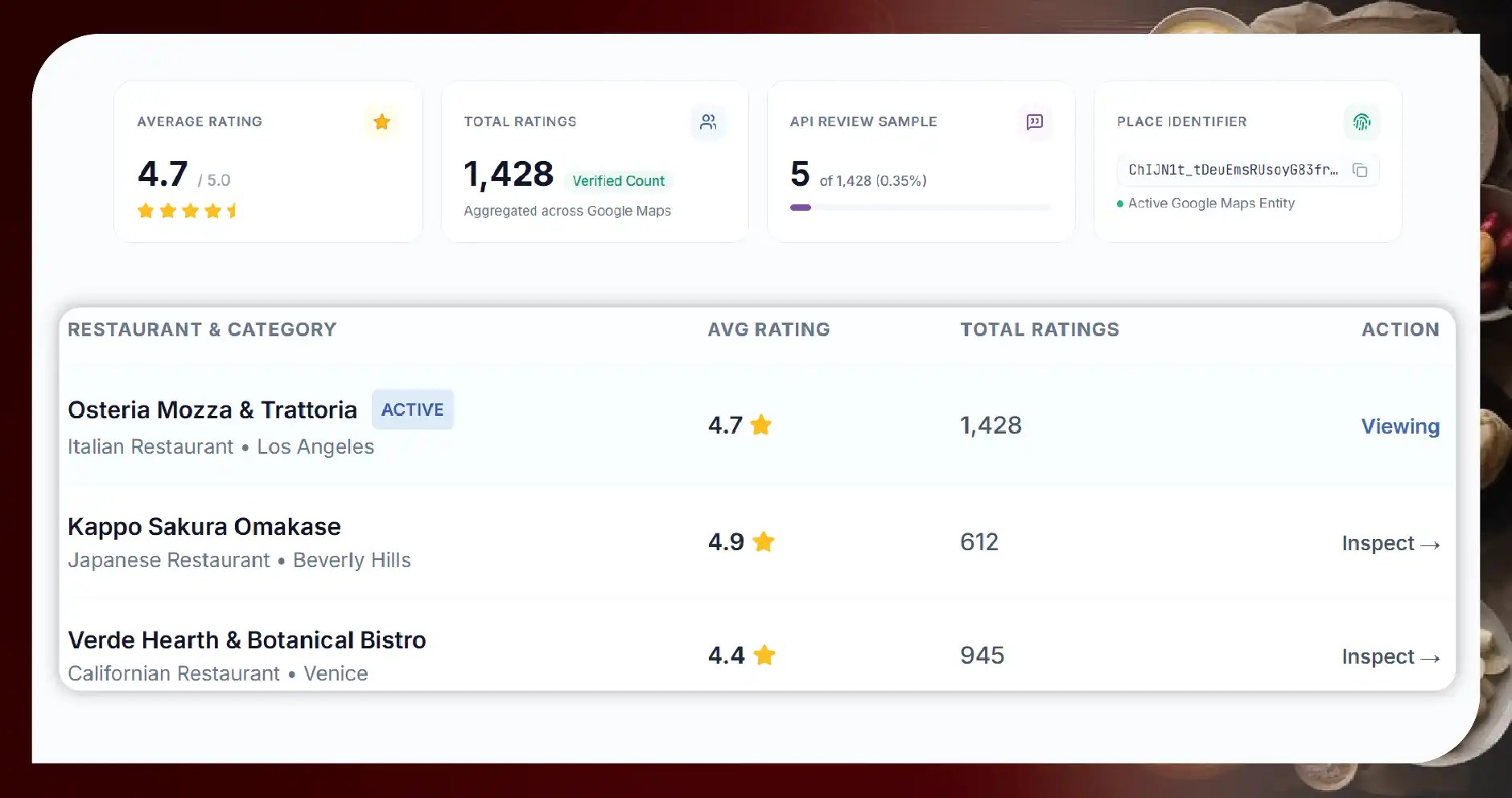
Google Maps provides restaurant information through its listings and Google Maps Platform services. Restaurant profiles can contain business names, locations, average ratings, review counts, operating hours, photographs, and customer-generated feedback.
Before developing a collection workflow, businesses should identify the information required for their research.
Important restaurant review parameters include:
- Restaurant name and Place ID
- Average customer rating
- Total number of ratings
- Available review text
- Review publication date
- Reviewer attribution
- Restaurant address and location
- Google Maps source link
- Available business categories
These parameters help researchers understand restaurant visibility, customer satisfaction, and differences between competing establishments.
However, Google Maps data access has important limitations. The Places API provides a limited selection of reviews, generally up to five reviews per place, rather than a complete historical review archive. Its terms also restrict extracting, scraping, exporting, or storing Google Maps content outside permitted services. Therefore, businesses must distinguish between using the API for compliant in-application experiences and building independent datasets from appropriately licensed sources.
2. Define the Restaurant Research Scope
The first step in developing a scalable restaurant intelligence project is defining the geographical and business coverage.
Collecting information without a clear research scope can generate inconsistent records and unnecessary processing costs. Businesses should establish their target locations, restaurant categories, and competitive groups before implementing their data workflows.
For example, a food delivery company researching restaurants in India might divide its coverage into Delhi, Mumbai, Bengaluru, Hyderabad, Pune, and Chennai.
Within each location, researchers can organize restaurants according to:
- Cuisine categories, including Indian, Chinese, Italian, and Mexican.
- Restaurant formats, including cafes, QSRs, fine dining, and cloud kitchens.
- Price segments, including budget, mid-range, and premium.
- Business types, including independent restaurants and national chains.
- Geographic segments, including neighbourhoods and commercial districts.
A well-defined scope makes restaurant comparisons more meaningful and helps businesses identify the market segments requiring further investigation.
3. Choose the Right Data Collection Method
Selecting an appropriate data access method is essential when designing a restaurant review intelligence system.
Google provides the Places API for accessing permitted place information. Developers can use Text Search and Nearby Search to discover establishments and Place Details to retrieve supported information about individual restaurants.
A typical workflow involves:
- Enabling the Places API through Google Cloud.
- Configuring billing and API credentials.
- Searching for restaurants using geographical or text-based queries.
- Identifying restaurants through their Place IDs.
- Requesting supported fields through Place Details.
- Displaying permitted information with the required attribution.
The API can provide restaurant ratings, rating counts, and a limited number of reviews, depending on the requested fields and service configuration.
For businesses requiring extensive historical review archives, comprehensive sentiment datasets, or bulk exports, an alternative is to use independently licensed review datasets, authorized data partnerships, or customer feedback collected directly through their own platforms.
This distinction is important because technical access does not automatically grant permission to reuse or redistribute platform content.
4. Identify the Most Important Review and Rating Fields
A standardized data structure helps organizations compare restaurant performance across locations and business categories.
The collection framework should distinguish between restaurant-level information and individual review-level information.
Restaurant-level parameters
| Data Parameter | Business Application |
|---|---|
| Restaurant Name | Business identification |
| Place ID | Place reference management |
| Average Rating | Customer satisfaction overview |
| Rating Count | Review volume assessment |
| Restaurant Category | Cuisine classification |
| Location | Geographic segmentation |
| Business Status | Listing status analysis |
Review-level parameters
| Data Parameter | Business Application |
|---|---|
| Review Text | Customer feedback analysis |
| Review Rating | Individual experience assessment |
| Publication Date | Feedback recency |
| Reviewer Attribution | Required source identification |
| Original Language | Language-based analysis |
| Source Link | Review reference access |
These fields provide a consistent structure for permitted review displays and analytical projects. Businesses should also maintain source references and collection timestamps for internal quality control without retaining restricted Google Maps content.
5. Build a Scalable Restaurant Data Processing Pipeline
Handling restaurant information across multiple cities requires a reliable processing architecture.
A scalable pipeline should separate restaurant discovery, permitted data retrieval, validation, classification, and reporting into independent stages.
- Step 1: Restaurant discovery — Identify relevant establishments using supported geographical searches, restaurant categories, and Place IDs.
- Step 2: Data retrieval — Request only the fields required for the intended application. Field masks help reduce unnecessary API requests and associated processing costs.
- Step 3: Data validation — Check whether restaurant identifiers, ratings, review counts, and available metadata follow the expected formats.
- Step 4: Record standardization — Normalize cuisine classifications, location names, rating formats, and timestamps wherever the data source permits.
- Step 5: Quality assessment — Identify missing fields, inconsistent classifications, duplicate business references, and outdated information.
- Step 6: Reporting — Present permitted restaurant information through dashboards, analytical summaries, and location-based reports.
Automation can improve consistency across these stages. However, automated processing does not override platform restrictions on storage, extraction, or reuse.
6. Implement Google Maps Review Data Monitoring
Restaurant ratings and customer feedback change over time. A restaurant that receives positive feedback today may experience declining customer satisfaction following changes in service quality, food preparation, or management.
Google Maps Review Data Monitoring can be implemented through compliant workflows that retrieve permitted information when required and analyze feedback collected through independently authorized sources.
Businesses can monitor several important indicators:
- Changes in average restaurant ratings.
- Growth in customer rating counts.
- Frequency of negative customer feedback.
- Recurring complaints about food quality.
- Customer satisfaction with delivery services.
- Feedback concerning restaurant cleanliness.
- Positive mentions of staff and service quality.
For continuous monitoring, organizations should establish scheduled data refresh processes based on the permissions and refresh conditions of each source.
A combination of authorized customer feedback, restaurant-owned review channels, and permitted platform information can provide a broader understanding of customer experiences.
7. Apply Restaurant Review Data Analytics
Collecting restaurant information is only the beginning. The real business value comes from identifying patterns and converting customer feedback into useful insights.
Restaurant Review Data Analytics enables businesses to evaluate customer experiences across different restaurants, cuisines, and geographical markets using appropriately sourced information.
Some important analytical applications include:
- Sentiment Analysis: Classify authorized customer feedback into positive, negative, and neutral categories to understand overall satisfaction.
- Rating Distribution: Evaluate the proportion of high, medium, and low ratings to compare restaurant performance.
- Complaint Identification: Identify frequently mentioned issues involving food quality, delivery delays, pricing, and customer service.
- Cuisine Analysis: Compare customer satisfaction across different cuisine categories and restaurant formats.
- Geographical Benchmarking: Examine differences in customer feedback across cities, neighbourhoods, and restaurant clusters.
- Trend Identification: Analyze changes in independently collected feedback over time to identify emerging customer expectations.
These analytical methods help restaurant operators identify improvement opportunities and enable market researchers to understand consumer expectations.
8. Combine Review Intelligence with Restaurant and Menu Information
Customer reviews become more valuable when interpreted alongside other authorized restaurant datasets.
For example, a restaurant might receive positive feedback for its food quality but negative comments about high prices or limited menu choices. Examining menu information alongside customer feedback can help explain these differences.
Restaurant Menu Data Scraping from permitted sources can support the analysis of:
- Menu categories and dish availability.
- Item-level pricing.
- Vegetarian and non-vegetarian options.
- Cuisine specialization.
- Promotional offers.
- Menu changes over time.
Businesses can compare these indicators with independently sourced customer feedback to understand how pricing, product variety, and service quality influence customer preferences.
Combining restaurant profiles, menu information, and customer feedback also creates opportunities for AI Restaurant Intelligence. Machine learning models can classify feedback, identify recurring themes, generate operational insights, and support restaurant recommendation systems using appropriately licensed datasets.
9. Overcome Common Restaurant Review Data Challenges
Developing restaurant intelligence at scale involves several practical challenges.
- Incomplete Information: Not every restaurant has the same volume of publicly accessible information. Use clearly defined missing-data indicators instead of assuming unavailable fields represent zero values.
- Duplicate Restaurants: Multiple listings may represent similar or identical establishments. Use authorized identifiers and carefully designed matching procedures to improve entity resolution.
- Multilingual Reviews: Restaurants in international markets may receive feedback in multiple languages. Language detection and translation workflows can help standardize independently sourced feedback.
- Changing Ratings: Ratings and review counts can change over time. Record permitted collection timestamps and distinguish current measurements from historical observations.
- Data Quality: Inconsistent categories, incomplete records, and inaccurate classifications can affect analytical results. Establish validation rules and quality checks.
- Compliance Requirements: Platform terms, attribution rules, privacy regulations, and licensing agreements must be considered before collecting, processing, or redistributing information.
Addressing these challenges helps organizations build more reliable restaurant intelligence systems.
10. How Food Data Scrape Can Help You?
- Restaurant Intelligence: Food Data Scrape organizes permitted restaurant information into structured datasets, helping businesses understand market coverage, restaurant categories, competitive positioning, and customer experience indicators across targeted geographical markets.
- Customer Feedback Analysis: Analyze appropriately licensed customer feedback to identify recurring complaints, satisfaction patterns, food preferences, and service expectations that help restaurant operators improve their customer experience.
- Competitor Benchmarking: Compare restaurant ratings, menu pricing, cuisine categories, and independently sourced feedback to understand competitor positioning and identify opportunities for business expansion.
- Automated Data Processing: Develop scalable workflows for authorized data collection, validation, classification, and reporting, reducing manual effort while maintaining consistent data quality across multiple restaurant research projects.
- Market Intelligence: Combine licensed restaurant, menu, and customer feedback datasets to identify emerging food trends, evaluate consumer preferences, and support strategic decisions for food businesses and delivery platforms.
Conclusion
Extracting restaurant reviews and ratings at scale requires more than automated data collection. Businesses need a structured approach that combines appropriate data access, reliable processing, standardized parameters, and meaningful analytics. Google Maps provides useful restaurant discovery and limited review information through its Places API, but its platform policies restrict bulk extraction and external storage of its content. Organizations should therefore select authorized collection methods and appropriately licensed datasets according to their business requirements.
Combining restaurant intelligence with Food Delivery Datasets can help businesses understand customer preferences, restaurant performance, menu availability, and competitive positioning across food delivery markets. Companies can also Scrape Food Delivery API information through authorized interfaces to develop structured insights into restaurant listings, menus, and delivery operations.
With the right data strategy, businesses can Scrape Restaurant Reviews And Rating Data from permitted sources, build comprehensive analytical frameworks, identify customer experience trends, and strengthen restaurant market intelligence. A compliance-focused data strategy ultimately transforms scattered information into actionable insights that support better decisions, improved services, and sustainable business growth.
If you are seeking for a reliable data scraping services, Food Data Scrape is at your service. We hold prominence in Food Data Aggregator and Mobile Restaurant App Scraping with impeccable data analysis for strategic decision-making.