Introduction
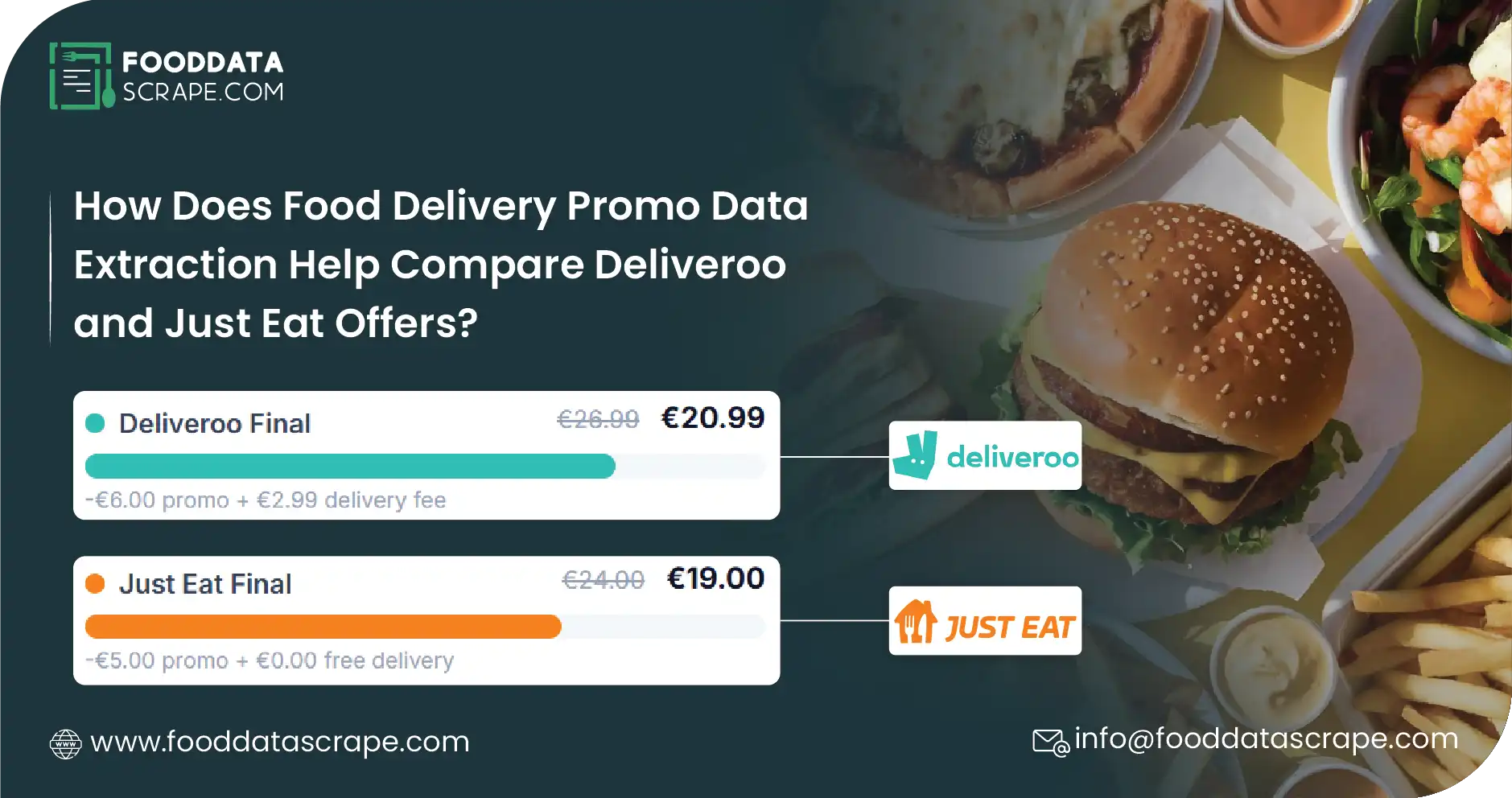
Food delivery platforms have transformed how customers discover restaurants, compare menu prices, and make purchasing decisions. Promotional offers such as free delivery, Buy One Get One (BOGO), percentage discounts, fixed-value savings, and meal bundles play an important role in influencing customer orders. However, these promotions are not always presented in a consistent format across platforms. Deliveroo and Just Eat, for example, may display similar promotional benefits using different labels, eligibility conditions, minimum order values, and discount structures.
Businesses interested in competitive pricing and promotional benchmarking increasingly rely on food delivery promo data extraction to collect structured information about restaurant offers, promotional campaigns, and customer incentives. A systematic approach to Scrape Deliveroo and Just Eat Promotion Data enables analysts to compare discounts across different restaurants, locations, cuisines, and ordering periods.
The challenge is that promotional information collected from multiple platforms often contains inconsistent descriptions. A free delivery offer may appear as a delivery-fee waiver, while a percentage discount might be displayed as a limited-time restaurant deal. Food Delivery Promotion Data Tracking helps businesses identify these differences and convert promotional information into comparable data.
Normalising promotional types across Deliveroo and Just Eat allows restaurant chains, food aggregators, market researchers, and delivery businesses to understand which incentives attract customers, how competitors position their offers, and where promotional opportunities exist. By creating a standard classification framework, businesses can transform fragmented promotional listings into actionable market intelligence.
1. Understanding Different Food Delivery Promotion Types
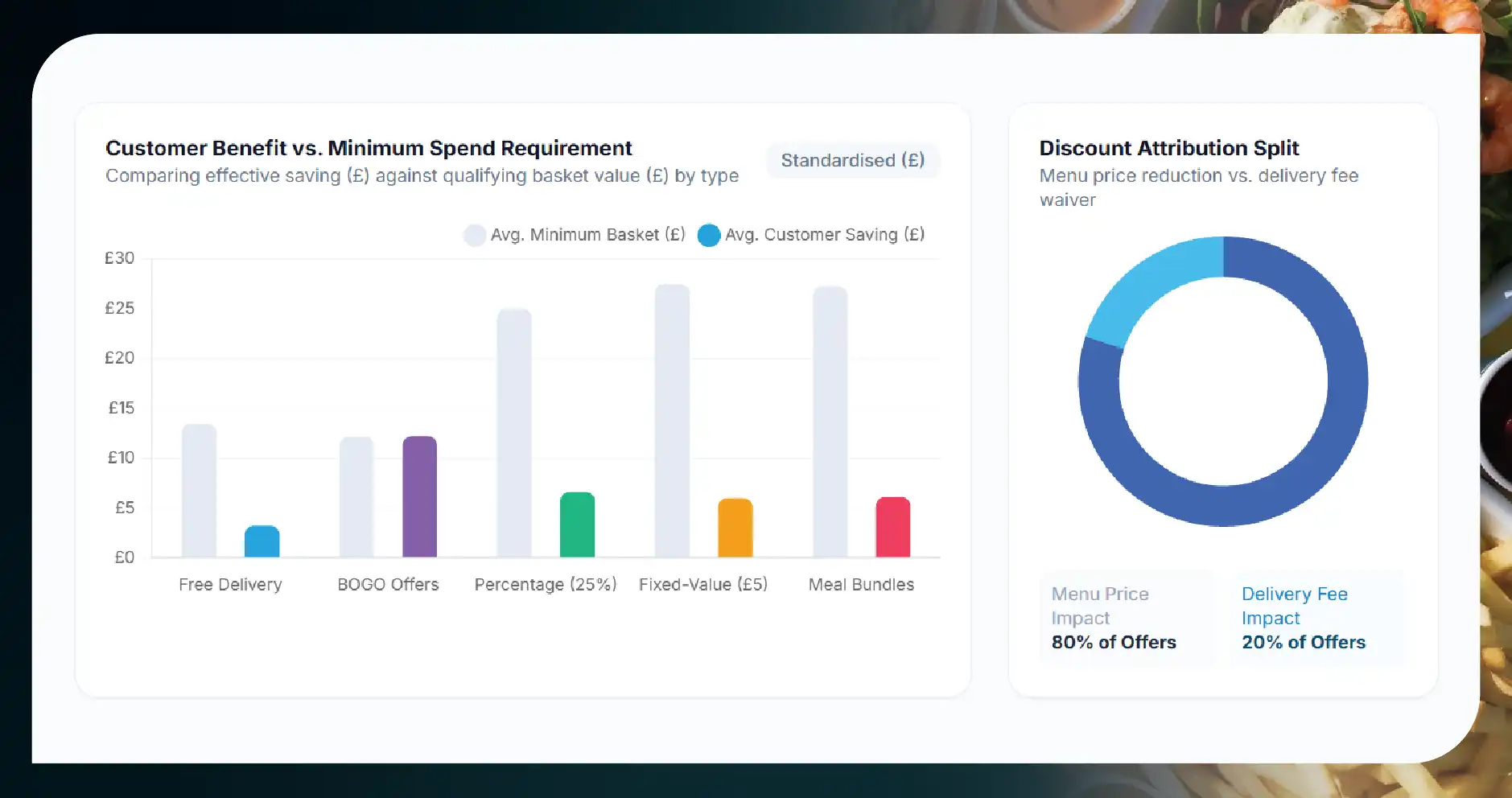
Before comparing promotions across platforms, businesses must understand the major promotional categories. Each category offers a different customer benefit and influences purchasing decisions in a specific way.
Free Delivery Offers
Free delivery promotions remove the delivery charge from eligible orders. Restaurants or platforms may offer these discounts to attract new customers, increase order frequency, or encourage purchases during specific promotional periods.
These offers should be recorded separately from food discounts because they reduce delivery costs rather than menu prices. Important fields include delivery fee before promotion, discounted delivery fee, eligibility conditions, minimum basket value, and offer validity.
Buy One Get One (BOGO) Offers
BOGO promotions provide an additional item when customers purchase a qualifying product. Common examples include buying one pizza and receiving another free or purchasing two selected meals for the price of one.
These promotions require detailed classification because some offers apply to identical products, while others cover selected menu combinations. Businesses should capture qualifying products, free-item descriptions, quantity restrictions, and applicable restaurant categories.
Percentage-Based Discounts
Percentage discounts reduce the eligible order value by a specified percentage. Examples include 10%, 20%, 30%, or 50% off selected restaurant orders.
The actual savings may depend on maximum discount limits, minimum basket requirements, customer eligibility, and participating menu items. Recording these conditions is essential for accurate comparisons.
Fixed-Value Discounts
Some restaurants provide fixed monetary savings, such as £5 off an order worth £25 or more. These promotions are different from percentage discounts because the saving remains fixed once eligibility conditions are met.
Meal Bundles and Combo Offers
Meal bundles combine multiple menu items at a promotional price. These can include burgers, fries, drinks, family meals, or restaurant-specific combinations.
A standardised system should distinguish bundle pricing from BOGO and percentage discounts to prevent misleading promotional comparisons.
2. Comparing Promotional Structures Across Deliveroo and Just Eat
Deliveroo and Just Eat provide restaurant discovery and ordering experiences through which customers encounter different promotional formats. However, their offer presentation, eligibility conditions, and restaurant-level campaign structures can vary.
A cross-platform comparison should focus on the underlying promotional benefits rather than relying exclusively on the promotional labels displayed to customers.
| Promotional Category | Deliveroo Offer Example | Just Eat Offer Example | Standardised Category |
|---|---|---|---|
| Free Delivery | £0 delivery fee | Free delivery | Delivery Discount |
| BOGO | Buy one, get one free | 2-for-1 offer | BOGO |
| Percentage Off | 20% off selected orders | 20% discount | Percentage Discount |
| Fixed Discount | £5 off £25 | £5 savings | Fixed-Value Discount |
| Meal Bundle | Promotional meal deal | Discounted combo | Bundle Discount |
| New Customer Offer | First-order discount | Welcome offer | Acquisition Promotion |
These are illustrative examples rather than verified live platform offers.
A standardised promotional taxonomy makes it easier to compare offers even when platforms use different wording. It also helps businesses distinguish restaurant-funded discounts from platform-funded incentives whenever the funding information is available.
3. Building a Standardised Promotional Data Schema
A reliable promotional comparison system requires a structured database. Simply collecting promotional descriptions is insufficient because analysts need consistent fields to evaluate offer value, eligibility, and availability.
Restaurant Identification
Restaurant-level information establishes which business is offering a promotion. Important fields include restaurant name, restaurant ID, cuisine category, location, platform, and restaurant listing URL.
Matching restaurant identities across Deliveroo and Just Eat helps identify businesses operating on both platforms. This supports direct promotional benchmarking.
Promotion Identification
Each offer should have a unique promotional record containing its title, description, promotion ID where available, and standardised category.
For example, Deliveroo's promotional label might say "Buy One Get One Free," while Just Eat displays "2-for-1." Both can be assigned the same BOGO classification.
Discount Information
Discount-related fields should include:
- Original order value.
- Discount percentage.
- Fixed discount amount.
- Delivery fee before and after the promotion.
- Minimum order requirement.
- Maximum discount limit.
- Eligible products or categories.
- Final payable amount, where available.
Validity and Eligibility
Promotions are often temporary and subject to specific conditions. Therefore, the database should capture campaign start date, expiry date, customer eligibility, redemption restrictions, and applicable ordering conditions.
Location and Availability
Restaurant promotions can differ by delivery zone. Capturing city, postcode, service area, and delivery availability helps businesses identify geographic variations.
4. How to Normalise Promotional Data Across Both Platforms?
Normalisation transforms inconsistent promotional information into a standardised structure that supports meaningful analysis.
Step 1: Collect Original Promotional Descriptions
Gather restaurant-level promotional information from Deliveroo and Just Eat, retaining the original offer titles and descriptions. Keeping source information makes subsequent verification easier.
Step 2: Identify Promotion Keywords
Create a keyword dictionary containing common promotional expressions.
| Keywords or Expressions | Standardised Promotion |
|---|---|
| Free delivery, £0 delivery, delivery waived | Free Delivery |
| BOGO, 2-for-1, buy one get one | BOGO |
| 10% off, 20% discount, percentage savings | Percentage Discount |
| £5 off, save £10, fixed savings | Fixed Discount |
| Meal deal, combo, family bundle | Bundle Offer |
Step 3: Apply Classification Rules
Use predefined classification rules to assign every promotion to a standard category. Automated text processing can identify common expressions, while more complex descriptions can be reviewed using additional eligibility information.
Step 4: Standardise Currency and Values
Convert monetary values into a consistent currency and numerical format. For example, percentage discounts should be stored as numerical percentages rather than mixed text descriptions.
Step 5: Remove Duplicate Promotions
The same restaurant may display an identical offer across multiple pages or promotional sections. Duplicate detection using restaurant IDs, offer descriptions, product identifiers, and validity periods helps maintain database accuracy.
Step 6: Validate Promotion Conditions
Check whether minimum order requirements, maximum savings, customer restrictions, and delivery conditions have been captured correctly.
This process makes Multi-Platform Promo Data Normalisation more reliable and reduces inconsistencies in promotional comparisons.
5. Important Fields for BOGO and Discount Analysis
BOGO promotions require additional attention because their actual economic value depends on product prices and purchasing conditions.
For example, a restaurant offering a £12 pizza with a free second pizza provides a different customer benefit from a restaurant offering two £8 pizzas under the same promotional label.
A useful BOGO dataset should capture:
- Restaurant and platform identifiers.
- Original qualifying product.
- Free or discounted product.
- Original product prices.
- Number of eligible items.
- Promotion conditions.
- Minimum purchase requirements.
- Campaign validity.
- Geographic availability.
- Final promotional price.
BOGO Offer Data Scraping allows businesses to examine how restaurants structure multi-item discounts and compare the actual savings available to customers.
For percentage-based promotions, analysts should also calculate the effective discount after considering maximum savings and minimum order requirements.
For example, a 30% discount capped at £5 does not provide a £9 saving on a £30 order. The actual benefit is limited to £5.
This distinction prevents misleading comparisons between promotions with different restrictions.
6. Geographic Filtering and Restaurant-Level Promotion Analysis
Promotional campaigns frequently vary between cities, neighbourhoods, and delivery zones. A restaurant may offer free delivery in one location while providing a percentage discount in another.
Geographic filters help businesses understand these differences.
City-Level Filtering
Compare promotional categories across major cities to identify where restaurants use aggressive discounting strategies.
Postcode-Level Filtering
Postcode-level analysis helps identify local promotional availability and differences between nearby delivery areas.
Restaurant-Level Filtering
Track individual restaurant promotions across platforms to identify changes in discount structures, offer frequency, and campaign duration.
Cuisine-Level Filtering
Compare promotional activity across pizza, burgers, Indian food, Chinese cuisine, desserts, and other categories.
Delivery-Zone Filtering
Examine whether promotions are available across an entire restaurant delivery area or restricted to selected locations.
Through Deliveroo And Just Eat Deals Monitoring, businesses can understand how geographic availability influences promotional competition and customer acquisition.
7. Tracking Promotional Changes and Refresh Frequency
Promotional information changes frequently. Restaurants introduce new offers, modify discount percentages, withdraw campaigns, and update eligibility conditions.
A reliable monitoring system should capture these changes rather than treating promotional data as static information.
- Real-Time Monitoring: Frequent checks can identify important changes in active offers, where supported by platform access and collection infrastructure.
- Daily Refresh: Daily collection helps businesses maintain updated promotional records and identify new restaurant campaigns.
- Historical Tracking: Maintaining previous promotional snapshots makes it possible to examine discount patterns, campaign duration, and seasonal promotional activity.
- Change Detection: Comparing new records with historical data helps identify changes in offer value, delivery fees, expiry dates, and eligibility conditions.
The refresh frequency should depend on business requirements, platform update behaviour, and the importance of promotional accuracy.
8. Turning Promotional Records into Business Intelligence
Once promotional information has been collected and normalised, businesses can use it for competitive benchmarking, pricing analysis, restaurant partnerships, and campaign planning.
Restaurant Promotion Intelligence helps food businesses understand which promotional formats competitors use and how frequently they introduce discounts.
Food Delivery Promo Data Analytics can reveal patterns across different restaurants, locations, cuisines, and promotional categories.
For example, analysts can calculate:
- Percentage of restaurants offering free delivery.
- Average discount percentage by cuisine.
- Number of active BOGO campaigns.
- Average promotional savings.
- Distribution of promotional types by city.
- Frequency of campaign changes.
- Percentage of restaurants running multiple promotions.
These indicators can help restaurant groups evaluate their promotional positioning and identify opportunities to improve customer acquisition.
A Deliveroo Food Delivery Scraping API can also support structured integration of collected information into internal databases, reporting platforms, and business intelligence dashboards, subject to available access methods and applicable platform requirements.
Similarly, a structured JustEat Food Dataset can help analysts compare restaurant coverage, promotional availability, pricing, and campaign activity across different markets.
9. Challenges in Multi-Platform Promotion Collection
Despite the benefits, collecting and standardising food delivery promotions involves several challenges.
- Inconsistent Offer Descriptions: Different promotional labels may communicate the same benefit, requiring reliable classification rules.
- Changing Campaign Conditions: Restaurants may modify eligibility requirements without changing the main promotional headline.
- Location-Based Variations: Offers can differ between delivery zones, making location matching important.
- Duplicate Listings: Restaurants operating across multiple branches may create repeated promotional records.
- Incomplete Pricing Information: Some promotional listings do not expose every condition or final payable amount.
- Platform Access Restrictions: Collection methods must respect applicable terms, privacy requirements, technical controls, and permitted access mechanisms.
Addressing these challenges requires consistent data validation, historical storage, structured classification, and transparent documentation of missing information.
10. How Food Data Scrape Can Help You?
- Multi-Platform Collection: Food Data Scrape collects permitted promotional information across Deliveroo and Just Eat, helping businesses consolidate restaurant offers into a structured dataset for cross-platform comparisons.
- Promotion Classification: Standardised classification separates free delivery, BOGO, percentage discounts, fixed savings, and bundles, making promotional benchmarking more consistent across different restaurant listings.
- Geographic Intelligence: Location-based filtering organises promotional records by city, postcode, and delivery zone, helping businesses identify regional differences and restaurant-level campaign opportunities.
- Historical Promotion Tracking: Historical snapshots capture changes in promotional values, eligibility requirements, and campaign availability, supporting trend analysis and more informed competitive assessments.
- Customised Data Delivery: Structured datasets can be delivered in suitable formats for dashboards, reporting systems, and internal analytics workflows, supporting efficient promotional research and decision-making.
Conclusion
Normalising free delivery, BOGO, percentage discounts, fixed-value savings, and meal bundles across Deliveroo and Just Eat creates a consistent foundation for restaurant promotional intelligence. Instead of comparing promotional headlines alone, businesses can evaluate actual savings, eligibility conditions, delivery charges, geographic availability, and campaign duration.
A structured approach to Mobile App Scraping for Food can help businesses collect relevant restaurant and promotional information from permitted mobile application sources. Combining these records with web-based information creates broader visibility into food delivery competition.
Well-organised Food Delivery Datasets also support restaurant benchmarking, pricing research, promotional strategy development, and historical campaign analysis.
By integrating standardised classifications, geographic filters, and scheduled refreshes, businesses can build a more reliable promotional intelligence system. They can also Scrape Food Delivery API Data through permitted interfaces to support automated data integration and reporting.
Ultimately, the value of promotional intelligence lies not simply in collecting more offers but in making different offers comparable. With consistent data structures and accurate classification, businesses can understand how free delivery, BOGO, and percentage discounts influence restaurant competition and customer purchasing decisions.
If you are seeking for a reliable data scraping services, Food Data Scrape is at your service. We hold prominence in Food Data Aggregator and Mobile Restaurant App Scraping with impeccable data analysis for strategic decision-making.