Introduction
The HoReCa (Hotels, Restaurants and Cafés) sector offers significant business opportunities for food manufacturers, distributors, wholesalers and ingredient suppliers. However, identifying the right restaurant or hotel accounts requires more than compiling a list of available outlets. Food suppliers need to understand outlet purchasing potential, cuisine preferences, customer positioning, menu diversity and pricing strategies before approaching prospective buyers. This is where HoReCa outlet data scraping becomes valuable for building structured and actionable prospecting databases.
HoReCa Outlet Data Scraping For Food Supplier Prospecting enables suppliers to evaluate restaurants, cafés, hotels, bakeries and other foodservice businesses using publicly available marketplace information. By collecting price-for-two estimates, cuisine categories, customer ratings, locations and menu details, suppliers can classify outlets according to their commercial potential. Businesses can Scrape HoReCa Outlet Grading Data to distinguish premium dining establishments from casual restaurants, budget-friendly cafés and high-volume foodservice outlets.
A structured grading framework helps suppliers prioritize sales territories, identify relevant prospects and align their products with individual outlet requirements. For example, premium restaurants may require specialty ingredients, imported products and high-quality dairy, while quick-service restaurants may prioritize bulk supplies, standardized ingredients and cost efficiency. Combining multiple restaurant attributes creates a practical foundation for data-driven food supplier prospecting.
1. Understanding HoReCa Outlet Grading for Food Suppliers
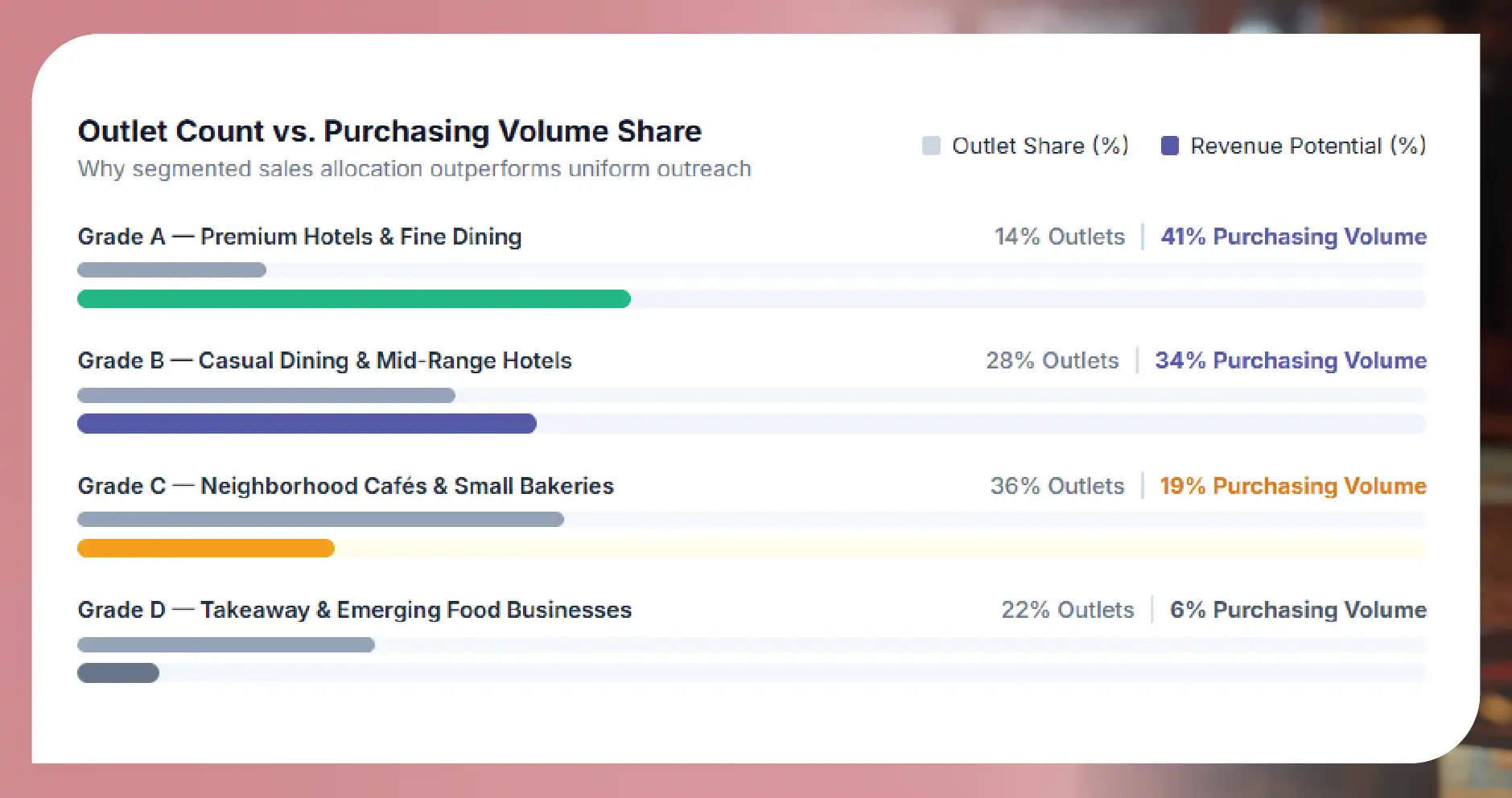
HoReCa outlet grading is a systematic process of categorizing foodservice establishments according to their business characteristics, customer positioning, operational scale and potential purchasing requirements.
Instead of approaching every restaurant with the same sales strategy, suppliers can assign grades based on measurable indicators. These grades help sales teams identify outlets that match their product categories, distribution capabilities and commercial objectives.
A typical grading framework can include:
- Grade A: Premium hotels, upscale restaurants, fine-dining establishments and high-rated specialty cafés.
- Grade B: Established casual-dining restaurants, popular cafés, mid-range hotels and multi-cuisine outlets.
- Grade C: Budget restaurants, neighborhood cafés, small bakeries and independent foodservice businesses.
- Grade D: Small takeaway outlets, emerging food businesses and low-price foodservice establishments.
These categories are illustrative rather than universal. Suppliers can customize grading criteria according to product margins, purchasing volumes, geographic coverage and customer acquisition priorities.
2. Using Price-for-Two as a Restaurant Segmentation Indicator
Price-for-two is an important restaurant attribute for understanding customer positioning and the approximate spending level associated with an establishment.
Restaurants listed on platforms such as Zomato and other food discovery marketplaces frequently display estimated dining costs for two people. Suppliers can use this information to classify restaurants into pricing segments and identify outlets serving different customer demographics.
For example, an indicative classification could include:
| Price-for-Two Range | Restaurant Segment | Potential Supplier Opportunity |
|---|---|---|
| Below ₹500 | Budget dining | Affordable staples and bulk ingredients |
| ₹500–₹1,000 | Value dining | Regular food ingredients and packaged products |
| ₹1,000–₹2,000 | Mid-range dining | Premium dairy, sauces and specialty ingredients |
| ₹2,000–₹4,000 | Premium dining | Specialty ingredients and imported products |
| Above ₹4,000 | Luxury dining | High-end ingredients and customized sourcing |
These price bands should be adjusted for individual cities and market conditions.
Restaurant Price-for-Two Data Extraction helps suppliers compare restaurants across different neighborhoods and identify establishments whose customer positioning matches their product portfolios.
However, price-for-two should not be treated as a direct indicator of restaurant revenue or procurement expenditure. It represents estimated customer spending, not actual purchasing volume. Suppliers should combine it with other attributes to improve grading accuracy.
3. Classifying Restaurants Through Cuisine Categories
Cuisine classification provides another important dimension for evaluating potential foodservice customers. Different cuisines require different ingredients, preparation methods, storage requirements and procurement arrangements.
For instance, Italian restaurants may purchase mozzarella, parmesan, pasta, olive oil and specialty sauces. Indian restaurants may require spices, pulses, cooking oils, dairy products, flour and fresh produce. Bakeries and patisseries often need chocolate, cream, butter, flour, fillings and decorative ingredients.
By analyzing cuisine categories, suppliers can match their products with the operational requirements of individual outlets.
| Cuisine Category | Relevant Food Supplier Products |
|---|---|
| Indian | Spices, pulses, rice, flour and cooking oils |
| Italian | Cheese, pasta, olive oil and sauces |
| Chinese | Noodles, sauces, seasonings and cooking oils |
| Continental | Dairy, frozen foods, meat and specialty ingredients |
| Bakery and Desserts | Chocolate, cream, butter and baking ingredients |
| Japanese | Seafood, rice, sauces and specialty seasonings |
| Mexican | Tortillas, beans, cheese and spice blends |
Cuisine-wise Menu Data allows suppliers to identify restaurants with specific ingredient requirements and develop more relevant sales proposals.
Cuisine information also helps distributors discover underserved categories within particular cities, neighborhoods and restaurant clusters.
4. Evaluating Restaurant Ratings and Customer Reviews
Restaurant ratings offer useful insights into customer satisfaction, establishment popularity and perceived service quality. Food suppliers can incorporate these indicators into outlet grading to prioritize established businesses and identify promising prospects.
Ratings can help distinguish between restaurants with strong customer engagement and establishments with relatively limited visibility. However, ratings should be considered alongside review counts, cuisine, price positioning and location.
For example, a restaurant with a 4.5-star rating and 2,000 reviews may represent a more established prospect than an outlet with a similar rating but only 20 reviews.
Suppliers can evaluate:
- Average customer rating.
- Total number of customer reviews.
- Rating distribution.
- Recent rating changes.
- Customer feedback about food quality.
- Reviews mentioning ingredient freshness, consistency and portion sizes.
HoReCa Market Intelligence becomes more actionable when customer feedback is combined with commercial and operational information.
Suppliers can also identify restaurants receiving recurring complaints about food consistency, menu availability or product quality. Such insights may reveal opportunities for better ingredients, improved sourcing arrangements and specialized product offerings.
Nevertheless, ratings measure customer perception rather than actual procurement capacity. They should support, not independently determine, outlet grades.
5. Combining Price, Cuisine and Ratings into a Grading Model
The real value of HoReCa outlet grading emerges when multiple attributes are evaluated together.
A restaurant with premium pricing, a specialized cuisine category and strong customer ratings may represent an attractive prospect for specialty ingredient suppliers. Meanwhile, a high-volume casual restaurant with moderate pricing may be more suitable for bulk commodity distributors.
Suppliers can develop a weighted scoring model to assign grades consistently.
An illustrative grading framework is:
| Evaluation Parameter | Weight |
|---|---|
| Price-for-two positioning | 30% |
| Customer ratings | 25% |
| Review volume | 15% |
| Cuisine compatibility | 20% |
| Location and market coverage | 10% |
| Total | 100% |
Each restaurant receives a score based on normalized attribute values and supplier-defined criteria.
For example, a premium dairy distributor may assign greater importance to cuisine compatibility and price positioning. A bulk flour supplier may prioritize outlet scale, cuisine requirements and geographic accessibility.
This flexibility makes Restaurant Pricing and Ratings Data Scraping particularly useful for creating different prospecting models for different food product categories.
6. Building City-Wise Restaurant Prospecting Databases
Geographic segmentation helps suppliers identify potential customers within specific distribution territories. A restaurant database organized by city, locality and postal code can support sales planning and distributor allocation.
For instance, suppliers operating in Mumbai may prioritize premium restaurants in Bandra, Lower Parel and Juhu, while distributors targeting Bengaluru may evaluate restaurant clusters in Indiranagar, Koramangala and Whitefield.
Extract Food Supplier Target Outlet Data using structured restaurant attributes such as:
- Restaurant name and outlet identifier.
- City, neighborhood and complete available address.
- Cuisine and restaurant category.
- Price-for-two estimate.
- Customer rating and review count.
- Menu categories and available dishes.
- Delivery and dining availability.
- Website and publicly listed contact information, where available.
Scrape City-Wise Restaurant Outlet Data to create searchable prospecting databases that help sales teams identify relevant establishments within their assigned territories.
City-wise datasets also help businesses compare outlet concentration, cuisine distribution and pricing differences across multiple markets.
7. Identifying Premium and Emerging Foodservice Opportunities
Outlet grading is not limited to established restaurants. It can also help suppliers identify emerging foodservice businesses with growth potential.
New restaurants, specialty cafés, cloud kitchens, bakeries and independent dining establishments may require reliable suppliers as their operations expand.
By tracking changes in restaurant listings, ratings, menus and pricing, suppliers can identify businesses entering new market segments.
For example, a café introducing premium desserts may become a prospective customer for chocolate, dairy, cream and bakery ingredient distributors. Similarly, a restaurant expanding its vegetarian menu may require additional pulses, fresh produce and specialty packaged ingredients.
HoReCa Trends in Europe also demonstrate why suppliers should consider changing dining preferences, premiumization, specialty cuisines and evolving foodservice formats when developing international prospecting strategies.
A combination of outlet grading and market monitoring helps suppliers identify emerging demand rather than relying exclusively on existing customer relationships.
8. Why Menu Data Adds Another Layer to Outlet Grading?
Restaurant menus provide deeper insights into ingredient requirements than cuisine labels alone.
Two restaurants categorized under the same cuisine may have significantly different procurement needs. One Italian restaurant may specialize in pizza and pasta, while another may focus on premium seafood and contemporary European dishes.
Analyzing menu items helps suppliers understand these differences and identify more precise product opportunities.
Restaurant Menu Data Scraping can capture:
- Dish names and descriptions.
- Menu categories and subcategories.
- Listed prices.
- Vegetarian and non-vegetarian classifications.
- Specialty ingredients mentioned in descriptions.
- Premium and signature dishes.
- Seasonal and promotional offerings.
- Menu availability across different outlets.
For example, a restaurant featuring multiple cheese-based dishes may be a suitable prospect for cheese distributors. A bakery offering artisan breads, croissants and premium pastries may require specialized flour, butter, chocolate and other baking ingredients.
Menu analysis can therefore strengthen outlet grading by connecting restaurant positioning with actual product requirements.
9. Implementing a Data-Driven HoReCa Prospecting Workflow
Food suppliers need a consistent workflow to convert restaurant information into actionable sales intelligence.
A practical implementation process includes:
- Source Identification: Identify relevant food discovery platforms, restaurant directories and publicly accessible menu sources.
- Data Collection: Collect restaurant names, locations, cuisines, price-for-two estimates, ratings and review counts.
- Menu Extraction: Capture available menu items, categories, descriptions and listed prices.
- Data Cleaning: Standardize restaurant names, locations, currencies and cuisine classifications.
- Outlet Matching: Identify duplicate listings and connect branches belonging to the same restaurant brand.
- Grading: Apply weighted scoring models to categorize outlets according to supplier requirements.
- Lead Prioritization: Create prospect lists based on product compatibility, geographic coverage and commercial potential.
- Continuous Monitoring: Refresh datasets to identify changes in prices, ratings, menus and outlet availability.
The resulting database can be integrated into CRM systems, sales dashboards and distributor management platforms.
It is important to validate estimates against actual business information before making procurement or revenue assumptions. Data collection should also comply with applicable platform terms, privacy requirements and data protection regulations.
How Food Data Scrape Can Help You?
1. Restaurant Prospect Identification
Food Data Scrape collects restaurant names, locations, cuisines, pricing and ratings to help suppliers identify relevant HoReCa establishments and prioritize potential buyers across targeted markets.
2. Price-Based Outlet Classification
Analyze restaurant price-for-two estimates and categorize outlets into budget, mid-range and premium segments, enabling suppliers to align product portfolios with different restaurant positioning strategies.
3. Cuisine and Menu Intelligence
Extract cuisine categories, menu items and listed prices to identify ingredient requirements, discover specialty food opportunities and develop customized supplier prospecting strategies.
4. Rating-Based Market Evaluation
Monitor customer ratings, review volumes and restaurant performance indicators to evaluate outlet positioning, identify established prospects and strengthen data-driven sales prioritization across cities.
5. City-Wise Prospecting Databases
Build structured restaurant databases across multiple cities and neighborhoods, helping distributors identify target outlets, optimize sales territories and improve foodservice market coverage.
Conclusion
HoReCa outlet grading provides food suppliers with a structured approach to identifying, evaluating and prioritizing restaurant customers. Combining price-for-two estimates, cuisine categories, customer ratings, review volumes and menu information creates a more comprehensive understanding of outlet positioning and potential ingredient requirements.
With Real-Time Price Monitoring, suppliers can track changing restaurant prices, compare market positioning and identify evolving foodservice opportunities. Integrating Food Delivery Datasets further expands market visibility by providing information about restaurant listings, menus, availability and delivery-oriented foodservice businesses.
Businesses can also Scrape Restaurant Rating Data to monitor customer perceptions, evaluate outlet performance and strengthen prospect prioritization. When these datasets are combined into a centralized grading framework, food manufacturers, wholesalers and distributors can improve lead identification, develop targeted sales strategies and allocate resources more effectively.
Ultimately, data-driven HoReCa prospecting enables suppliers to move beyond generic restaurant lists and build focused customer databases aligned with their products, distribution capabilities and business growth objectives.
If you are seeking for a reliable data scraping services, Food Data Scrape is at your service. We hold prominence in Food Data Aggregator and Mobile Restaurant App Scraping with impeccable data analysis for strategic decision-making.
Get a Free Food Data Sample in 48 Hours.
Tell us your platforms, target markets and required fields — we'll map exactly what's possible with food data scraping, recommend the right approach, and send a working sample so you can verify quality before any commitment.