Introduction
The luxury food market is evolving as affluent consumers increasingly seek premium chocolates, imported cheeses, artisanal bakery products, organic ingredients, specialty beverages, gourmet meats, and exclusive ready-to-eat meals. From high-end supermarket chains to premium food delivery platforms, luxury food products are available across multiple digital channels, creating new opportunities and competitive challenges for retailers, distributors, manufacturers, and market researchers. Understanding how premium products are priced across these channels is essential for developing effective pricing strategies and identifying market opportunities.
Luxury food price data scraping provides businesses with a systematic approach to collecting product prices, promotional offers, availability, brand information, package sizes, and other essential details from digital retail platforms. Instead of manually checking multiple websites and applications, businesses can automate the collection of structured pricing information and evaluate market movements more efficiently.
Through Scrape Luxury Food Pricing Data solutions, companies can examine how premium products are positioned across gourmet retailers, specialty food stores, online supermarkets, and delivery applications. This information helps identify pricing differences, monitor premium product categories, and understand consumer-facing price variations across locations.
Premium Food Brand Price Scraping also enables businesses to compare products from established international brands and emerging luxury food manufacturers. By continuously collecting relevant information, companies can develop a comprehensive understanding of premium food pricing patterns and make informed decisions about product positioning, distribution, and competitive strategies.
1. Understanding the Premium Food Pricing Landscape
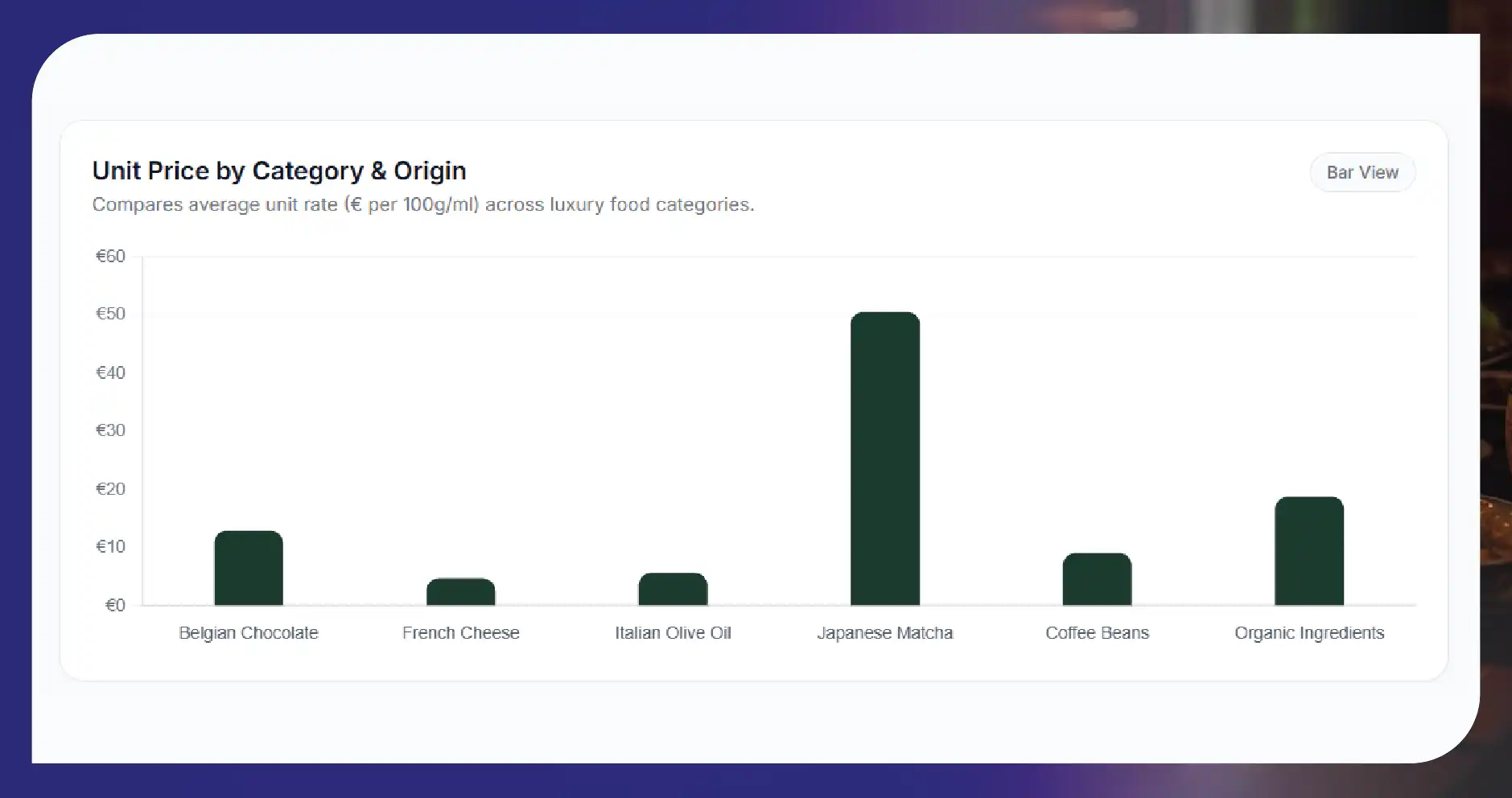
Luxury food products operate differently from conventional grocery products. Their prices are influenced by brand reputation, ingredient quality, country of origin, production methods, exclusivity, packaging, and distribution channels.
For example, imported Belgian chocolates, French cheeses, Italian olive oils, Japanese matcha, premium coffee beans, and organic specialty ingredients often command higher prices than standard alternatives. Even within the same product category, pricing can vary considerably depending on the retailer and brand positioning.
Premium food businesses must therefore monitor multiple pricing dimensions rather than simply comparing product prices.
Important pricing factors include:
- Brand positioning: Established luxury brands may maintain higher prices because of their reputation, heritage, and perceived quality.
- Product origin: Imported and region-specific products can carry additional transportation, customs, and distribution costs.
- Packaging size: Different package weights and quantities influence the actual unit price.
- Retailer positioning: Gourmet supermarkets and specialty retailers may apply different markups.
- Promotional strategies: Seasonal discounts, membership benefits, and exclusive offers influence displayed prices.
- Product availability: Limited availability and exclusive collections can affect premium product pricing.
Collecting these details creates a stronger foundation for comparing products across digital sales channels.
2. Identifying Gourmet Retailers and Delivery Apps for Price Collection
The first step in developing an effective pricing intelligence system is identifying the appropriate data sources. Luxury food products are distributed through different retail formats, and each platform provides a different perspective on market pricing.
Businesses can collect information from gourmet supermarkets, premium online grocery stores, specialty food retailers, brand-owned shopping websites, and food delivery applications.
Potential sources include:
- Premium supermarket websites featuring imported and specialty grocery products.
- Gourmet food stores selling artisanal cheeses, chocolates, and bakery products.
- Online retailers offering organic and internationally sourced ingredients.
- Specialty coffee and tea marketplaces.
- Premium food delivery applications listing restaurant meals and gourmet grocery products.
- Brand-owned websites displaying exclusive collections and recommended retail prices.
Gourmet Retailer Product Data Extraction helps businesses capture product-level information from these different sources and consolidate it into a standardized database.
A reliable collection process should record the retailer name, product title, brand, category, listed price, discounted price, package size, product description, availability, location, and product URL.
This allows businesses to identify identical products across retailers and compare their prices without confusing different package sizes or product variants.
3. Collecting Essential Product and Pricing Information
A successful premium food pricing project requires more than collecting displayed prices. Businesses must capture sufficient product information to understand what is being compared.
For instance, a 250-gram imported chocolate box cannot be accurately compared with a 500-gram package using the displayed price alone. Similarly, organic extra virgin olive oil and conventional olive oil should not be treated as identical products.
A structured dataset should include the following fields:
| Data Field | Information Collected | Business Application |
|---|---|---|
| Product Name | Complete product title | Product identification |
| Brand Name | Manufacturer or brand | Brand comparison |
| Product Category | Chocolate, cheese, coffee, etc. | Category analysis |
| Product Variant | Flavour, ingredients, or type | Variant comparison |
| Package Size | Grams, litres, or units | Unit price calculation |
| Regular Price | Original listed price | Base price analysis |
| Discounted Price | Current promotional price | Discount monitoring |
| Retailer Name | Selling platform | Retailer comparison |
| Availability | In stock or unavailable | Stock analysis |
| Delivery Fee | Applicable delivery charges | Final cost comparison |
| Product URL | Original listing link | Source verification |
| Collection Timestamp | Date and time | Historical tracking |
Luxury Food Product Price Monitoring becomes more meaningful when these attributes are collected together. Businesses can calculate prices per kilogram, litre, or individual unit, making comparisons more accurate across different product formats.
4. Tracking Prices Across Multiple Retailers and Platforms
Premium food brands frequently sell through several retail channels. Their products may be available at specialty supermarkets, online grocery stores, department store food halls, and independent gourmet retailers.
However, the same product may carry different prices depending on the platform, delivery location, and promotional arrangement.
For example, a premium coffee brand could sell its 1-kilogram coffee beans at different prices across three online retailers. One retailer might offer a loyalty discount, another could provide free delivery, while a third might bundle the product with complementary accessories.
Food Delivery App Price Scraping extends this comparison to digital food ordering platforms, where businesses can monitor gourmet meal prices, premium ingredients, restaurant listings, special offers, and delivery charges.
An effective tracking framework should compare:
- Standard product prices across retailers.
- Promotional and discounted prices.
- Location-specific price variations.
- Delivery and service charges.
- Subscription and membership discounts.
- Product availability and assortment differences.
- Changes in product listings over time.
This information helps companies understand whether a product's competitive position changes across different purchasing channels.
5. Monitoring Promotional Pricing and Premium Brand Positioning
Promotional pricing is an important component of luxury food retail. Although premium brands often maintain higher price positioning, they may introduce limited-time discounts during festive periods, seasonal campaigns, product launches, and special shopping events.
Monitoring these changes helps businesses distinguish between regular pricing and temporary promotional activity.
For example, gourmet chocolate brands may introduce holiday collections, while specialty coffee retailers may offer discounts during seasonal sales. Imported cheese retailers might promote selected varieties before major festive occasions.
Premium Food Pricing Intelligence allows companies to identify:
- Brands offering frequent promotional discounts.
- Retailers maintaining stable premium prices.
- Products receiving seasonal price reductions.
- Differences between original and selling prices.
- Exclusive retailer-specific promotional campaigns.
- Premium categories experiencing increased discount activity.
Businesses can also calculate discount percentages and compare promotional intensity across competing brands.
These insights are particularly valuable for premium food manufacturers deciding whether to introduce promotions, revise recommended retail prices, or strengthen distribution partnerships.
6. Conducting Competitor and Cross-Channel Price Analysis
Competitive analysis helps luxury food businesses understand how their products compare with similar offerings in the marketplace.
However, competitor analysis should account for differences in product quality, ingredients, origin, certifications, and packaging. A premium Italian olive oil should be compared with products having similar characteristics rather than every olive oil available online.
Luxury Food Competitor Price Analysis enables companies to compare competing brands using standardized product attributes.
Businesses can develop comparison groups based on:
- Brand and product category.
- Country of manufacture.
- Organic or specialty certifications.
- Package weight and volume.
- Ingredient composition.
- Price per unit.
- Promotional frequency.
- Retailer distribution.
Consider a hypothetical comparison of three premium chocolate brands.
| Brand | Product Size | Retailer A | Retailer B | Retailer C |
|---|---|---|---|---|
| Brand A | 250 g | $18.00 | $19.50 | $17.75 |
| Brand B | 250 g | $21.00 | $20.50 | $22.00 |
| Brand C | 250 g | $16.50 | $17.25 | $16.00 |
These illustrative figures demonstrate how a business can identify pricing differences across retailers while maintaining consistent package-size comparisons.
The resulting analysis can support pricing adjustments, promotional planning, assortment decisions, and competitor benchmarking.
7. Implementing Real-Time Price Monitoring
Luxury food prices can change because of supplier costs, currency fluctuations, seasonal demand, transportation expenses, and retailer pricing strategies.
For businesses operating across several locations, periodic manual checks may not provide sufficient visibility into these changes.
Real-Time Food Price Tracking creates a more consistent approach to monitoring product listings and identifying pricing updates.
An automated monitoring system can follow a predefined collection schedule and capture changes in:
- Regular product prices.
- Promotional prices and discount percentages.
- Product availability.
- Package sizes and variants.
- Retailer-specific product listings.
- Delivery charges.
- Newly introduced premium products.
Businesses can configure alerts when selected products experience significant price changes or become unavailable.
Restaurant Intelligence can also complement premium retail pricing analysis by capturing gourmet restaurant menus, specialty dishes, menu prices, and promotional information. This provides additional visibility into how premium ingredients and food offerings are positioned in the foodservice market.
Real-Time Price Monitoring further supports historical price comparisons by maintaining timestamped records. Businesses can examine price movements over weeks or months and identify recurring promotional periods, seasonal changes, and unusual pricing patterns.
8. Data Cleaning, Standardization, and Product Matching
Collecting pricing information from multiple platforms often produces inconsistencies. Retailers may use different product titles, abbreviations, package descriptions, and currency formats for the same product.
Without proper standardization, comparing these listings can generate inaccurate results.
A structured data processing workflow should include:
- Product Matching: Identify identical products using brand names, product identifiers, package sizes, ingredients, and descriptions.
- Unit Standardization: Convert weights and volumes into consistent measurement units to calculate comparable prices.
- Currency Normalization: Convert international prices into a common reporting currency while retaining original currency values.
- Duplicate Removal: Identify repeated listings and eliminate unnecessary records.
- Price Validation: Check missing, inconsistent, or unusually high and low prices.
- Historical Storage: Maintain previous price observations for trend analysis.
These processes improve data reliability and make the resulting datasets more useful for business intelligence applications.
9. Building a Luxury Food Pricing Dashboard
Once pricing information has been collected and standardized, businesses can transform it into interactive dashboards.
A dashboard provides a centralized view of premium product prices, retailer performance, promotional activity, and market movements.
Useful dashboard components include:
| Dashboard Component | Key Metrics | Business Value |
|---|---|---|
| Brand Comparison | Average price, minimum price, maximum price | Brand benchmarking |
| Retailer Analysis | Product count and price differences | Retailer evaluation |
| Category Tracking | Average unit price by category | Category intelligence |
| Discount Analysis | Discount percentage and frequency | Promotion assessment |
| Availability Tracking | In-stock and unavailable products | Assortment monitoring |
| Historical Trends | Daily, weekly, and monthly prices | Price movement analysis |
| Geographic Comparison | Location-wise product prices | Regional benchmarking |
Businesses can also apply filters for product categories, brands, retailers, countries, and collection dates.
For management teams, these dashboards simplify the identification of pricing opportunities and help translate large datasets into actionable commercial insights.
10. How Food Data Scrape Can Help You?
- Automated Data Collection: Food Data Scrape automates premium product information collection across gourmet retailers and delivery applications, reducing repetitive manual research while maintaining structured and consistent pricing records.
- Competitor Benchmarking: It compares premium brands, package sizes, promotional prices, and retailer offerings, helping businesses understand competitor positioning and identify opportunities for more effective pricing strategies.
- Historical Price Tracking: It maintains timestamped pricing records across selected products and platforms, enabling businesses to identify seasonal changes, promotional patterns, and longer-term premium food market movements.
- Customized Data Solutions: It delivers structured datasets containing product attributes, prices, availability, discounts, and retailer information, supporting customized research, market intelligence, and business analytics requirements.
- Interactive Dashboard Development: It transforms collected pricing information into organized dashboards, allowing businesses to compare retailers, monitor premium brands, evaluate category performance, and make informed commercial decisions.
Conclusion
The luxury food industry requires a more structured approach to understanding premium product pricing across digital retail channels. From imported chocolates and specialty coffee to artisanal cheeses and gourmet restaurant offerings, prices can vary considerably between brands, retailers, locations, and delivery applications. Automated data collection helps businesses monitor these differences while developing a clearer understanding of competitive positioning, promotional strategies, and consumer-facing price movements.
With organized Food Delivery Datasets, companies can combine product listings, restaurant information, delivery charges, and promotional records to develop broader pricing intelligence solutions. Businesses can also Scrape Food Delivery API Data to collect relevant information from supported delivery data sources and integrate it into their analytical systems.
By connecting these datasets with a centralized Food Delivery Dashboard, companies can simplify cross-platform comparisons, monitor premium product prices, and evaluate market developments through interactive reports. Ultimately, structured food pricing intelligence helps retailers, manufacturers, distributors, and market researchers make better-informed decisions in an increasingly competitive luxury food marketplace.
If you are seeking for a reliable data scraping services, Food Data Scrape is at your service. We hold prominence in Food Data Aggregator and Mobile Restaurant App Scraping with impeccable data analysis for strategic decision-making.