
The Indian food delivery market has experienced rapid growth over the past decade, with multiple platforms competing aggressively for consumer attention. This report provides an in-depth analysis of pricing patterns, promotional campaigns, and delivery charges across three major food aggregators. By examining real-time menu prices, discounts, and subscription benefits, businesses can gain a clearer understanding of the competitive landscape. The analysis highlights how restaurants adjust their pricing strategies in response to platform commissions and dynamic demand, and how consumers respond to price variations and promotional offers. Additionally, the report explores differences in order costs across cities, peak hours, and premium restaurant listings, providing actionable insights for decision-makers. The data also underscores the importance of monitoring delivery fees, coupon campaigns, and membership-based incentives to maintain competitive advantage. Overall, the report equips stakeholders with a comprehensive view of market dynamics, enabling smarter pricing and strategic planning.
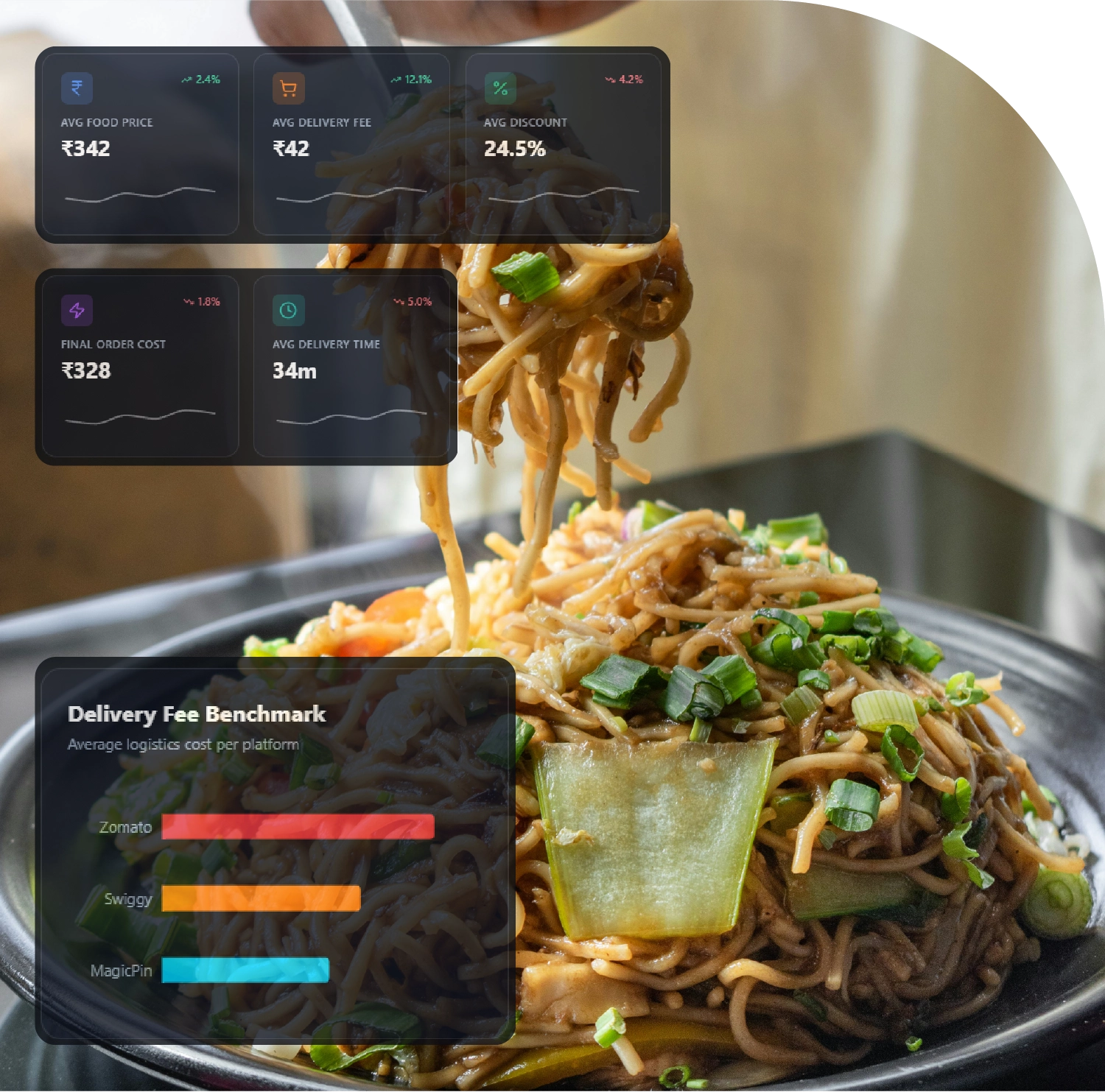
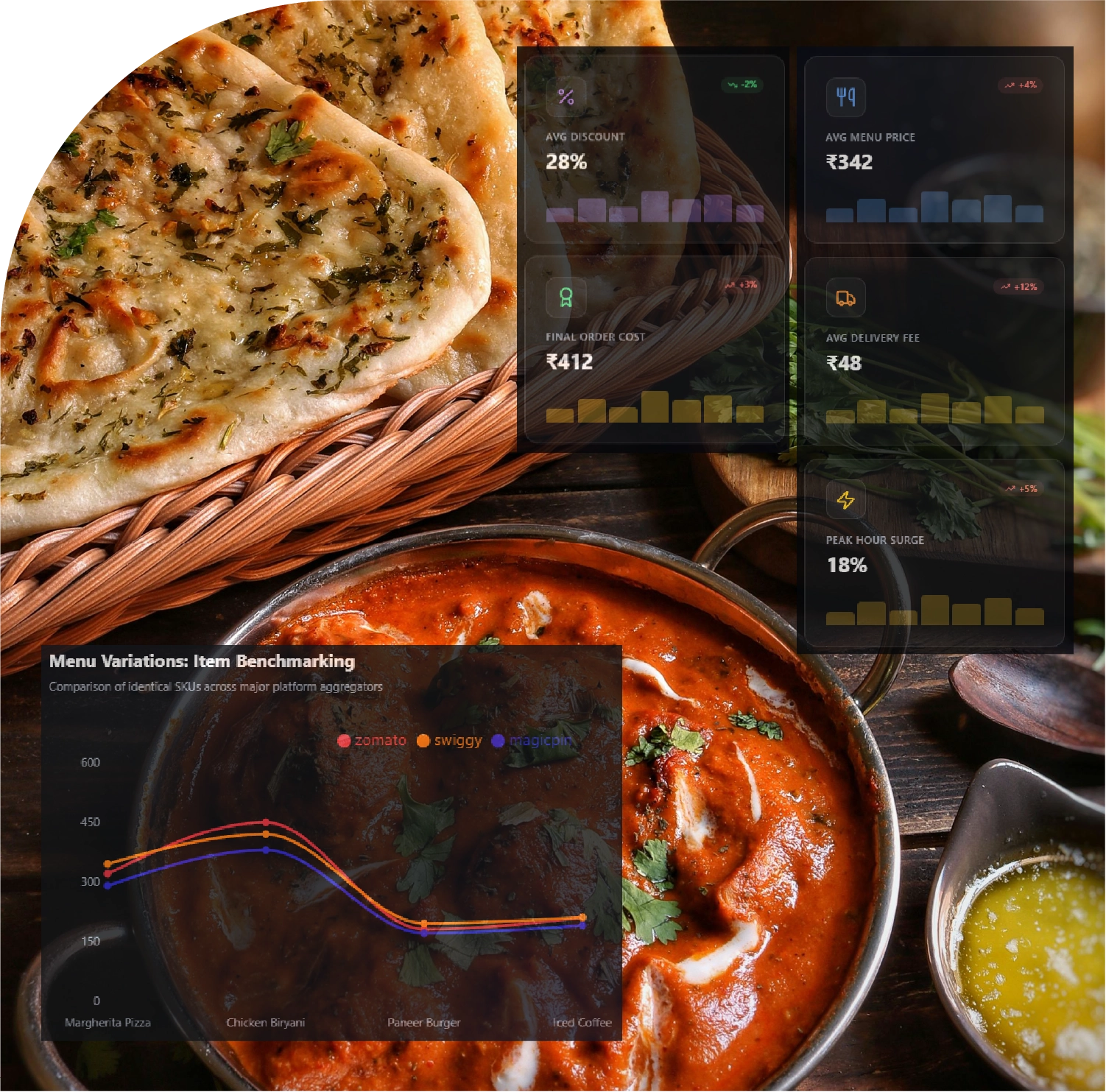
Menu Variations – Prices differ significantly across platforms for the same restaurant items.
Discount Trends – Promotional offers vary by time, location, and platform.
Delivery Costs – Platform fees and delivery charges influence total order value.
Peak Hour Analysis – Prices and fees increase during high-demand periods.
Restaurant Strategy – Menu adjustments are made to offset platform commissions.

The rapid expansion of food delivery platforms has transformed how consumers order meals in India. With millions of daily transactions occurring across platforms, price transparency and competitive analysis have become critical for restaurants, aggregators, and market analysts. This research explores Real-Time Food Price Comparison for Zomato, Swiggy & MagicPin, highlighting pricing patterns, platform fees, promotional discounts, and menu variations across major food delivery ecosystems.
The report also examines Zomato Vs Swiggy Vs Magicpin Food Price Analysis, focusing on how these platforms adjust prices through dynamic pricing models, platform commissions, and discount strategies. These insights support Competitive Pricing Analysis For Food Aggregators, enabling restaurants and analytics firms to track real-time price fluctuations and customer-facing offers.
Food delivery platforms charge platform fees and delivery charges that directly affect final order costs. For example, Swiggy currently charges around ₹15 per order, Zomato about ₹12.50, and Magicpin roughly ₹10, making Magicpin comparatively cheaper in terms of platform fee. Additionally, an 18% GST on delivery charges has increased the overall cost of ordering food online.
In such a competitive environment, real-time price tracking becomes essential for monitoring offers, coupons, and restaurant pricing variations across platforms.
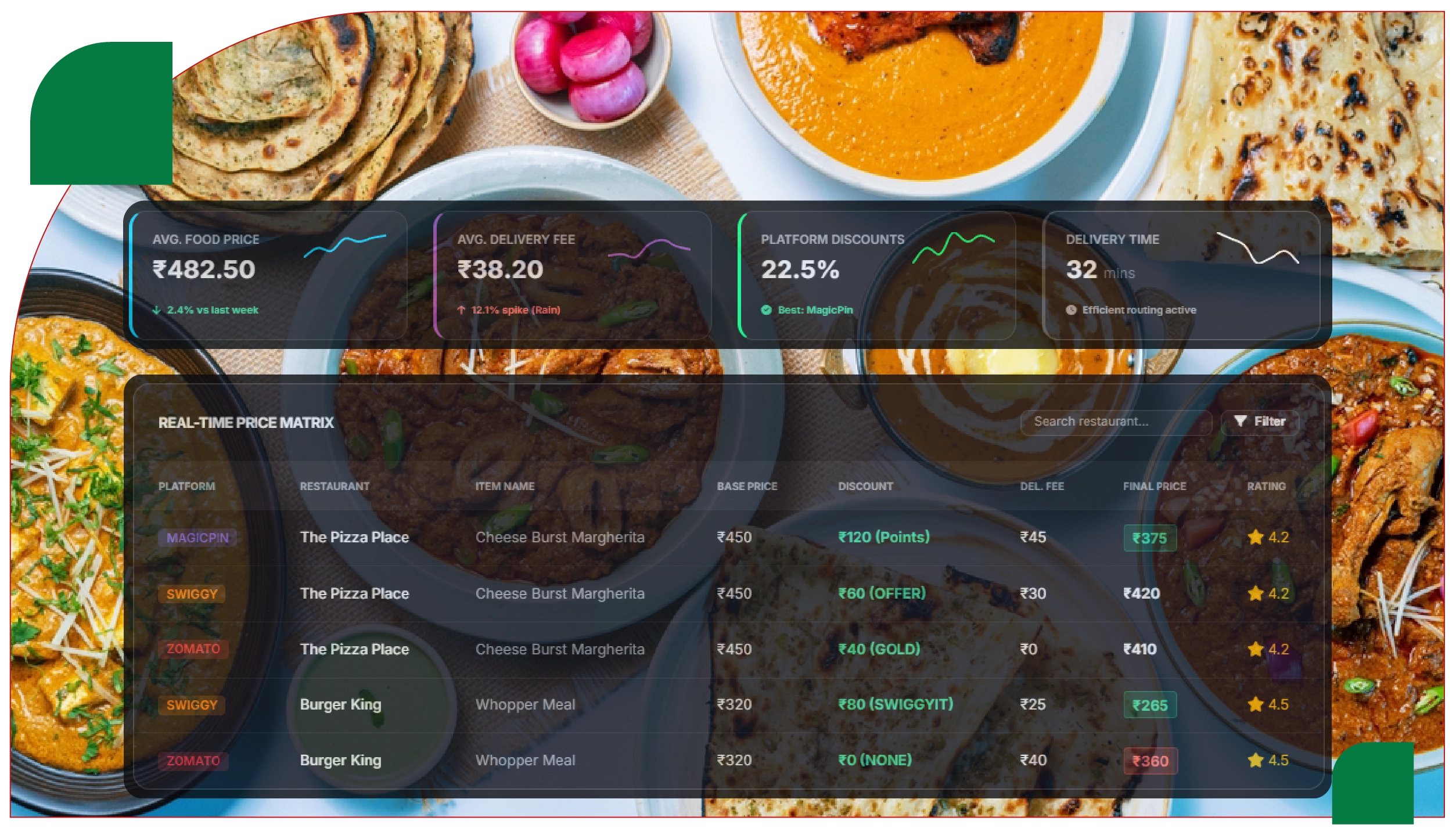
Food delivery pricing is influenced by several factors including restaurant commission structures, delivery demand, promotional campaigns, and geographical pricing variations. Restaurants listed on aggregator platforms often adjust menu prices to compensate for platform commissions that can range between 16% and 30%.
Real-time price monitoring tools help identify these fluctuations across platforms. Technologies used for Real-Time Offer And Coupon Tracking For Food Apps allow businesses to track discounts, cashback deals, combo offers, and platform-specific promotional campaigns.
Real-time tracking also supports Zomato Vs Swiggy Vs Magicpin Food Price Extraction, enabling analysts to identify the most cost-effective platform for specific restaurant items.
Data engineers typically deploy automated crawlers and APIs such as the Zomato Vs Swiggy Vs Magicpin Food Price Scraper to collect thousands of menu listings simultaneously. These solutions support Web Scraping Zomato Vs Swiggy Vs Magicpin Food Price, capturing detailed information such as item price, delivery fee, discount percentage, and restaurant ratings.
Advanced tools like the Zomato Food Delivery Scraping API enable large-scale data extraction and real-time analytics across multiple locations and restaurants.
Modern data pipelines powered by the Swiggy Food Delivery Scraping API help businesses monitor pricing changes, delivery fees, and promotional offers across thousands of restaurant listings.
Scalable intelligence systems using the Magicpin Food Delivery Scraping API allow analysts to capture menu data, coupon campaigns, and real-time discounts across different cities and delivery zones.
| Food Item | Avg Price on Zomato (₹) | Avg Price on Swiggy (₹) | Avg Price on Magicpin (₹) | Avg Discount (%) | Cheapest Platform |
|---|---|---|---|---|---|
| Margherita Pizza | 295 | 280 | 275 | 15% | Magicpin |
| Veg Burger | 160 | 150 | 145 | 18% | Magicpin |
| Paneer Butter Masala | 340 | 320 | 315 | 12% | Magicpin |
| Chicken Biryani | 265 | 250 | 245 | 20% | Magicpin |
| Cold Coffee | 130 | 120 | 115 | 10% | Magicpin |
| Masala Dosa | 140 | 135 | 130 | 15% | Magicpin |
| Veg Fried Rice | 210 | 200 | 195 | 16% | Magicpin |
| Butter Naan | 55 | 50 | 48 | 10% | Magicpin |
| Tandoori Chicken | 420 | 405 | 395 | 14% | Magicpin |
| Chocolate Shake | 160 | 150 | 145 | 12% | Magicpin |
The dataset highlights noticeable price variations across platforms. Swiggy often maintains slightly lower base menu prices, while Magicpin frequently compensates with stronger promotional discounts and lower platform fees.
Beyond menu prices, delivery charges and platform fees significantly influence final order costs. Delivery costs vary depending on distance, demand surge, and membership subscriptions such as Swiggy One or Zomato Gold.
Food delivery platforms have gradually increased platform fees as an additional revenue stream. Swiggy charges around ₹15, Zomato ₹12.50, and Magicpin approximately ₹10 per order.
These additional fees combined with GST on delivery charges have increased the average order cost across platforms.
Real-time data pipelines enable companies to monitor these price components through Web Scraping Food Delivery Data, capturing menu prices, delivery charges, service fees, and promotional discounts simultaneously.
Restaurants also benefit from analytics tools that Extract Restaurant Menu Data to identify price differences between platforms and adjust their pricing strategies accordingly.
| Platform | Avg Delivery Fee (₹) | Platform Fee (₹) | Avg Coupon Discount | Subscription Benefits | Total Avg Order Cost (₹) |
|---|---|---|---|---|---|
| Zomato | 36 | 12.50 | 20–25% | Zomato Gold free delivery | 310 |
| Swiggy | 40 | 15 | 18–22% | Swiggy One discounts | 320 |
| Magicpin | 30 | 10 | 25–30% | ONDC-based deals | 290 |
| Zomato (Peak Hours) | 50 | 12.50 | 10–15% | Priority delivery | 340 |
| Swiggy (Peak Hours) | 55 | 15 | 12–18% | Express delivery | 350 |
| Magicpin (Peak Hours) | 40 | 10 | 20–25% | Cashback offers | 315 |
| Zomato (Premium Restaurants) | 60 | 12.50 | 15% | Loyalty rewards | 380 |
| Swiggy (Premium Restaurants) | 65 | 15 | 12% | Membership benefits | 390 |
| Magicpin (Premium Restaurants) | 50 | 10 | 20% | Cashback wallet | 360 |
The data suggests that Magicpin often provides lower overall order costs due to reduced platform fees and higher discount percentages. However, Zomato and Swiggy dominate the market due to wider restaurant coverage and faster logistics networks.
Businesses that leverage food delivery data analytics gain a competitive advantage in pricing strategy, demand forecasting, and promotional planning.
Restaurant chains use price monitoring tools to ensure their menu prices remain competitive across different platforms. Food aggregators analyze this data to optimize platform commissions and promotional strategies.
Companies specializing in Food Delivery Scraping API solutions provide automated pipelines that continuously collect pricing data from hundreds of cities and thousands of restaurants.
Such platforms also deliver comprehensive Restaurant Data Intelligence, combining menu prices, ratings, delivery speed, and promotional campaigns into a unified analytics framework.
Real-time dashboards allow analysts to track hourly pricing trends, detect surge pricing events, and identify discount patterns across cities.
Several emerging trends are driving the demand for real-time food delivery price comparison analytics:
Real-time analytics tools make it possible to track these pricing patterns and identify opportunities for cost optimization.
The Indian food delivery ecosystem is becoming increasingly data-driven. Real-time monitoring of menu prices, delivery charges, and promotional offers enables businesses to understand competitive dynamics across platforms like Zomato, Swiggy, and Magicpin.
By combining automated data pipelines with AI-powered analytics, companies can track thousands of menu items and pricing changes daily. These insights power advanced Food delivery Intelligence, helping restaurants and aggregators optimize pricing strategies.
Interactive dashboards built from scraped datasets allow analysts to visualize price variations, delivery fees, and discount patterns in real time. Such solutions often power a centralized Food Price Dashboard that provides actionable insights for restaurant chains and market researchers.
As the industry continues to expand, structured Food Datasets will play a vital role in enabling smarter pricing strategies, improved customer experiences, and stronger competition among food delivery platforms.
If you are seeking for a reliable data scraping services, Food Data Scrape is at your service. We hold prominence in Food Data Aggregator and Mobile Restaurant App Scraping with impeccable data analysis for strategic decision-making.