The Client
The client is a rapidly expanding FMCG and retail brand operating across multiple quick commerce platforms to deliver products with speed, consistency, and competitive pricing. As the business expanded into new cities, it required accurate market intelligence to optimise pricing, inventory planning, and promotional campaigns. By leveraging Extract quick commerce product data, the client gained real-time visibility into product listings, stock availability, category performance, and promotional activities across leading delivery platforms.
Through Quick commerce competitor price tracking, the company continuously monitored competitor pricing, discount strategies, and assortment changes to make faster commercial decisions. The organisation also adopted Quick Commerce Data Extraction Services to automate large-scale data collection, eliminate manual monitoring, and generate actionable insights for category managers and pricing teams. This data-driven approach improved product availability, strengthened digital shelf performance, enhanced promotional effectiveness, and supported faster responses to changing consumer demand. The client now benefits from scalable intelligence that drives operational efficiency, market competitiveness, and sustainable revenue growth across the quick commerce ecosystem.
Key Challenges
-
Dynamic Pricing Across Multiple Platforms
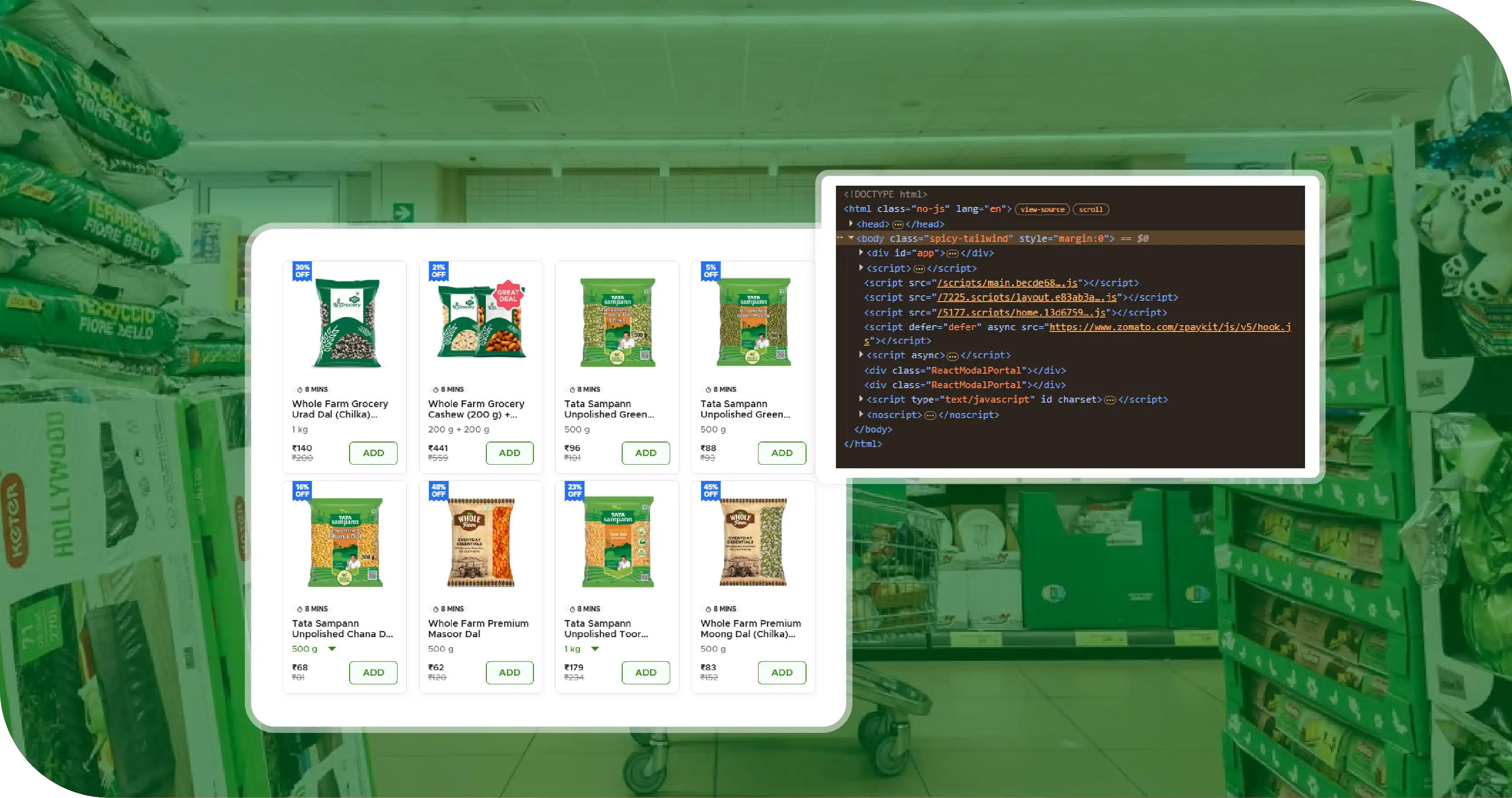
Product prices changed several times throughout the day, making manual monitoring unreliable. Without Blinkit Grocery Delivery Scraping API, the client struggled to detect competitor price movements promptly, resulting in delayed pricing decisions, reduced competitiveness, and missed opportunities to maximise sales and customer retention. -
Fragmented Product Catalogue Monitoring
The client faced difficulties tracking thousands of SKUs, category updates, and product availability across different locations. An incomplete Blinkit Dataset limited visibility into assortment changes, discontinued items, and regional inventory differences, affecting merchandising accuracy and demand planning. -
Slow Competitive Intelligence Collection
Monitoring competitor launches, promotional campaigns, and delivery performance required significant manual effort and produced inconsistent insights. Without Zepto Grocery Delivery Scraping API, the client lacked automated, real-time intelligence needed to benchmark competitors, optimise campaigns, and respond quickly to changing market conditions.
Key Solutions
-
Real-Time Multi-Platform Data Collection
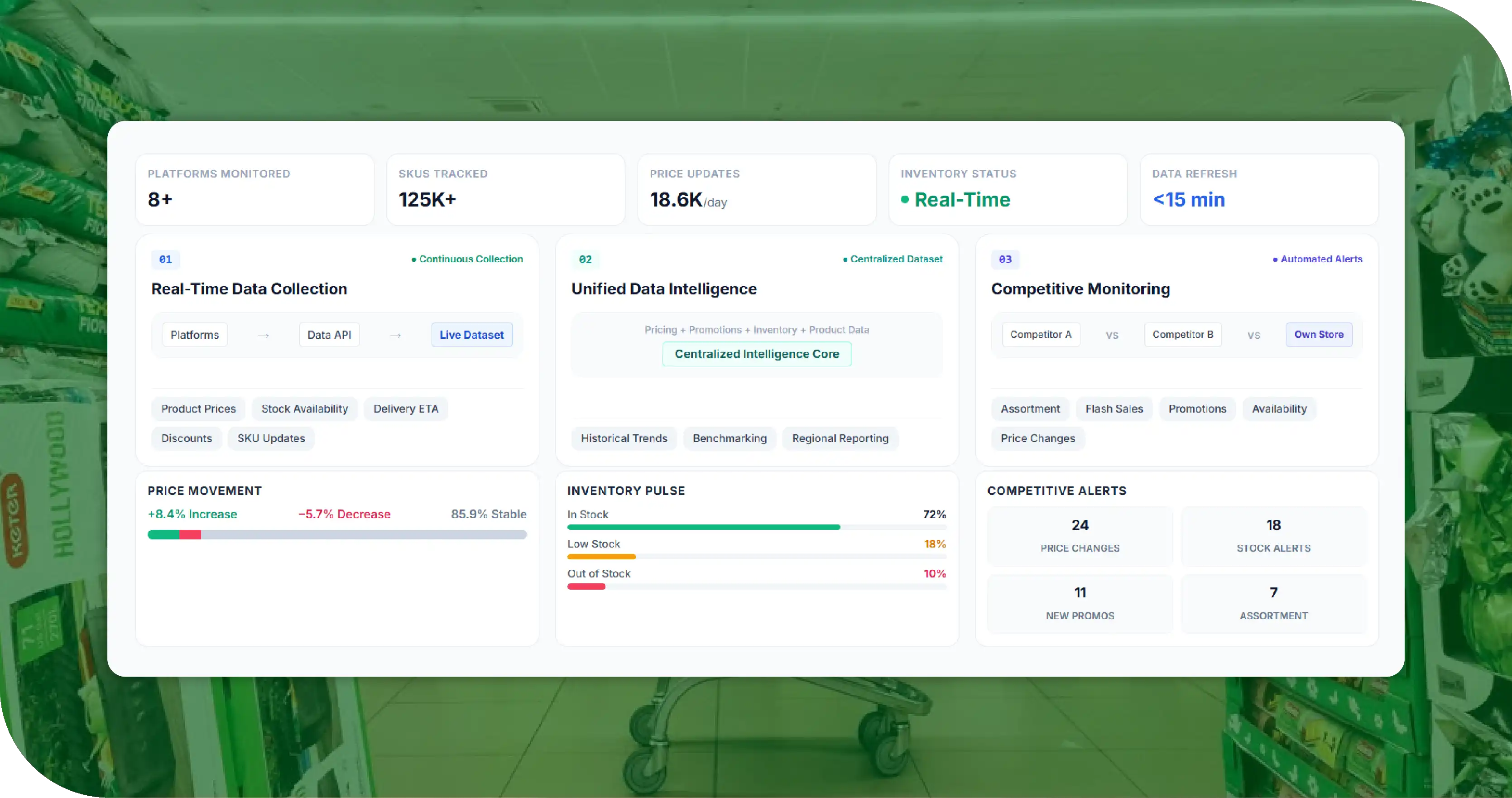
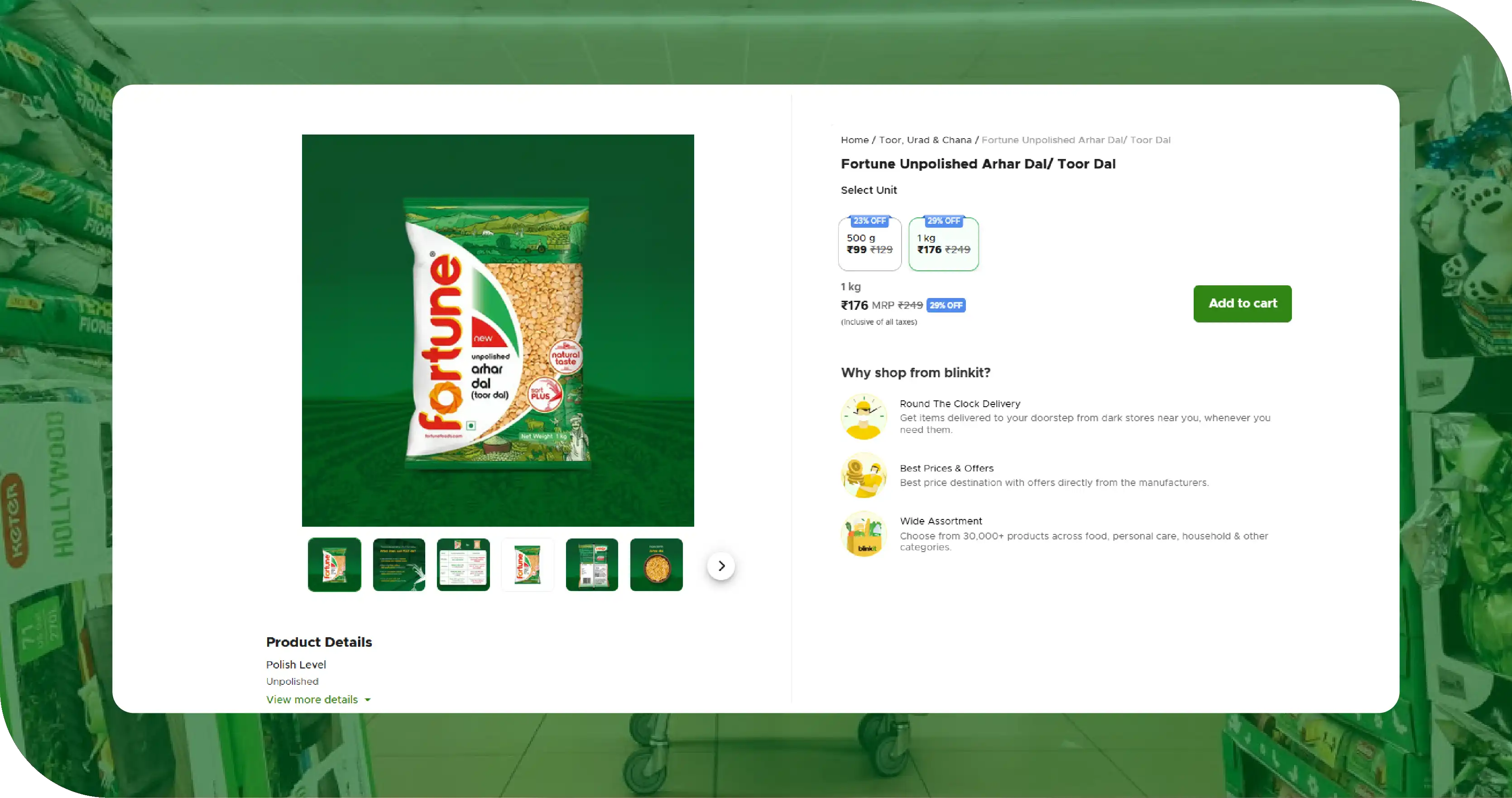
We implemented an automated Swiggy Instamart Grocery Delivery Scraping API solution that continuously captured product prices, stock availability, delivery estimates, discounts, and SKU updates across multiple quick commerce platforms. This eliminated manual tracking, improved data accuracy, and enabled immediate responses to changing market conditions. -
Unified Data Intelligence Platform
We developed centralized Quick Commerce Datasets combining pricing, promotions, inventory, product attributes, and category information from different marketplaces. The unified database empowered category managers with consistent reporting, historical trend analysis, competitive benchmarking, and faster commercial decision-making across all operating regions. -
Automated Competitive Monitoring
Our Web Scraping Quick Commerce Data framework monitored competitor assortments, promotional campaigns, flash sales, and product availability in near real time. Automated dashboards, alerts, and analytics helped the client optimise pricing strategies, improve inventory planning, strengthen digital shelf visibility, and increase operational efficiency.
Sample Scraped Data
| Data Parameter | Blinkit | Zepto | Instamart | Total Records Collected |
|---|---|---|---|---|
| Products Tracked | 68,500 | 64,200 | 59,800 | 192,500 |
| SKU Price Records | 1,245,000 | 1,178,000 | 1,102,000 | 3,525,000 |
| Inventory Availability Updates | 2,980,000 | 2,745,000 | 2,610,000 | 8,335,000 |
| Discount & Offer Records | 415,600 | 389,800 | 362,400 | 1,167,800 |
| Category Records | 1,240 | 1,180 | 1,105 | 3,525 |
| Brand Records | 5,480 | 5,160 | 4,980 | 15,620 |
| Delivery Time Records | 845,000 | 812,000 | 776,000 | 2,433,000 |
| Search Ranking Snapshots | 1,560,000 | 1,485,000 | 1,402,000 | 4,447,000 |
| Product Availability Snapshots | 3,420,000 | 3,185,000 | 3,010,000 | 9,615,000 |
| Daily Data Refreshes | 96 | 96 | 96 | 288 |
Methodologies Used
-
Multi-Source Marketplace Integration
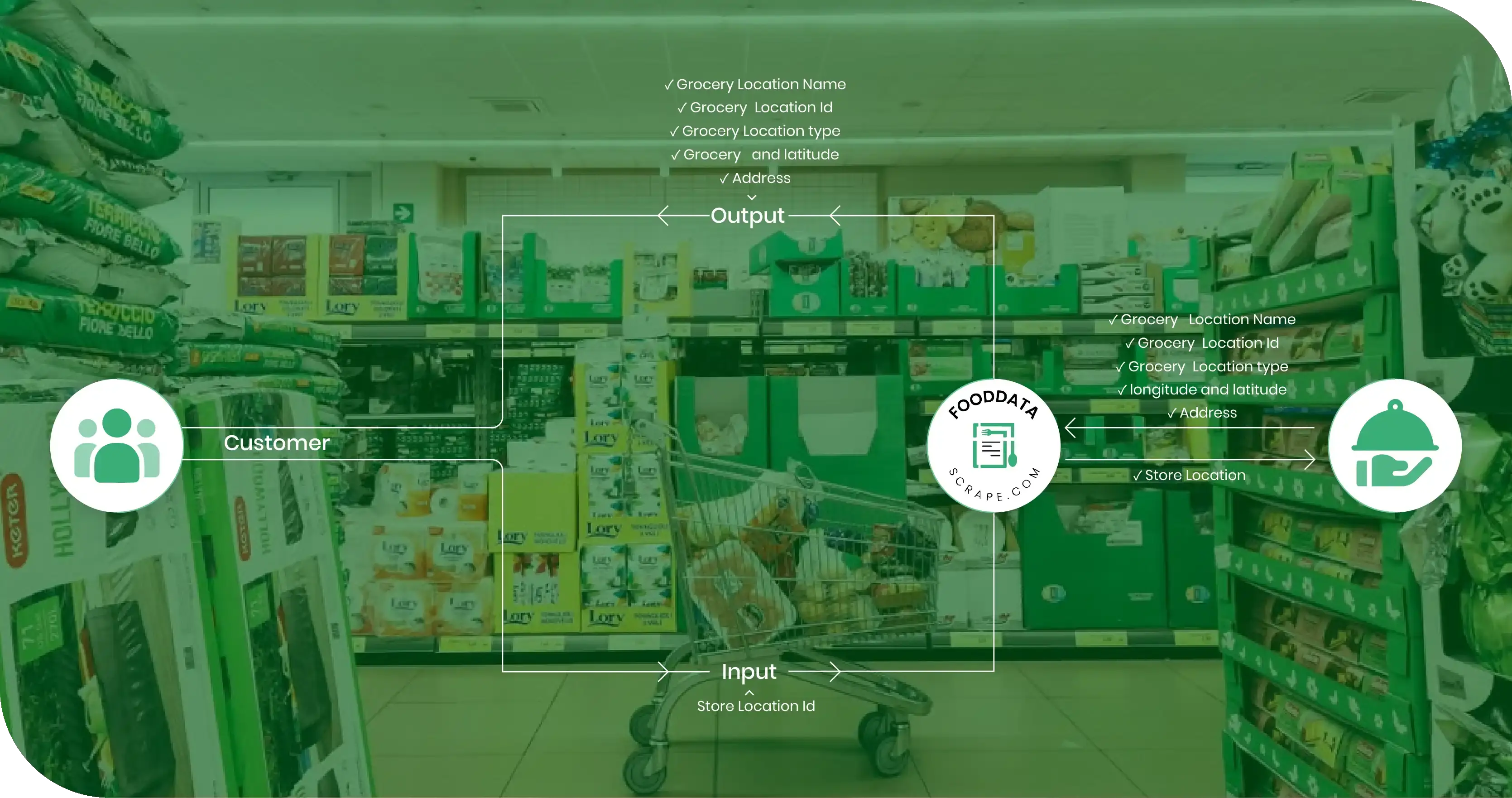
We integrated data collection across multiple quick commerce platforms into a unified workflow, ensuring consistent coverage of products, pricing, inventory, delivery timelines, and promotional campaigns. This approach provided comprehensive market visibility while reducing data fragmentation and manual intervention. -
High-Frequency Monitoring
Our solution captured marketplace changes at frequent intervals throughout the day to detect price revisions, stock fluctuations, and promotional updates as they occurred. Continuous monitoring enabled timely insights and ensured the client always worked with current, relevant market intelligence. -
Product Matching and Standardisation
We built intelligent matching logic to align identical products sold across different platforms despite variations in naming conventions, package sizes, or descriptions. This standardisation enabled accurate cross-platform comparisons and improved the reliability of competitive performance analysis. -
Historical Trend Analysis
We maintained a structured historical database that preserved daily marketplace snapshots over extended periods. This enabled long-term analysis of pricing behaviour, inventory movements, promotional cycles, seasonal demand, and competitor strategies to support forecasting and strategic planning. -
Custom Reporting and Business Intelligence
We created customised reports and performance dashboards tailored to business objectives, presenting clear metrics, comparative insights, exception reports, and actionable recommendations. Automated reporting reduced manual effort while helping stakeholders make faster, data-driven commercial and operational decisions.
Advantages of Collecting Data Using Food Data Scrape
-
Real-Time Business Intelligence
Our data scraping services deliver continuously updated market intelligence, enabling businesses to monitor pricing, product availability, promotions, and competitor activities without delays. This supports faster strategic decisions, improves operational responsiveness, and helps organisations stay ahead in highly competitive digital marketplaces. -
Improved Pricing Strategy
By collecting accurate pricing information from multiple competitors, our solutions help businesses optimise pricing models, identify discount opportunities, respond to market fluctuations, and maintain competitive positioning while protecting profit margins through informed, data-driven commercial decisions. -
Scalable and Automated Data Collection
Our automated infrastructure captures millions of data points without manual effort, ensuring reliable, high-frequency updates across large product catalogues. The scalable architecture supports expanding business requirements while significantly reducing operational costs and improving data collection efficiency. -
Higher Data Accuracy and Quality
Advanced validation, cleansing, and standardisation processes ensure structured, reliable datasets for analytics and reporting. Businesses benefit from consistent information that reduces errors, improves forecasting accuracy, and supports confident decision-making across marketing, operations, and supply chain functions. -
Seamless Integration and Custom Delivery
We deliver data in customised formats compatible with business intelligence platforms, ERP systems, databases, and cloud environments. Flexible delivery schedules, APIs, and automated workflows enable organisations to integrate actionable insights directly into existing operational and analytical processes.
Client's Testimonial
"The data scraping solution delivered exceptional visibility into our quick commerce operations. The real-time insights helped us monitor competitor pricing, product availability, and promotional trends with remarkable accuracy. Automated data collection significantly reduced manual effort while enabling faster, data-driven business decisions. The customised dashboards and structured datasets improved our pricing strategy, inventory planning, and market responsiveness across multiple platforms. Their technical expertise, timely delivery, and scalable approach exceeded our expectations. We have achieved measurable improvements in operational efficiency and competitive performance, making their data intelligence services a valuable asset to our digital growth strategy."
— Head of Category & Market Intelligence
Final Outcome
The project delivered measurable business value by providing complete visibility into pricing, inventory, promotions, and competitor performance across leading quick commerce platforms. Through the implementation of the Quick Commerce Data Scraping API, the client automated large-scale data collection, eliminated manual monitoring, and significantly improved the speed and accuracy of commercial decision-making. Leveraging Quick Commerce Data Intelligence Services, the organisation optimised pricing strategies, enhanced product availability, strengthened digital shelf performance, and improved promotional effectiveness across multiple markets. Historical and real-time analytics enabled faster responses to changing consumer demand and competitor actions. The scalable solution also streamlined reporting, increased operational efficiency, and supported long-term business growth. As a result, the client achieved stronger market competitiveness, improved customer satisfaction, higher sales performance, and a sustainable, data-driven framework for continuous quick commerce intelligence.