Introduction
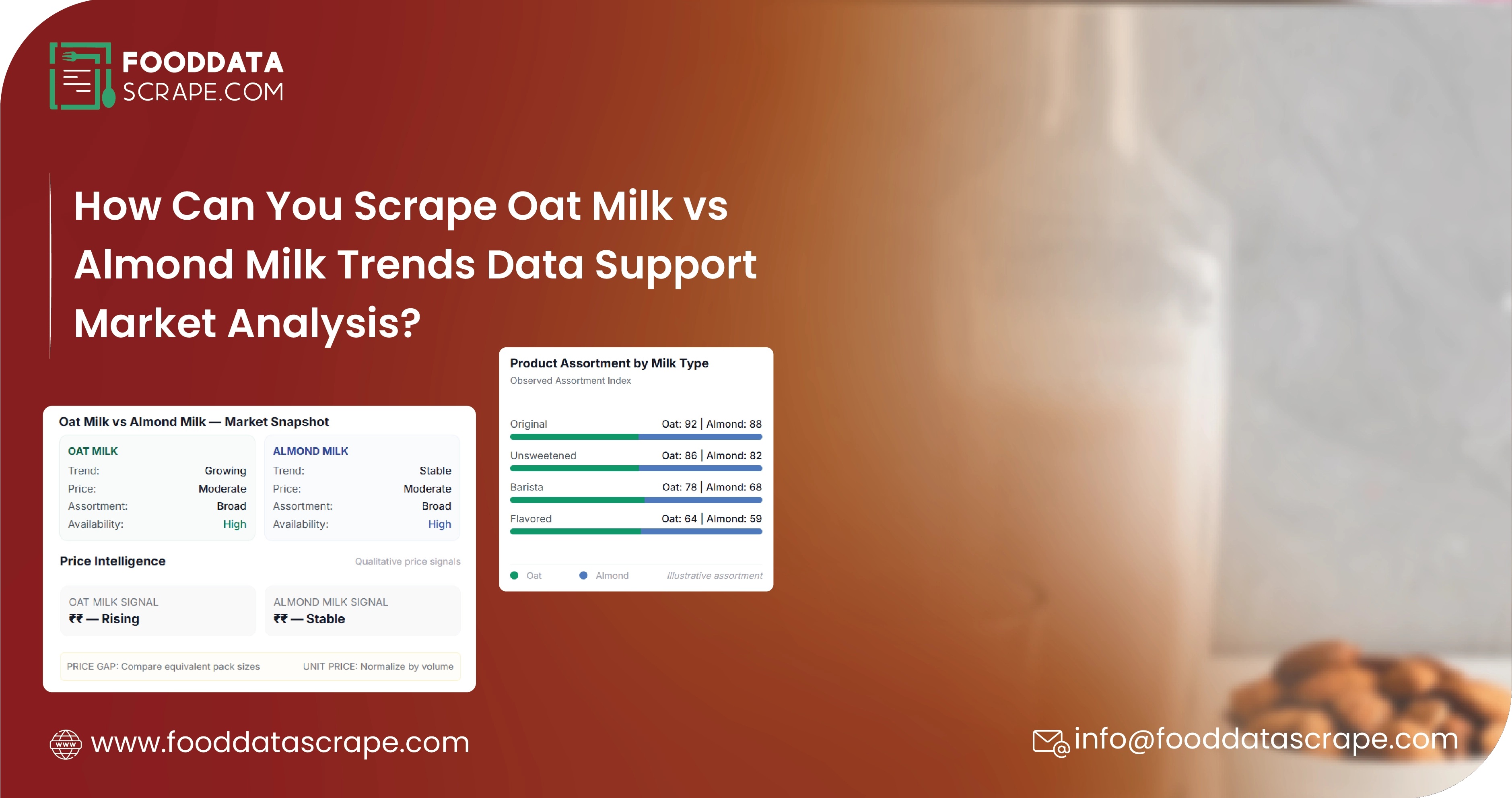
The plant-based milk category has moved from a niche alternative to an important part of modern food and beverage consumption. Consumers are increasingly comparing products not only by taste and price, but also by nutrition, ingredients, sustainability, availability, and suitability for coffee, breakfast, cooking, and everyday consumption. Recent research also shows that plant-based milk alternatives are continuing to expand while consumer preferences are becoming more segmented.
Scrape Oat Milk vs Almond Milk Trends Data to help businesses monitor this rapidly changing competitive landscape by collecting information on product listings, prices, pack sizes, ingredients, nutritional claims, ratings, reviews, promotions, and availability across online retailers, grocery platforms, food-delivery marketplaces, and brand websites.
The growing popularity of both categories creates an important question: which has stronger long-term consumer momentum—oat milk or almond milk? The answer depends on the market, consumer segment, product positioning, and use case.
Why Oat Milk and Almond Milk Are Worth Comparing?
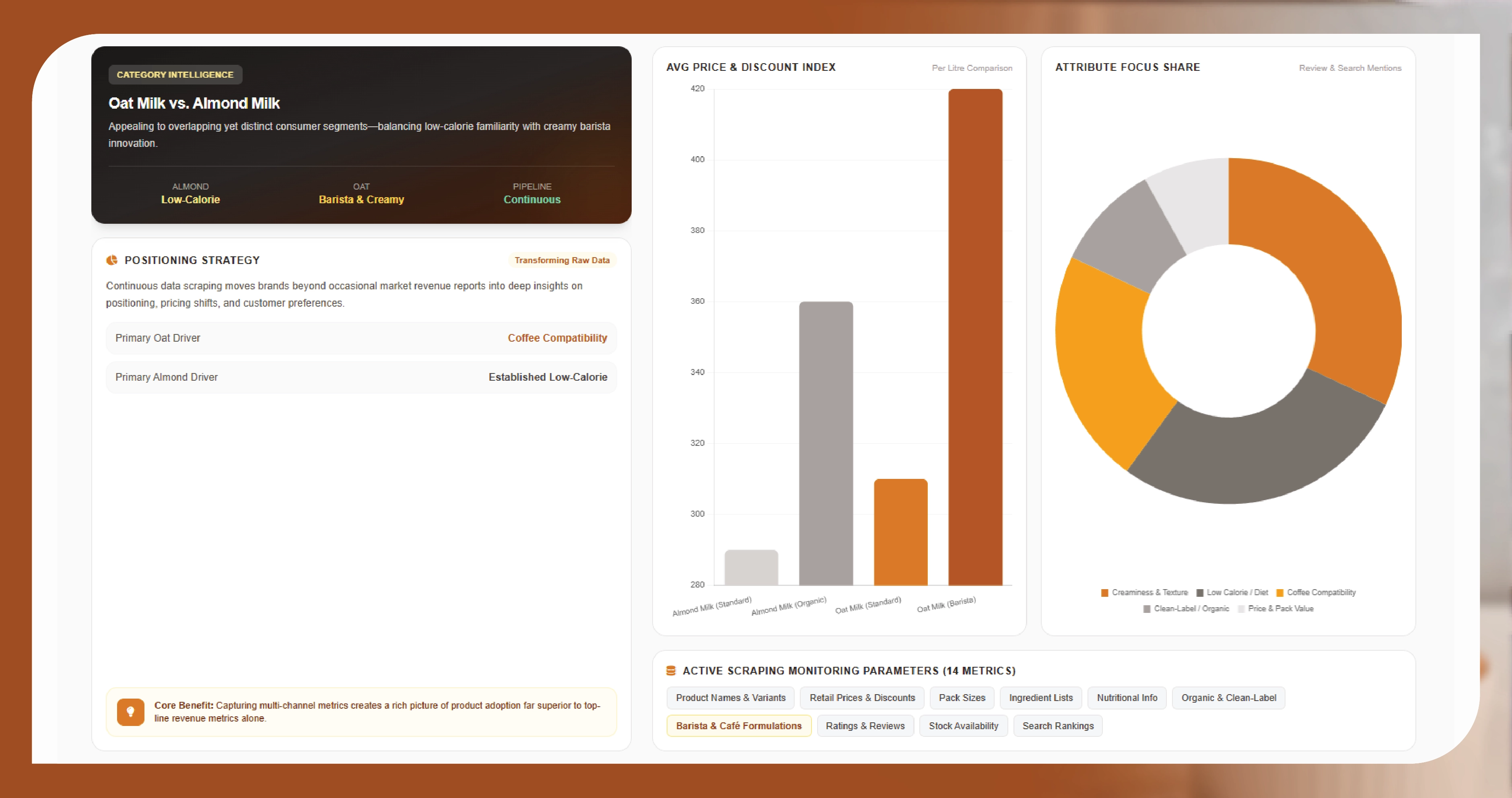
Oat and almond milk appeal to overlapping but not identical consumer groups. Almond milk has established itself as a familiar low-calorie dairy alternative, while oat milk has gained considerable attention for its creamy texture, coffee compatibility, and increasingly broad product innovation.
Oat Milk vs Almond Milk Data Scraping enables companies to continuously compare these two categories rather than relying on occasional market reports.
Data can be collected from multiple digital channels to identify how products are positioned and how consumer preferences change over time.
For example, a monitoring system can capture:
- Product names and variants
- Retail prices and discounts
- Pack sizes
- Ingredient lists
- Nutritional information
- Organic and clean-label claims
- Barista and café-specific formulations
- Customer ratings
- Customer reviews
- Product availability
- Search rankings
- Promotional activity
- New product launches
- Regional assortment differences
This creates a much more detailed picture of the category than simply tracking overall market revenue.
Oat Milk vs Almond Milk Product Data Analysis can then transform this raw information into insights about product positioning, pricing, consumer preferences, and competitive performance.
Oat Milk vs Almond Milk: What the Data Can Reveal
The biggest advantage of comparative data analysis is that it reveals differences that may not be obvious from market headlines.
Oat milk generally has a naturally creamy texture and performs particularly well in coffee applications. Its texture and flavor have contributed to strong adoption among café consumers and people looking for a richer alternative to dairy. Recent market research estimates continued strong growth for oat milk, with one 2026 forecast estimating the global market at approximately \$4.6 billion in 2026.
Almond milk, meanwhile, benefits from established consumer awareness and a strong association with lighter beverages. It is often selected by consumers looking for lower-calorie or lower-carbohydrate options, although nutritional composition varies considerably between brands and formulations.
The comparison therefore needs to go beyond market size.
Businesses should monitor why consumers choose each product.
For oat milk, important signals may include:
- Creaminess
- Coffee compatibility
- Barista positioning
- Plant-based lifestyle
- Texture
- Flavor
- Sustainability perception
- Premium positioning
For almond milk, relevant signals can include:
- Low-calorie positioning
- Nutty flavor
- Familiarity
- Vitamin and mineral fortification
- Unsweetened variants
- Weight-conscious consumption
- Established retail availability
This makes comparative scraping particularly valuable for brands competing for the same consumer occasions.
Tracking Plant-Based Milk Trends
Plant-Based Food Trends Data Scraping provides a broader view of the category by monitoring oat and almond milk alongside soy, coconut, pea, rice, cashew, and emerging alternatives.
This matters because consumer preferences do not remain static. A shopper who currently buys almond milk may move toward oat milk after discovering a new barista product, while another consumer may move toward pea or soy milk because of protein requirements.
The FDA notes that plant-based milk alternatives can vary significantly depending on their plant source, processing, and added ingredients. It also recommends that consumers examine factors such as protein, vitamin D, calcium, potassium, saturated fat, and added sugars when evaluating these products.
Consequently, brands can use scraped product data to monitor the evolution of nutritional positioning.
For example, analysts can identify whether brands are increasingly launching:
- High-protein products
- Sugar-free products
- Organic variants
- Fortified beverages
- Barista editions
- Flavored products
- Clean-label formulations
- Functional beverages
- Premium formulations
These signals can reveal where the category is heading before those changes become obvious in conventional market statistics.
Competitive Intelligence Between Oat and Almond Milk
Oat Milk vs Almond Milk Competitive Intelligence allows brands, retailers, distributors, and investors to benchmark competitors at the product level.
Instead of asking only which category is larger, companies can investigate which brands are winning specific consumer segments.
For example, competitive monitoring can identify whether a competitor has:
- More products in premium retail channels
- More promotional discounts
- Higher review volumes
- Better average ratings
- More organic products
- Greater availability
- More barista-focused products
- More pack-size options
- Stronger regional distribution
Pricing is another important dimension.
Suppose oat milk repeatedly sells at a premium compared with almond milk. This could indicate stronger perceived value, higher production costs, premium positioning, or stronger consumer willingness to pay. However, persistent discounts could indicate intense competition or attempts to stimulate demand.
Tracking these changes over several months provides considerably more insight than observing a single price point.
Consumer Reviews as a Source of Market Intelligence
Plant-Based Milk Consumer Trends Data can also be extracted from customer reviews and ratings.
Reviews provide qualitative information that traditional sales datasets often miss.
Consumers may discuss:
- Taste
- Texture
- Sweetness
- Aftertaste
- Coffee performance
- Packaging
- Price
- Ingredient quality
- Digestibility
- Product consistency
- Value for money
Natural-language analysis can categorize thousands of reviews and identify recurring themes.
For example, if oat milk reviews increasingly mention "creamy," "coffee," and "froths well," brands can interpret this as evidence that café and coffee use cases are becoming important purchase drivers.
If almond milk reviews repeatedly mention "unsweetened," "low calorie," or "breakfast," marketers can use those signals to understand different consumption occasions.
This approach transforms reviews from simple customer feedback into a continuous source of consumer intelligence.
Monitoring Broader Food Trends
Plant-Based Food Trends Data Scraping expands the analysis beyond beverages.
Plant-based consumption increasingly overlaps with other food categories, including yogurt, cheese, protein products, desserts, ready-to-eat meals, cereals, and snacks.
A brand selling oat milk, for instance, could monitor whether consumers are also purchasing oat-based creamers, protein drinks, plant-based yogurt, or vegan desserts.
This cross-category analysis can identify opportunities for product extensions and bundled promotions.
It can also reveal whether consumers are moving from strict vegan purchasing toward broader "flexitarian" behavior, where plant-based products supplement rather than completely replace animal-based foods.
How Food Data Scraping Supports Business Decisions?
Food Data Scraping Services can automate the collection and normalization of large amounts of food-market information.
Instead of manually checking hundreds of online product pages, businesses can create structured datasets containing product, pricing, promotional, review, and availability information.
The resulting datasets can support:
- Pricing strategy: Identify competitor price ranges and promotional patterns.
- Assortment planning: Determine which variants, sizes, and formulations are becoming more common.
- Product development: Discover unmet consumer needs from reviews and product gaps.
- Competitive monitoring: Track competitor launches, pricing changes, and positioning.
- Retail intelligence: Compare assortment and availability across stores and regions.
- Demand forecasting: Combine historical observations with current market signals.
- Marketing strategy: Identify the claims and attributes consumers respond to most frequently.
Ready to unlock smarter food market insights? Connect with us today to scrape, analyze, and transform real-time food data into actionable business intelligence.
Oat Milk vs Almond Milk: Which Has the Advantage?
There is no universal winner.
Oat milk appears particularly strong where creaminess, coffee applications, premium positioning, and texture are important. Its recent market growth projections also suggest substantial momentum.
Almond milk remains highly relevant because of its established consumer base, broad retail presence, and appeal among shoppers seeking lighter beverages. However, its environmental profile requires nuance: almond production has a notably higher water footprint than several other plant-based alternatives.
Nutrition also creates an important distinction. Reviews of plant-based milk alternatives generally find that nutritional composition differs substantially by base ingredient and formulation. Oat milk tends to contain more carbohydrates than almond milk, while almond milk is typically lower in calories and carbohydrates; protein levels can be relatively low in both compared with dairy or soy, depending on formulation.
Sustainability should likewise be evaluated across multiple measures rather than reduced to one simple winner. Environmental impacts can differ based on water use, land use, emissions, farming practices, processing, packaging, and transportation.
Therefore, the strongest competitive strategy is not necessarily to declare one product superior. It is to understand which product wins for which consumer, occasion, channel, and price point.
The Future of Oat and Almond Milk Data Intelligence
The plant-based milk market is becoming increasingly data-driven. As product variety expands, consumers encounter more choices, while brands face greater pressure to differentiate through taste, nutrition, pricing, sustainability, and innovation.
Continuous product monitoring can reveal emerging trends faster than traditional periodic research. A business can identify a competitor's new product, detect a sudden price change, observe declining availability, analyze new customer complaints, or discover a rapidly growing product attribute.
The next stage of market intelligence will combine product data, pricing information, consumer reviews, search behavior, retailer availability, and food-delivery signals into unified dashboards.
Ultimately, the goal is not simply to collect more data. It is to understand what the data says about consumer demand and competitive movement.
How Food Data Scraping Can Help You?
1. Track Competitor Pricing
Food data scraping helps you monitor competitor prices, discounts, promotions, pack sizes, and product variations, enabling smarter pricing strategies and stronger market positioning.
2. Understand Consumer Demand
Analyze product ratings, reviews, search trends, and availability to identify changing consumer preferences, emerging demands, popular flavors, and purchasing patterns across food categories.
3. Discover Product Opportunities
Scraped food datasets reveal market gaps, underserved consumer needs, trending ingredients, and successful product attributes, helping businesses develop innovative products with stronger commercial potential.
4. Monitor Market Competition
Compare competitors across products, prices, promotions, ratings, assortment, and geographic availability to understand competitive movements and identify opportunities for differentiation and expansion.
5. Improve Sales Forecasting
Historical and real-time food datasets help businesses identify demand patterns, seasonal changes, pricing effects, and promotional impacts, supporting more accurate sales planning and inventory decisions.
Conclusion
The comparison between oat milk and almond milk represents a broader transformation in the plant-based food industry. Oat milk is benefiting from strong momentum, creamy formulations, coffee applications, and premium innovation, while almond milk continues to benefit from familiarity, broad availability, and strong demand for lighter and unsweetened options.
Effective data collection can help brands identify Sales & Demand Trends across products, retailers, regions, and consumer segments.
Businesses can also Scrape Food Delivery API Data to monitor product availability, pricing, promotions, and consumer-facing assortment across digital food platforms.
Finally, Real-Time Price Monitoring can help companies detect competitor discounts, price increases, promotional cycles, and changing price gaps between oat and almond milk.
When these datasets are combined, businesses gain a continuously updated view of the plant-based milk market—making it easier to identify emerging opportunities, understand consumer behavior, optimize pricing, and compete more effectively.
If you are seeking for a reliable data scraping services, Food Data Scrape is at your service. We hold prominence in Food Data Aggregator and Mobile Restaurant App Scraping with impeccable data analysis for strategic decision-making.
Get a Free Food Data Sample in 48 Hours.
Tell us your platforms, target markets and required fields — we'll map exactly what's possible with food data scraping, recommend the right approach, and send a working sample so you can verify quality before any commitment.