Introduction
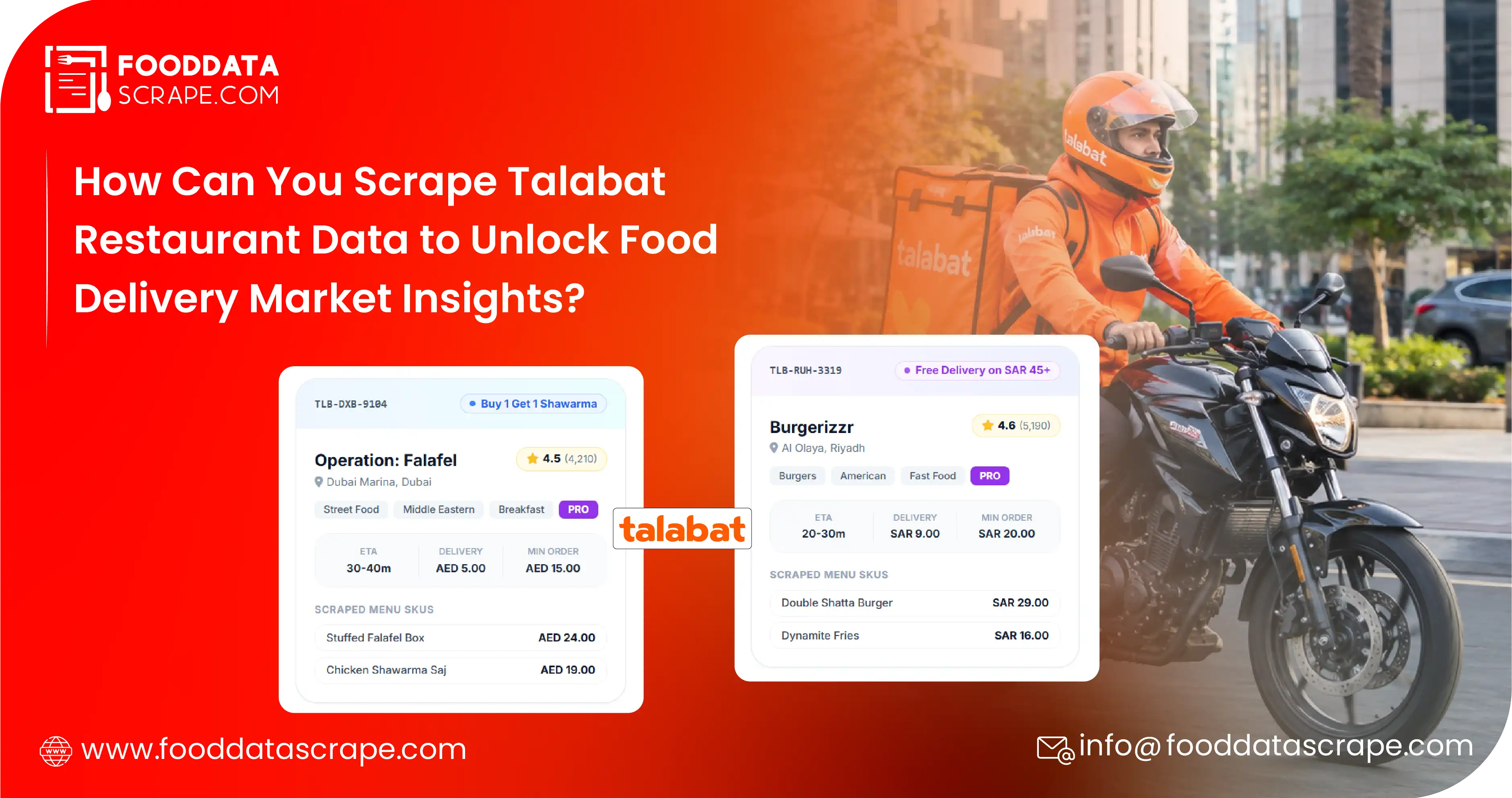
Talabat has become an important digital food delivery platform across several Middle Eastern markets, connecting customers with restaurants, cafés, cloud kitchens, and food brands. Its extensive online menu listings, product descriptions, prices, promotional offers, customer ratings, and delivery information provide valuable insights into the rapidly evolving food delivery industry. Businesses can analyze this information to understand customer preferences, evaluate competitors, and identify emerging market opportunities.
A reliable method to Scrape Talabat Restaurant Data solution helps businesses collect publicly accessible restaurant information systematically, reducing the time required for manual research. Through Talabat Restaurant Data Scraping, companies can organize menu listings, cuisine categories, item prices, discounts, ratings, and restaurant availability into structured datasets for analysis.
For restaurant chains, food aggregators, market researchers, and pricing analysts, this information supports evidence-based decisions. By transforming scattered platform listings into consistent records, businesses can monitor competitive changes, evaluate menu performance, understand regional demand, and develop strategies that improve their position in the increasingly competitive online food delivery market.
What Is a Scraper for Talabat Restaurant Data?
A scraper for Talabat restaurant data is a technology solution designed to collect relevant restaurant and menu information from accessible Talabat pages or authorized data sources. It automates repetitive collection tasks and converts retrieved information into organized formats suitable for business intelligence and analytics.
Depending on the project requirements and available source fields, a scraper may capture restaurant names, cuisine types, menu categories, item descriptions, prices, promotional offers, ratings, delivery estimates, and availability indicators.
The collected information can be delivered in CSV, Excel, JSON, or database-ready formats. Businesses can then integrate these records into pricing dashboards, competitor analysis systems, reporting tools, and machine learning workflows.
Rather than relying on occasional manual checks, organizations can establish scheduled collection processes that help them identify meaningful changes over time. Data access, collection frequency, and field coverage depend on platform permissions, technical availability, and applicable terms.
Why Is Talabat Restaurant Data Valuable?
The online food delivery market changes continuously. Restaurants introduce new dishes, revise prices, launch discounts, adjust menus, and respond to changing customer expectations. Without structured monitoring, businesses may struggle to recognize these developments quickly.
Restaurant data provides a practical foundation for understanding market dynamics. For example, a restaurant operator can compare the prices of similar dishes across competing outlets, while a market research company can examine cuisine popularity across different neighborhoods.
Food brands can also investigate how their products are positioned on delivery platforms, identify restaurants offering complementary products, and evaluate promotional activity across categories.
The value increases when records are collected consistently and compared across locations and time periods. Historical information can reveal pricing patterns, promotional cycles, menu expansion, and changes in competitive positioning. These insights help decision-makers move beyond isolated observations toward measurable business strategies.
Key Data Fields to Extract from Talabat
A comprehensive data collection project should begin with clearly defined business objectives and a suitable list of fields.
1. Restaurant Profile Information
Restaurant profile records help businesses understand the composition of a local delivery market. Relevant fields may include restaurant name, cuisine category, location, branch information, platform listing identifier, and operating status where available.
These details help analysts group restaurants by brand, cuisine, neighborhood, or outlet. They also support duplicate identification and consistent comparisons across multiple collection periods.
2. Menu Items and Descriptions
Businesses can Extract Talabat Menu Data to understand the products restaurants offer and how those products are presented to customers.
Useful fields include menu category, item name, description, portion size, customization options, and listed price. Where available, dietary labels, ingredient information, and add-on options can provide additional context.
Organizing menu items into consistent categories makes it easier to compare equivalent products, identify assortment gaps, and study how restaurants differentiate their offerings.
3. Pricing and Promotional Offers
Price information is essential for evaluating competitive positioning. Depending on the available listing, relevant fields may include original price, displayed selling price, discount percentage, promotional labels, and applicable offer conditions.
Analysts can compare standard menu prices with promotional prices to understand discount strategies. They should distinguish item prices from delivery charges, service fees, taxes, and minimum-order requirements because these components affect the customer's total expenditure differently.
4. Ratings and Customer Feedback Indicators
Where publicly accessible, restaurant ratings, review counts, and related feedback indicators can help researchers examine customer engagement and reputation.
These indicators should be interpreted carefully. A rating alone does not explain why customers prefer a restaurant, and review counts may reflect differences in restaurant age, exposure, and order volume. Combining ratings with menu breadth, cuisine, and price information produces a more balanced competitive assessment.
5. Delivery and Availability Information
Delivery estimates, listing availability, and order status can help businesses understand the customer experience at the time of collection.
These fields may vary according to location, demand, opening hours, and platform conditions. Consequently, a single observation should not be treated as a permanent measure of restaurant availability or delivery performance.
Repeated observations, collected at appropriate intervals, offer a more reliable picture of changing conditions.
How Talabat Restaurant Data Scraping Works?
An effective collection workflow combines source assessment, data retrieval, validation, and analysis.
Step 1: Define the Collection Scope
Identify the target markets, cities, restaurant categories, branches, and data fields. A project focused on competitor pricing requires different fields from one examining menu trends or restaurant coverage.
Clear requirements prevent unnecessary collection and keep the resulting dataset aligned with business objectives.
Step 2: Identify Suitable Data Sources
Determine whether the required information is accessible through an authorized API, licensed data provider, permitted export, or publicly accessible pages that may lawfully be collected.
Review the platform's terms, technical restrictions, and applicable privacy requirements before implementation. Authentication controls and other access restrictions should not be bypassed.
Step 3: Collect and Structure the Data
The collection system retrieves permitted records and maps them into a predefined schema. Standardized fields make it easier to compare restaurants even when their menu descriptions or category labels differ.
For example, different descriptions of similar burger meals can be assigned to a common analytical category while preserving the original listing text for reference.
Step 4: Clean and Validate Records
Data cleaning helps identify missing prices, inconsistent currency formats, duplicate restaurant entries, and incomplete menu descriptions.
Validation rules can flag unusually large price changes, unexpected field values, and records that require further review. Keeping collection timestamps and source identifiers also improves traceability.
Step 5: Schedule Updates and Analyze Results
A scheduled workflow can refresh permitted information according to business needs and source availability. The resulting records can feed dashboards, reporting systems, and competitive analysis tools.
Businesses should retain historical snapshots where permitted, allowing analysts to compare current observations against previous records instead of overwriting every change.
Major Business Applications of Talabat Data
Talabat Competitor Menu Price Monitoring
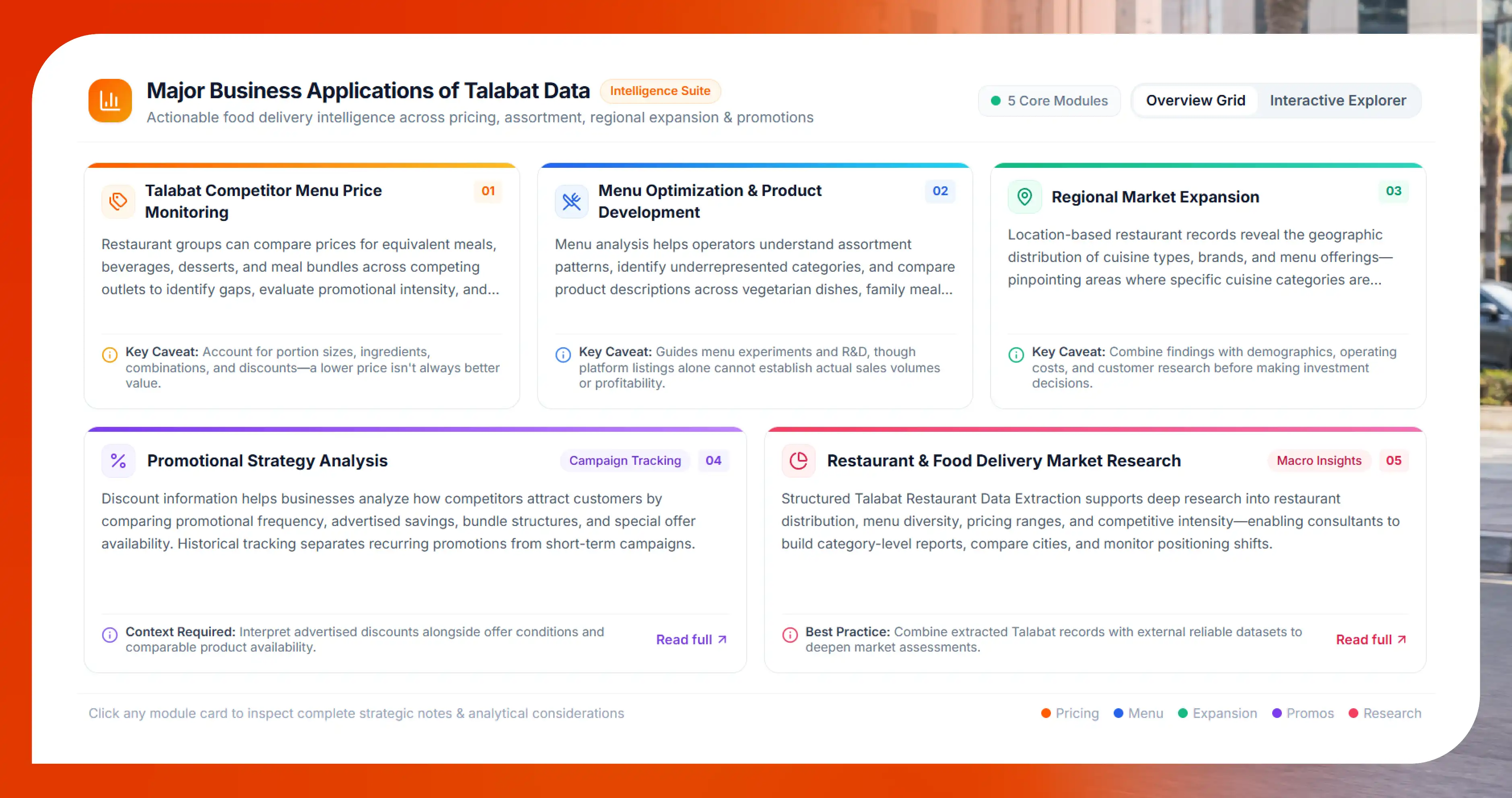
Restaurant groups can compare prices for equivalent meals, beverages, desserts, and meal bundles across competing outlets. Talabat Competitor Menu Price Monitoring can help pricing teams identify gaps, evaluate promotional intensity, and understand whether their menus are positioned above or below comparable alternatives.
Comparisons should account for portion sizes, ingredients, meal combinations, and discounts to avoid misleading conclusions. A lower displayed price does not necessarily mean a better-value offering.
Menu Optimization and Product Development
Menu analysis helps restaurant operators understand assortment patterns, identify underrepresented categories, and compare product descriptions. Businesses can assess whether competitors offer more vegetarian dishes, family meals, beverages, or premium combinations.
These observations can guide menu experiments and product development, although platform listings alone cannot establish actual sales volumes or profitability.
Regional Market Expansion
Location-based restaurant records can reveal the distribution of cuisine types, restaurant brands, and menu offerings across selected areas.
Companies evaluating expansion opportunities can identify locations where particular cuisine categories appear less represented. Such findings should be combined with population characteristics, operating costs, customer research, and other market indicators before investment decisions are made.
Promotional Strategy Analysis
Discount information can help businesses understand how competitors use offers to attract customers. Researchers can compare promotional frequency, advertised savings, bundle structures, and the availability of special offers.
Historical observations can also help distinguish recurring promotions from short-term campaigns. However, advertised discounts should be interpreted alongside offer conditions and the availability of comparable products.
Restaurant and Food Delivery Market Research
Structured Talabat Restaurant Data Extraction supports research into restaurant distribution, menu diversity, pricing ranges, and competitive intensity.
Consultants and market researchers can develop category-level reports, compare cities, and monitor changes in restaurant positioning. Combining these records with other reliable datasets can improve the depth of market assessments.
Challenges in Collecting Talabat Data
Despite its potential value, restaurant data collection requires careful planning.
- Dynamic listings: Restaurant information may change frequently, making collection timestamps essential for distinguishing current observations from historical records.
- Inconsistent formats: Prices, descriptions, and category labels may differ between restaurants. Standardization is necessary before meaningful comparisons can be made.
- Location-specific information: Menus, offers, and delivery availability can vary by address or service area. Analysts should record the relevant market context whenever possible.
- Incomplete observations: Certain fields may not be accessible or consistently displayed. Missing information should be marked appropriately rather than estimated without evidence.
- Technical restrictions: Platform changes, rate limits, access permissions, and website structures can affect collection reliability. Authorized data access and maintainable workflows help reduce operational disruption.
- Data interpretation: Restaurant listings reveal what is displayed on the platform, not necessarily actual sales, customer conversion, inventory levels, or profit margins. Businesses should avoid treating these different measures as interchangeable.
Best Practices for Reliable Restaurant Data Collection
Start with a focused set of business questions and collect only the fields needed to answer them. This keeps projects manageable and reduces unnecessary processing.
Use stable restaurant identifiers wherever available to track branches and detect duplicates. Preserve original descriptions alongside normalized categories so analysts can verify transformations and revisit classifications when required.
Record timestamps, currency, location context, and applicable promotional conditions. These details make historical comparisons more meaningful and reduce the risk of confusing a temporary discount with a standard price.
Establish quality checks for missing values, unexpected changes, and inconsistent records. Periodically review the collection workflow to account for source changes and evolving data requirements.
Finally, document source permissions, retention policies, and permitted uses. A well-designed collection process should prioritize data accuracy, responsible access, and business relevance rather than maximizing record volume alone.
How Food Data Scrape Can Help You?
1. Competitor Price Intelligence
Food Data Scrape helps businesses compare restaurant menu prices, discounts, and meal bundles across selected markets, supporting informed pricing decisions and helping identify competitive gaps without relying on manual checks.
2. Menu Trend Analysis
Structured menu records reveal cuisine diversity, popular product categories, portion variations, and new offerings, enabling restaurant operators to evaluate assortment opportunities and develop menus aligned with evolving customer preferences.
3. Market Opportunity Identification
Restaurant listings organized by location and cuisine help researchers evaluate market coverage, identify underserved categories, and compare competitive intensity before exploring new neighborhoods or expanding existing restaurant operations.
4. Promotional Performance Monitoring
Consistent observations of listed offers help analysts examine discount patterns, promotional frequency, and bundle strategies, providing useful context for planning campaigns and assessing competitors' visible promotional positioning.
5. Scalable Data Integration
Food Data Scrape supports structured data delivery for dashboards, reporting systems, and analytics workflows, helping organizations maintain organized restaurant intelligence that can be refreshed and analyzed according to authorized access conditions.
Conclusion
A scraper for Talabat restaurant data provides businesses with a systematic way to understand restaurant listings, menu structures, pricing strategies, promotional offers, and competitive positioning. When collected responsibly and validated carefully, these records can support market research, menu optimization, regional expansion, and pricing analysis.
Food Data Scraping enables organizations to transform scattered restaurant information into structured intelligence that can be compared across locations and time periods. Businesses can strengthen their analysis by combining restaurant listings with customer research, operational information, and other reliable market indicators.
Organizations exploring integration options can also Scrape Food Delivery API data through authorized interfaces or suitable licensed sources, depending on the platform's available access methods. Properly structured Food Delivery Datasets can then support dashboards, historical comparisons, and broader food delivery market research.
Ultimately, the strongest results come from combining reliable collection methods with clear analytical objectives, responsible data practices, and consistent quality checks. This approach helps food businesses make better-informed decisions in a competitive and rapidly changing digital marketplace.
If you are seeking for a reliable data scraping services, Food Data Scrape is at your service. We hold prominence in Food Data Aggregator and Mobile Restaurant App Scraping with impeccable data analysis for strategic decision-making.
Get a Free Food Data Sample in 48 Hours.
Tell us your platforms, target markets and required fields — we'll map exactly what's possible with food data scraping, recommend the right approach, and send a working sample so you can verify quality before any commitment.