The Client
The client was a food-tech market intelligence organization focused on understanding restaurant pricing, promotional behavior, consumer offers, and competitive positioning in India's online food delivery market. Its primary requirement was to develop granular intelligence around restaurant brands operating on Swiggy in Nagpur.
The organization required Nagpur Swiggy Offer Data Extraction to identify promotional patterns across restaurant brands, cuisines, order values, and customer-facing offers. It also wanted Nagpur Swiggy Market Intelligence Data to compare restaurant-level pricing, discounts, ratings, availability, and menu characteristics across different areas.
Another requirement involved Dynamic Discount Data Scraping, allowing the client to capture changing promotional information instead of depending on occasional manual observations. The client planned to use the collected intelligence for competitor benchmarking, restaurant performance analysis, promotional strategy research, pricing studies, and market opportunity identification.
Key Challenges
-
Tracking Changing Brand Promotions
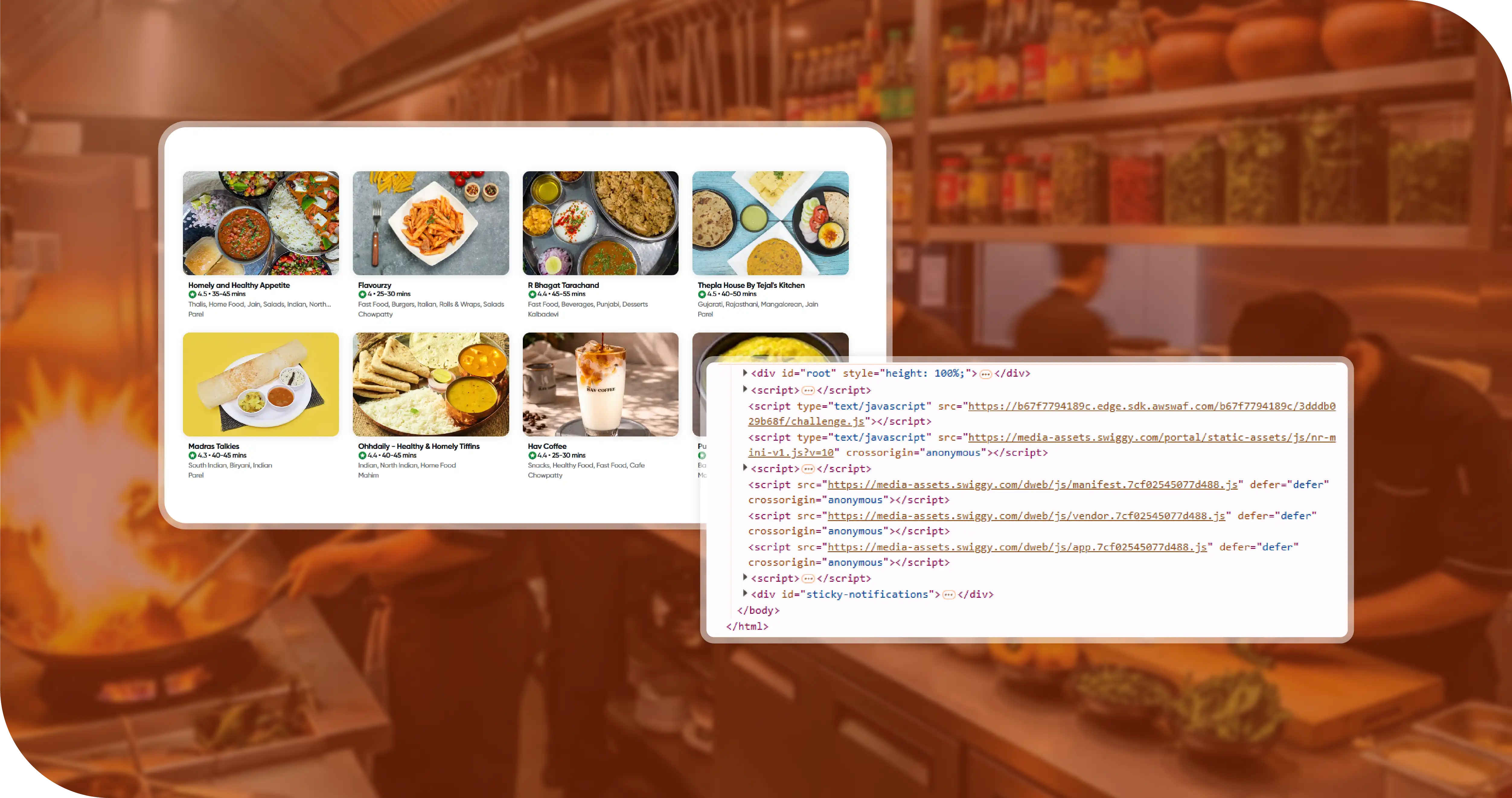
The client needed consistent Swiggy Discount Monitoring Data because restaurant discounts could change frequently according to brand campaigns, order values, customer segments, locations, and promotional periods. Manual collection made it difficult to maintain comparable historical records and identify meaningful changes. -
Building Scalable Data Infrastructure
The client required a reliable Swiggy Food Delivery Scraping API capable of supporting structured collection at scale. Data needed to be organized consistently across restaurants, brands, menus, prices, discounts, ratings, cuisines, and locations for downstream analytics and dashboard integration. -
Maintaining Data Completeness
Traditional manual research could not efficiently support the required volume and frequency. The client therefore needed Swiggy Data Extraction Services capable of collecting comprehensive restaurant-level information while maintaining standardized fields, minimizing duplication, and preparing clean records for analytical applications.
Key Solutions
-
Brand and Menu Intelligence Collection
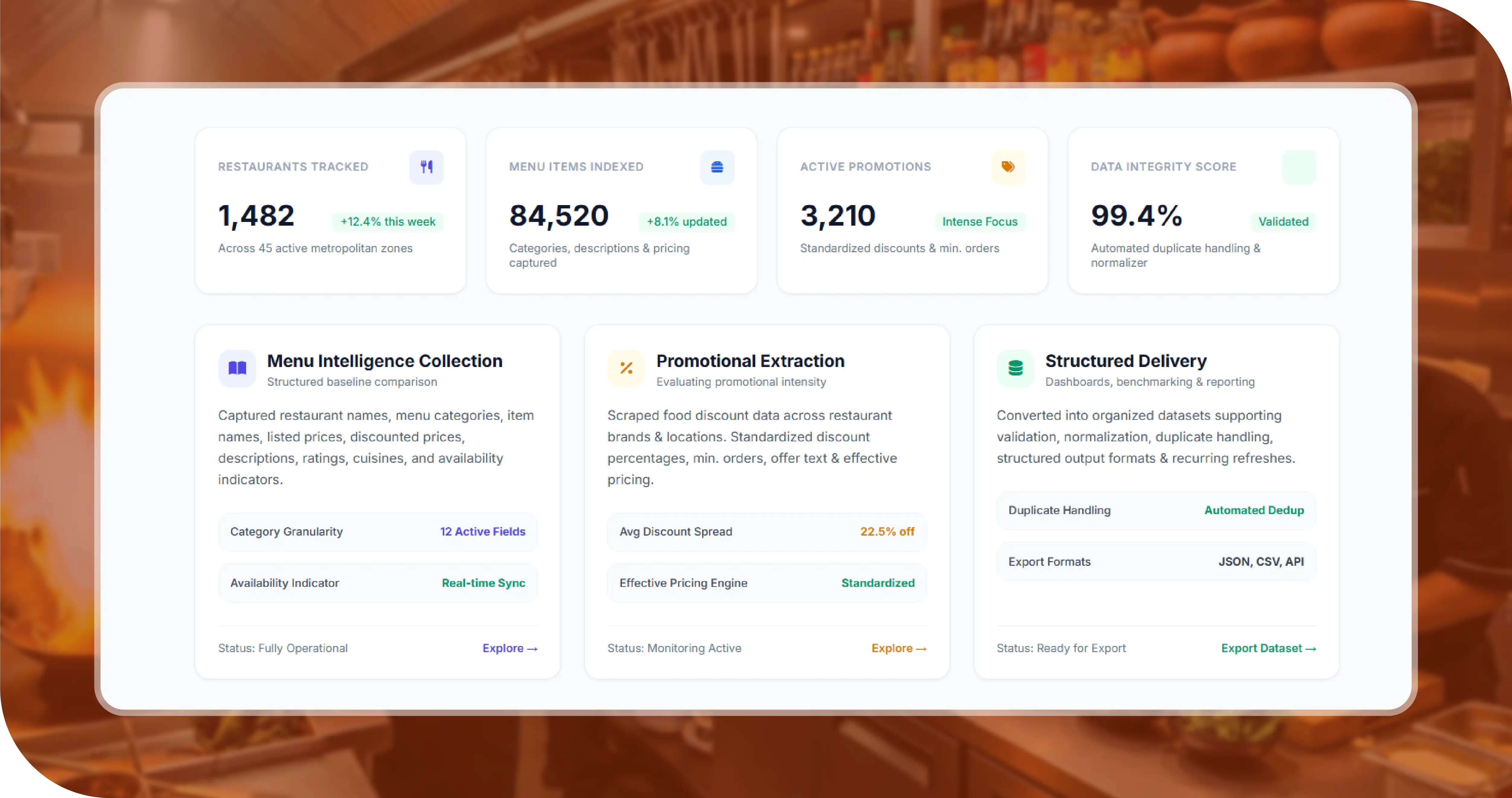
Our team implemented Restaurant Menu Data Scraping to capture restaurant names, menu categories, item names, listed prices, discounted prices, descriptions, ratings, cuisines, and availability indicators. This created a structured foundation for comparing brands and their customer-facing offerings. -
Promotional Data Extraction
We enabled the client to Scrape Food Discounts Data across selected restaurant brands and locations. Discount percentages, promotional offers, minimum order requirements, offer descriptions, and effective pricing fields were standardized so the client could evaluate promotional intensity and compare competing brands. -
Structured Data Delivery
Our Food Data Scraping Services converted collected information into organized datasets suitable for analysis, dashboards, benchmarking, and internal reporting. The solution incorporated validation, normalization, duplicate handling, and structured output formats to support recurring data refreshes.
Sample Project Output
| Brand | City | Area | Cuisine | Restaurants Tracked | Menu Items | Avg. Listed Price (₹) | Avg. Discount (%) | Avg. Final Price (₹) | Offers Tracked | Avg. Rating | Data Records |
|---|---|---|---|---|---|---|---|---|---|---|---|
| Domino's Pizza | Nagpur | Dharampeth | Pizza | 8 | 186 | 329 | 18.4 | 268 | 42 | 4.2 | 1,248 |
| KFC | Nagpur | Sadar | Fast Food | 6 | 142 | 365 | 21.7 | 286 | 35 | 4.1 | 964 |
| McDonald's | Nagpur | Wardha Road | Burgers | 7 | 158 | 298 | 16.9 | 248 | 38 | 4.0 | 1,087 |
| Pizza Hut | Nagpur | Manish Nagar | Pizza | 5 | 127 | 341 | 20.8 | 270 | 29 | 4.1 | 824 |
| Burger King | Nagpur | Civil Lines | Burgers | 5 | 119 | 19.6 | 24.3 | 226 | 31 | 4.0 | 793 |
| Subway | Nagpur | Sitabuldi | Sandwiches | 6 | 134 | 312 | 15.8 | 263 | 27 | 4.2 | 901 |
| Absolute Barbecues | Nagpur | Wardha Road | Barbecue | 3 | 74 | 689 | 12.5 | 603 | 14 | 4.4 | 318 |
| Biryani Blues | Nagpur | Sadar | Biryani | 4 | 96 | 284 | 17.6 | 234 | 22 | 4.0 | 512 |
| Behrouz Biryani | Nagpur | Manish Nagar | Biryani | 4 | 88 | 301 | 22.1 | 234 | 25 | 4.2 | 476 |
| The Belgian Waffle Co. | Nagpur | Dharampeth | Desserts | 4 | 91 | 247 | 19.3 | 199 | 21 | 4.3 | 488 |
Note: The numerical values in this table are illustrative sample project-output figures created to demonstrate the type of structured intelligence delivered.
Methodologies Used
-
Automated Data Collection
Automated extraction workflows were configured to collect restaurant, menu, pricing, promotional, rating, cuisine, and location information systematically. This reduced dependence on manual research and enabled repeatable data collection across multiple brands and restaurant listings. -
Brand-Level Classification
Collected records were classified according to restaurant brand, cuisine, location, menu category, promotional type, and pricing attributes. This classification helped the client compare similar businesses while identifying differences in promotional strategies and product-level pricing. -
Data Normalization
Raw records were standardized into consistent fields, formats, and naming conventions. Prices, discount percentages, restaurant names, menu categories, ratings, and promotional descriptions were normalized to make cross-brand comparisons more reliable and easier to process. -
Duplicate Identification
Duplicate restaurant and menu records were identified and removed through validation rules. Brand names, restaurant locations, menu attributes, and other identifiers were compared to improve dataset consistency and prevent duplicate records from distorting analytical results. -
Quality Validation
The collected dataset underwent quality checks covering missing fields, pricing anomalies, duplicate entries, inconsistent formats, and incomplete records. Validation procedures helped improve the usability of the final data for dashboards, market research, benchmarking, and recurring intelligence programs.
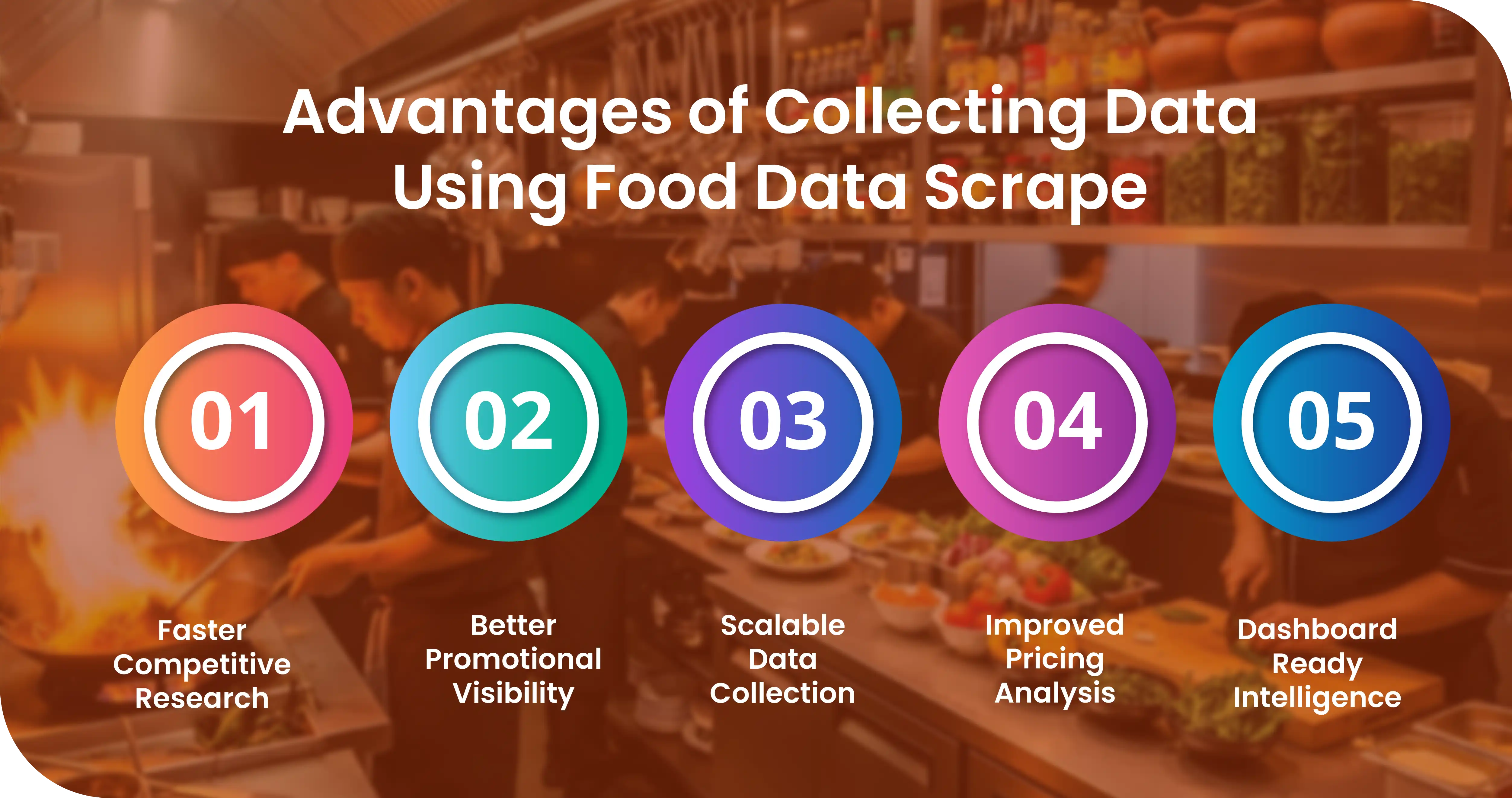
Advantages of Collecting Data Using Food Data Scrape
-
Faster Competitive Research
Automated data collection reduces the time required to gather restaurant pricing and promotional information manually. Businesses can process larger volumes of records and conduct brand-level competitive analysis more efficiently across multiple restaurant categories and locations. -
Better Promotional Visibility
Structured discount intelligence helps businesses understand promotional patterns, offer frequency, discount percentages, and customer-facing pricing. This allows analysts to identify changing promotional behavior and develop more detailed competitive and market-monitoring reports. -
Scalable Data Collection
Food Data Scrape can support recurring collection requirements across multiple brands, cities, restaurant categories, and menu items. This scalability allows organizations to expand their research coverage without proportionally increasing manual data collection efforts. -
Improved Pricing Analysis
Combining listed prices, discounts, final prices, and menu information provides a broader view of restaurant pricing behavior. Businesses can compare price positioning, promotional intensity, and customer-facing offers across competing brands and locations. -
Dashboard-Ready Intelligence
Clean, structured datasets can be integrated into analytical workflows, dashboards, reporting systems, and business intelligence environments. This gives organizations a reusable data foundation for monitoring restaurant markets, promotional trends, and competitive pricing movements.
Client's Testimonial
"Food Data Scrape provided us with a structured approach to understanding restaurant-level pricing and promotional activity across Nagpur. Previously, our research teams depended heavily on manual observations, which made it difficult to maintain consistency when offers and menu prices changed. The delivered dataset gave us a more organized view of brands, menus, discounts, ratings, and customer-facing prices. The standardized structure also made it easier for our analysts to compare restaurant brands and identify market-level patterns. We particularly valued the combination of recurring extraction, data validation, and structured delivery. The project has strengthened our ability to conduct competitive research and build recurring food delivery intelligence reports."
—Head of Market Intelligence, Client Organization
Final Outcome
The project created a structured and scalable intelligence framework for analyzing restaurant brands, menus, pricing, and promotional activity across Nagpur's Swiggy ecosystem. The client received standardized records covering brand information, restaurant locations, menu items, listed prices, discounts, ratings, cuisines, and promotional attributes.
The resulting Swiggy Dataset enabled analysts to compare brands across pricing levels, discount intensity, menu breadth, and promotional activity. Instead of relying on isolated manual observations, the client gained access to organized records suitable for recurring market analysis.
The solution also improved the client's ability to identify pricing differences between brands and locations, monitor promotional changes, and build data-driven competitive reports. Structured data delivery reduced preparation time for downstream analytics while supporting dashboard development and recurring research workflows. Overall, the project established a reusable foundation for restaurant intelligence, promotional monitoring, pricing benchmarking, and broader food delivery market analysis.