Introduction
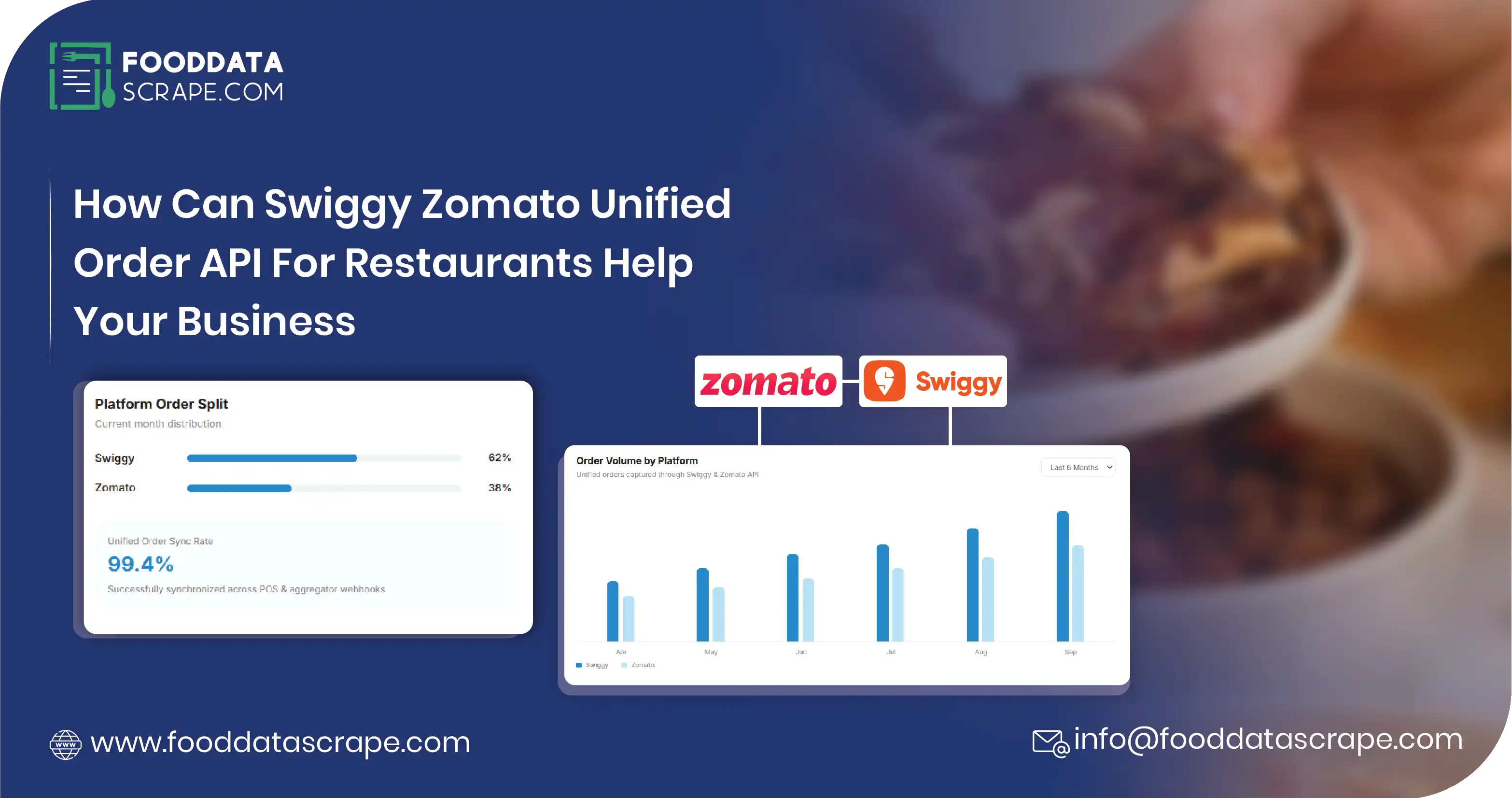
The food delivery ecosystem has become an essential revenue channel for restaurants, cloud kitchens, QSR brands, and multi-outlet food businesses. As restaurants expand their presence across multiple platforms, managing fragmented marketplace information becomes increasingly difficult. Swiggy Zomato Unified Order API For Restaurants can help businesses create a centralized approach to marketplace order intelligence, while Swiggy Zomato Restaurant Order Data Extraction can support deeper analysis of menus, pricing, orders, promotions, ratings, and outlet performance. At the same time, Multi-Outlet Restaurant Market Intelligence enables restaurant groups to compare demand patterns and operational opportunities across different locations.
A unified approach does more than consolidate information. It can turn scattered marketplace signals into actionable business intelligence. Restaurants can monitor changing customer preferences, compare prices, identify high-performing products, evaluate promotional strategies, and understand how individual outlets perform across different delivery channels.
Why Unified Food Delivery Data Matters?
Restaurant businesses increasingly rely on digital marketplaces to acquire customers and generate orders. However, each platform can present information differently, making direct comparisons challenging.
A restaurant may have hundreds or thousands of menu items, multiple outlets, different promotional campaigns, changing prices, and fluctuating availability. Reviewing these elements manually across platforms can consume significant time.
A centralized data layer can bring relevant information together and organize it around common fields.
For example, businesses can analyze:
- Order volumes
- Menu products
- Product categories
- Prices
- Discounts
- Ratings
- Reviews
- Outlet locations
- Product availability
- Promotional offers
- Average order values
- Customer demand patterns
Once standardized, this information becomes much easier to analyze.
Building a Centralized Restaurant Data Architecture
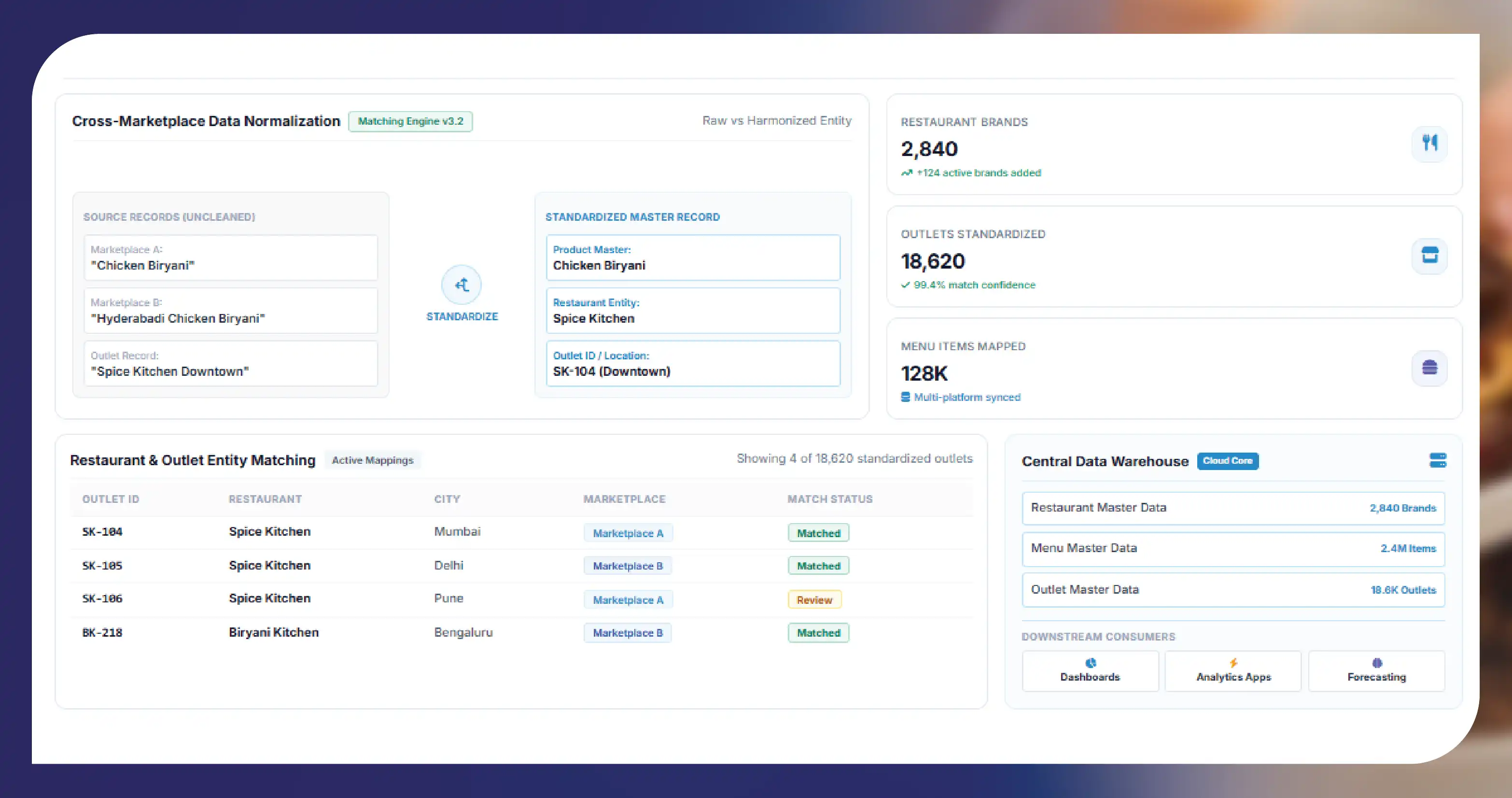
A unified marketplace architecture typically starts with data collection and ends with analytics.
The first stage involves gathering permitted and authorized data from relevant sources. The information is then transformed into a consistent format.
Different marketplaces may use different naming conventions. One platform might list a product as "Chicken Biryani," while another could use "Hyderabadi Chicken Biryani." A normalization process can help analysts determine whether these represent comparable products.
The same principle applies to restaurants and outlets.
A brand operating 100 locations may have variations in restaurant names, addresses, or identifiers. Standardizing these records makes outlet-level comparisons more accurate.
The final data can be stored in a database or cloud data warehouse and connected to dashboards, analytics applications, or forecasting systems.
Understanding Cross-Platform Order Patterns
Swiggy Zomato Order Data Scraping API solutions can support structured workflows for collecting relevant marketplace information through permitted methods.
For restaurant businesses, the objective is not simply to collect large volumes of records. The real objective is understanding how those records relate to business performance.
For instance, restaurant managers may want to know whether a product's popularity is consistent across platforms.
A pizza could generate substantial demand on one marketplace but comparatively lower demand on another. That difference may be influenced by price, discounts, placement, customer demographics, delivery coverage, availability, or other marketplace factors.
Analyzing these differences gives restaurant operators a more complete view of customer behavior.
Connecting Marketplace Information With Business Systems
Swiggy Zomato Order API Integration can connect marketplace intelligence with existing restaurant technology infrastructure.
Rather than keeping marketplace data isolated, businesses can integrate relevant information with internal systems.
Potential destinations include:
- POS platforms
- Restaurant management systems
- Data warehouses
- Business intelligence tools
- Inventory systems
- CRM platforms
- Forecasting applications
- Executive dashboards
This integration can make reporting more automated.
For example, a restaurant chain could combine internal sales information with marketplace menu and pricing observations. Management could then compare delivery performance with dine-in and takeaway activity.
This broader perspective can help identify whether growth is coming from a specific marketplace, location, menu category, or customer segment.
Turning Raw Data Into Actionable Analytics
Swiggy Zomato Order Analytics API capabilities can help transform marketplace information into measurable business indicators.
Restaurant operators can monitor changes in average order value, product popularity, discount intensity, outlet performance, and menu availability.
Imagine a restaurant group with 75 locations.
Instead of manually checking every outlet, an automated analytical system could highlight locations with unusual changes.
One outlet might experience rapidly increasing demand for breakfast products. Another might show declining order values. A third could have frequent availability issues. A fourth might be benefiting from a particular promotional strategy.
These signals allow managers to prioritize their attention.
The result is a shift from reactive reporting toward proactive decision-making.
Tracking Menu Changes and Competitor Positioning
Restaurant Menu Data Scraping can provide another important layer of restaurant intelligence.
Menus are constantly evolving. Restaurants add new products, remove slow-moving dishes, modify prices, introduce bundles, and experiment with portion sizes.
Competitors are doing the same.
Monitoring these changes can help restaurant businesses understand the competitive environment.
Relevant attributes can include:
- Product names
- Categories
- Prices
- Descriptions
- Add-ons
- Combos
- Ratings
- Review counts
- Discounts
- Availability
- Promotional labels
A restaurant could discover that nearby competitors are increasingly introducing value-oriented combos.
That insight may encourage the business to reconsider its own menu structure or promotional positioning.
Applying AI to Restaurant Decision-Making
AI Restaurant Intelligence can take marketplace analytics beyond basic reporting.
AI models can identify relationships and patterns across large datasets that would be difficult for humans to discover manually.
Potential applications include demand forecasting, menu classification, anomaly detection, customer segmentation, product recommendations, and promotional analysis.
Suppose historical data shows that certain outlets experience a major increase in demand for specific dishes during weekends.
An AI model could analyze historical patterns and help forecast future demand.
Restaurants could use those forecasts to improve preparation, inventory allocation, staffing, and promotional planning.
AI can also classify thousands of menu items into standardized categories, making large-scale competitive analysis more efficient.
Creating Valuable Historical Datasets
Food Delivery Datasets provide the foundation for long-term marketplace analysis.
A single snapshot tells a business what the market looks like today. A historical dataset can reveal how the market is changing.
This distinction is extremely important.
By maintaining historical records, businesses can identify:
- Seasonal demand changes
- Long-term price movements
- Product launches
- Menu removals
- Promotional cycles
- Rating changes
- Outlet expansion
- Competitive shifts
- Category growth
Historical data can therefore support strategic decisions rather than simply daily reporting.
Designing a Reliable Collection Pipeline
The strategy to Scrape Food Delivery API Data workflows should be designed around consistency, data quality, and authorized access.
A typical process begins by defining the required fields and sources.
The system then collects relevant information at scheduled intervals. Raw records are validated before entering the analytical database.
Cleaning may include removing duplicate records, standardizing product names, correcting formatting differences, and aligning timestamps.
The resulting dataset can then be processed through analytical models or reporting systems.
Data freshness is another important consideration. Pricing and menu information can change frequently, so businesses may require different collection frequencies depending on the use case.
Competitive price monitoring may require frequent updates, while broader market research may work with less frequent collection.
Exploring Marketplace Data for Zomato Analysis
A Food Delivery Dataset from Zomato can support a wide range of restaurant market research activities when obtained through appropriate and authorized sources.
Businesses can analyze restaurant categories, menu structures, pricing, ratings, geographic coverage, product availability, and promotional patterns.
Historical records make these datasets considerably more useful.
For example, tracking a restaurant's menu over several months can reveal whether it is gradually shifting toward premium products, value meals, vegetarian offerings, or specific cuisine categories.
Researchers can also use geographic analysis to identify areas with high restaurant density or emerging competitive activity.
Structuring Data for Scalable Analysis
A Zomato Food Delivery Scraping API can be incorporated into a broader data architecture where permitted.
The objective is to convert marketplace information into structured records that can be stored and analyzed efficiently.
A scalable architecture might contain separate layers for collection, processing, storage, analytics, and visualization.
This separation makes it easier to expand the system.
For example, a restaurant intelligence platform could initially monitor 50 outlets and later expand to several thousand locations without completely redesigning the data architecture.
Standardized identifiers and schemas become especially important as the dataset grows.
Ready to Turn Food Delivery Data Into Actionable Restaurant Intelligence? Unlock smarter order analytics, menu insights, pricing intelligence, and multi-outlet performance with a unified data-driven approach.
Using Swiggy Data for Market Research
A Swiggy Dataset can complement marketplace research by providing another perspective on restaurant menus, pricing, availability, ratings, categories, and other permitted marketplace attributes.
Combining information from multiple marketplaces can reveal differences that remain hidden when each platform is analyzed independently.
For example, a restaurant might have similar menu prices across platforms but very different promotional positioning.
Another restaurant could have strong visibility on one marketplace and limited visibility on another.
These differences can help businesses investigate potential opportunities and operational challenges.
Comparing the Two Delivery Ecosystems
The real value of a unified system emerges when marketplace information can be compared consistently.
Restaurants can examine differences in pricing, product availability, menu composition, promotions, ratings, and customer demand.
A product that performs exceptionally well on one platform may need a different strategy on another.
Likewise, an outlet that performs strongly in one delivery ecosystem may require additional analysis if its performance is weaker elsewhere.
Cross-platform comparison can help answer important questions:
- Which products perform best?
- Which outlets have the strongest digital demand?
- Where are competitors offering lower prices?
- Which promotions appear most frequently?
- Which menu categories are expanding?
- Where are availability problems occurring?
Answering these questions consistently can support stronger operational decisions.
Applications for Multi-Outlet Restaurant Brands
Multi-location restaurant groups have some of the greatest potential to benefit from unified marketplace intelligence.
A centralized system can compare outlets by geography, menu category, order activity, pricing, and customer engagement.
Management can identify high-performing locations and investigate what makes them successful.
They can also identify weaker locations and determine whether the issue relates to menu composition, pricing, availability, competition, or customer demand.
Expansion teams can use geographic intelligence to identify promising areas. Menu teams can identify products that consistently perform across locations. Marketing teams can evaluate promotional strategies. Operations teams can monitor demand fluctuations.
This turns marketplace information into an organization-wide intelligence resource.
The Role of Real-Time and Historical Intelligence
Real-time information is useful for operational decisions, while historical information is essential for strategic planning.
A restaurant manager may need to know today's product availability or current promotional activity.
An executive, however, may want to understand how pricing has evolved over the last year.
A unified architecture can support both.
Real-time or near-real-time feeds can power operational dashboards, while historical datasets can support forecasting and trend analysis.
Combining both perspectives gives restaurants a more complete understanding of marketplace performance.
Future Opportunities in Restaurant Data Intelligence
The restaurant industry is moving toward increasingly automated decision-making.
Future restaurant intelligence systems will likely combine marketplace information with internal POS data, customer feedback, inventory information, location characteristics, seasonal patterns, and operational metrics.
The focus will increasingly move from descriptive analytics to predictive intelligence.
Instead of simply identifying that orders declined, businesses will want to understand why the decline occurred and what could happen next.
Predictive models may help estimate demand, identify potential menu winners, detect unusual marketplace behavior, and recommend operational adjustments.
This creates a significant opportunity for restaurants that invest in a strong data foundation.
How Food Data Scrape Can Help You?
1. Improve Menu Intelligence
Food data scraping helps you monitor restaurant menus, products, categories, prices, discounts, and availability, enabling better menu optimization and stronger competitive positioning across multiple delivery platforms.
2. Monitor Competitor Pricing
Scraped food data allows you to track competitor prices, promotions, meal combinations, and discounts, helping identify pricing gaps, market movements, and opportunities for more competitive offers.
3. Understand Customer Demand
Analyzing food delivery data helps identify popular cuisines, dishes, ordering patterns, ratings, and consumer preferences, allowing restaurants to understand demand and make informed product decisions.
4. Optimize Multi-Outlet Performance
Food data scraping enables comparisons across restaurant locations, platforms, and markets, helping identify high-performing outlets, weaker locations, regional preferences, and opportunities for targeted operational improvements.
5. Enable Smarter Forecasting
Historical food datasets can support predictive analytics and AI models, helping forecast demand, identify emerging food trends, optimize inventory, evaluate promotions, and improve restaurant business planning.
Conclusion
A unified approach to Swiggy and Zomato marketplace intelligence can help restaurants overcome fragmented data and create a more consistent view of digital ordering performance.
From menu monitoring and price analysis to outlet benchmarking and demand forecasting, structured marketplace data can support decisions across marketing, operations, pricing, menu development, and expansion.
The most important advantage is not simply having more data. It is having connected, standardized, historical, and actionable data.
For restaurants operating across multiple outlets and delivery channels, a unified intelligence architecture can become an important competitive advantage. When combined with analytics, automation, and AI, marketplace data can help restaurant brands understand customers more effectively, respond to changing demand, optimize menus, and make better decisions at scale.
If you are seeking for a reliable data scraping services, Food Data Scrape is at your service. We hold prominence in Food Data Aggregator and Mobile Restaurant App Scraping with impeccable data analysis for strategic decision-making.
Get a Free Food Data Sample in 48 Hours.
Tell us your platforms, target markets and required fields — we'll map exactly what's possible with food data scraping, recommend the right approach, and send a working sample so you can verify quality before any commitment.
Request a strategy call
Thanks — our data team will reach out within 48 hours with your sample.