Introduction
The growth of online food delivery has transformed how customers discover restaurants, compare prices, and take advantage of promotional offers. Food delivery platforms such as Uber Eats provide customers with multiple ways to save money through restaurant discounts, limited-time deals, free delivery, percentage-based offers, combo promotions, and exclusive app-based rewards. For businesses planning to build a restaurant deals app, this promotional information offers valuable opportunities to create a centralized platform for discovering and comparing restaurant offers.
Uber Eats promotions data scraping helps businesses collect restaurant discounts, promotional campaigns, offer descriptions, eligibility conditions, and delivery incentives from the platform. Through Uber Eats Restaurant Deals Data Extraction, developers can organize this information into structured datasets that support restaurant discovery, deal comparison, and personalized recommendations. Integrating Real-Time Restaurant Promotion Monitoring also helps keep the application updated when restaurants introduce new offers, modify existing discounts, or discontinue promotional campaigns.
However, developing a reliable restaurant deals application requires more than collecting discount information. Businesses must identify the right data fields, establish appropriate refresh schedules, implement location-based filters, and maintain accurate promotional records. A structured approach enables developers to build applications that deliver relevant deals while helping restaurants improve promotional visibility and customer acquisition.
1. Understanding the Role of Uber Eats Promotion Data in Restaurant Deals Apps
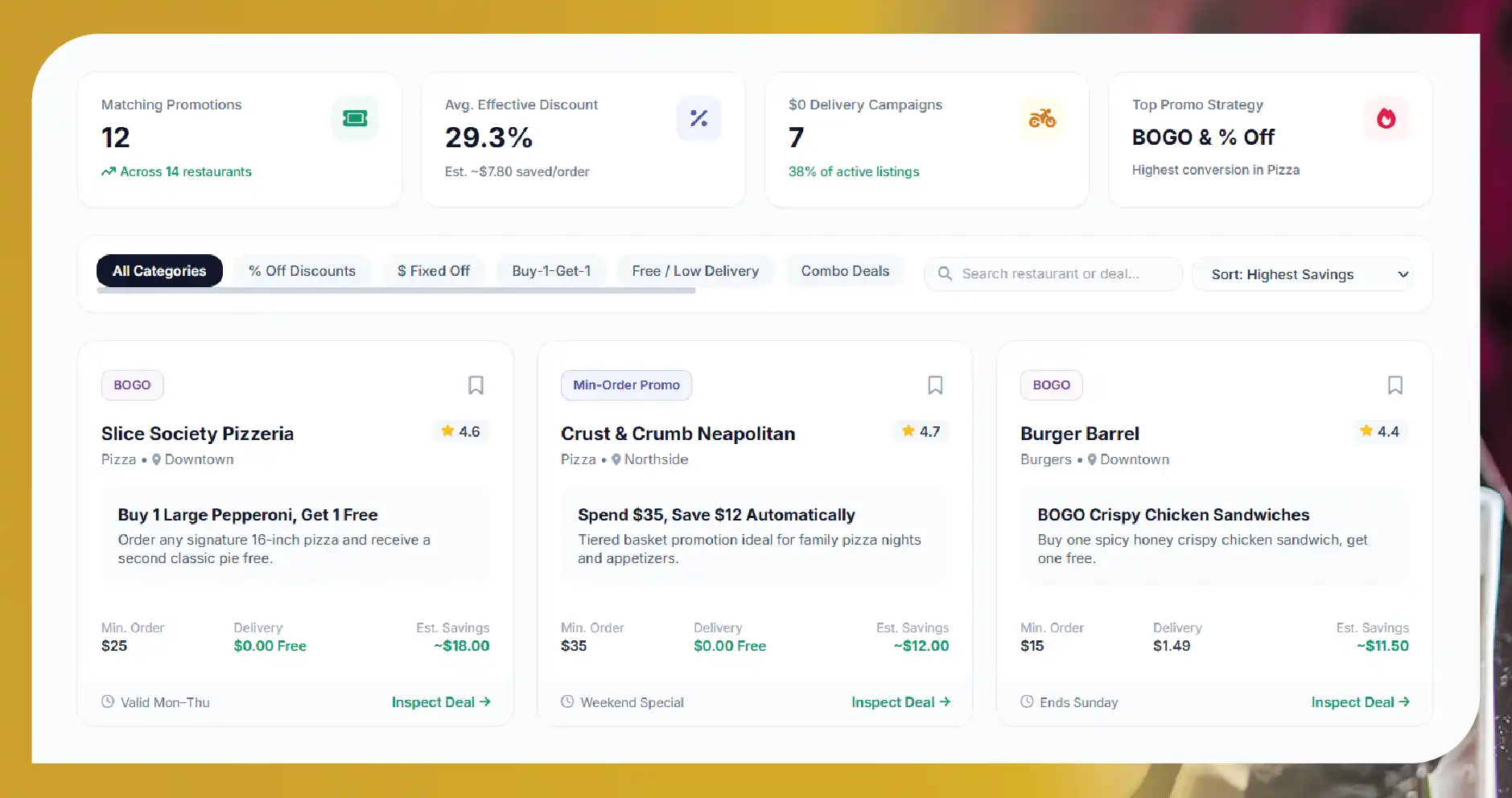
A restaurant deals app connects customers with restaurants offering attractive discounts and promotional benefits. Instead of browsing multiple food delivery platforms individually, customers can explore available offers through a single interface.
Uber Eats promotional information can provide a useful foundation for building this experience. The collected information may include restaurant names, cuisine categories, discount percentages, promotional descriptions, minimum order values, delivery fees, and offer validity conditions.
For example, a customer searching for pizza discounts in a particular neighbourhood could view participating restaurants, compare available promotions, and identify offers that match their budget.
Developers can organize promotional information into several categories:
- Percentage-based discounts, such as 20% or 30% off.
- Fixed-value discounts on qualifying orders.
- Buy-one-get-one promotional offers.
- Free or discounted delivery campaigns.
- Restaurant-specific combo deals.
- Minimum-order-value promotions.
- New-customer and loyalty-based offers.
Scrape Uber Eats Competitor Promotion Data to understand how different restaurants position their discounts, structure promotional campaigns, and compete for customer attention. This information can support deal discovery, competitive benchmarking, and promotional recommendation features.
2. Essential Data Fields Required for a Restaurant Deals App
The quality of a restaurant deals application depends heavily on the completeness and consistency of its underlying dataset. Developers should establish a standardized data schema before collecting promotional information.
The following fields can help create a structured restaurant promotion database.
| Data Category | Important Fields | Application |
|---|---|---|
| Restaurant Information | Restaurant ID, name, address | Restaurant identification |
| Location Information | Latitude, longitude, city, postcode | Geo-based discovery |
| Cuisine Information | Cuisine type, food category | Category filtering |
| Promotion Details | Offer title, description, promotion type | Deal presentation |
| Discount Information | Discount percentage, fixed discount | Savings comparison |
| Pricing Information | Original price, discounted price | Price comparison |
| Eligibility | Minimum order, customer conditions | Offer validation |
| Delivery Information | Delivery fee, estimated delivery time | Delivery comparison |
| Validity Information | Start date, end date, availability status | Offer expiration |
| Source Information | Platform, source URL, collection timestamp | Data verification |
Each field serves a specific purpose in the application.
- Restaurant identification fields help prevent duplicate listings and connect multiple promotions to the correct restaurant. Unique restaurant identifiers are particularly useful when a restaurant runs several campaigns simultaneously.
- Promotion fields describe the actual deal available to customers. These should distinguish between percentage discounts, fixed-value reductions, free delivery, and conditional offers.
- Pricing fields allow customers to understand the potential savings. Applications should distinguish between menu prices, eligible order values, delivery charges, service fees, and promotional discounts rather than presenting an incomplete final-price estimate.
- Validity fields help determine whether a promotion is currently available, scheduled for a future date, or expired.
A consistent schema makes the dataset easier to maintain, analyze, and integrate with mobile applications.
3. Designing a Reliable Data Collection and Extraction Process
Building a restaurant deals app requires a repeatable data collection process. Businesses can use authorized data access methods, available platform integrations, and permitted collection mechanisms to gather promotional information.
A typical extraction workflow involves five stages.
Step 1: Identify Relevant Restaurants
Start by identifying restaurants across selected cities, neighbourhoods, and cuisine categories. Focus on businesses that display promotional offers and maintain active food delivery listings.
Step 2: Collect Promotional Information
Capture available offer titles, discount values, promotional descriptions, eligibility conditions, and associated restaurant information. Preserve the original promotional wording where necessary to avoid changing the meaning of an offer.
Step 3: Standardize Collected Records
Different restaurants may describe similar promotions differently. Standardize offer types, discount formats, restaurant identifiers, and location information to make comparisons easier.
Step 4: Validate Promotional Records
Check for missing fields, duplicate promotions, expired offers, inconsistent discount values, and incomplete restaurant information. Records that cannot be verified should be marked accordingly.
Step 5: Store Structured Data
Store the processed information in a database that supports efficient searching, filtering, and updating. Relational databases can help maintain relationships between restaurants, offers, locations, and promotional histories.
This workflow creates a foundation for Food Delivery Promotion Intelligence, helping businesses transform scattered promotional information into organized and actionable insights.
4. Implementing Real-Time and Scheduled Promotion Refresh Mechanisms
Promotional information changes frequently. Restaurants may introduce weekend discounts, modify minimum order requirements, launch limited-time campaigns, or remove offers without advance notice.
Therefore, a restaurant deals app must include a systematic refresh mechanism.
A practical approach is to combine scheduled updates with change-based validation.
| Data Type | Suggested Refresh Frequency | Purpose |
|---|---|---|
| Active Promotions | Every 1–3 hours | Identify offer changes |
| Restaurant Details | Daily | Maintain listing accuracy |
| Menu Prices | Every 12–24 hours | Monitor pricing changes |
| Delivery Charges | Every 1–3 hours | Reflect changing delivery costs |
| Restaurant Availability | Every 15–30 minutes | Update listing status |
| Offer Validity | Every 1–3 hours | Identify expired campaigns |
| Historical Promotions | Daily | Maintain promotional history |
These are suggested application refresh intervals, not guaranteed Uber Eats update frequencies. Actual schedules should follow permitted access limits and available data-update mechanisms.
A reliable refresh system should maintain timestamps for every record. The application should also distinguish between the time an offer was collected and the time it was last verified.
Uber Eats Restaurant Promotion Data Tracking helps developers identify promotional changes, maintain historical records, and avoid displaying outdated offers.
For example, if a restaurant previously offered a 25% discount but now displays a 15% discount, the system can record both values with their respective observation timestamps.
This historical information can support promotional trend analysis and help businesses understand how restaurant discount strategies evolve.
5. Using Geo Filters to Deliver Location-Relevant Restaurant Deals
Location-based filtering is one of the most important features of a restaurant deals application. Customers generally want promotions from restaurants that can deliver to their current location rather than discounts from businesses operating in distant neighbourhoods.
Geo filters help solve this problem by connecting restaurant coordinates with customer locations.
Developers can implement several location-based features.
- City-Level Filters: Allow customers to select a city and explore restaurants offering discounts within that market.
- Neighbourhood Filters: Organize promotional listings by neighbourhood, locality, or postal code.
- Radius-Based Search: Allow users to discover deals within a selected distance, such as 2 km, 5 km, or 10 km.
- Delivery-Zone Filters: Prioritize restaurants that can deliver to the customer's selected address, subject to platform availability and delivery eligibility.
- Distance-Based Sorting: Display restaurants according to their approximate distance from the customer.
Geographic coordinates can be stored using latitude and longitude fields. Geospatial database capabilities can then support distance calculations, location clustering, and proximity-based searches.
For example, a customer searching for burger discounts within 5 km could receive a filtered list of restaurants offering qualifying promotions within the selected radius.
However, geographic proximity does not automatically establish delivery eligibility. The application should distinguish between a restaurant's physical distance and its actual serviceable delivery area.
6. Developing Advanced Restaurant Deal Discovery and Filtering Features
Once the promotional dataset is structured, developers can build features that make the application more useful and engaging.
Customers should be able to discover offers based on their preferences, budgets, and dining requirements.
Important features include:
- Discount Filters: Display promotions based on minimum discount percentages or fixed savings.
- Cuisine Filters: Identify offers for Indian, Chinese, Italian, Mexican, and other cuisines.
- Price Filters: Find restaurants within a selected spending range.
- Delivery Filters: Compare free delivery, discounted delivery, and standard delivery options.
- Offer Type Filters: Separate BOGO deals, combo offers, percentage discounts, and promotional codes.
- Availability Filters: Show currently verified promotions and available restaurant listings.
- Personalized Recommendations: Suggest offers based on previous searches and customer preferences.
Restaurant Offer And Pricing Analytics can further improve the application by comparing promotional values across restaurants and identifying attractive deals.
For example, two restaurants may advertise a 30% discount, but their minimum order requirements and additional charges could differ. Comparing these conditions gives customers a clearer understanding of the actual value.
Developers can also introduce recommendation algorithms that rank deals according to discount value, cuisine preferences, location, estimated spending, and promotion eligibility.
7. Integrating Restaurant, Menu, and Mobile Application Data
Promotional information becomes more valuable when connected with restaurant and menu information.
Customers often want to understand which dishes are included in an offer, whether a promotion applies to selected menu items, and how much their final order might cost.
Restaurant Menu Data Scraping can help organize menu names, categories, item descriptions, prices, and available product information. Connecting these records with restaurant promotions creates a more comprehensive deal discovery experience.
Similarly, Uber Eats Restaurant Data Scraping can support restaurant-level information collection, including business details, cuisine categories, locations, and listing information, subject to permitted access.
The application should also be designed around mobile usability.
Mobile App Scraping for Food can support research into food delivery application listings, interfaces, and publicly accessible promotional information where collection is authorized.
For the app itself, developers should prioritize:
- Fast restaurant and deal searches.
- Location-aware promotional recommendations.
- Clear discount and eligibility descriptions.
- Mobile-friendly restaurant listing cards.
- Push notifications for relevant offer updates.
- Saved deals and favourite restaurants.
- Filters that work efficiently across different devices.
A well-integrated architecture connects promotional records, restaurant profiles, menu information, and customer preferences without creating duplicate or inconsistent records.
8. Data Quality, Compliance, and Database Management Considerations
A restaurant deals app must maintain reliable information to build customer trust. Displaying expired promotions, inaccurate discounts, or misleading delivery information can negatively affect the user experience.
Businesses should introduce automated data quality checks.
- Duplicate Detection: Identify repeated offers using restaurant IDs, promotion descriptions, offer types, and observation timestamps.
- Expiration Management: Automatically flag promotions after their verified validity periods.
- Price Validation: Check whether displayed discounts and prices are mathematically consistent.
- Missing Field Detection: Identify incomplete records before they appear in customer-facing listings.
- Historical Record Management: Maintain previous promotional values for analysis and auditing.
- Source Attribution: Record the data source and collection timestamp for each promotional entry.
Compliance is equally important. Businesses should use authorized APIs, licensed datasets, permitted integrations, or other approved access methods. They should respect platform terms, applicable privacy requirements, intellectual property restrictions, and technical access controls.
A scalable database architecture should also support regular backups, secure access, efficient indexing, and reliable API delivery to the mobile application.
9. How Food Data Scrape Can Help You?
Food Data Scrape can help businesses transform restaurant promotional information into structured datasets that support deal discovery, competitive research, and restaurant pricing intelligence.
1. Promotional Data Collection
Food Data Scrape can help collect available restaurant promotion details, discount values, offer descriptions, and eligibility conditions to create structured datasets for restaurant deals applications and promotional discovery.
2. Restaurant-Level Intelligence
Organize restaurant names, cuisine categories, locations, menu information, and promotional records to create connected datasets that improve restaurant discovery, competitive comparisons, and location-based application features.
3. Promotion Monitoring
Support scheduled promotional data updates to identify changes in discount values, offer availability, delivery incentives, and campaign conditions while maintaining timestamps and historical promotional records.
4. Geographic Data Structuring
Organize restaurant location information using city, neighbourhood, postcode, and geographic coordinates to support radius-based searches, regional deal discovery, and location-specific restaurant promotion comparisons.
5. Flexible Data Integration
Deliver structured promotional and restaurant datasets in application-friendly formats to support database integration, analytics dashboards, recommendation systems, and restaurant deals application development across multiple markets.
Conclusion
Building a restaurant deals app with Uber Eats promotional information requires a structured approach to data collection, field standardization, refresh scheduling, geographic filtering, and database management. Businesses must connect restaurant profiles with accurate promotional details to create a reliable deal discovery experience.
Combining Food Delivery Datasets with restaurant, menu, pricing, and promotional information can support more comprehensive restaurant intelligence applications. Businesses can also Scrape Food Delivery API Data through authorized integrations to connect relevant food delivery information with their application infrastructure. Additionally, the ability to Scrape Offers Data from Food Delivery Apps through permitted collection methods can help expand promotional coverage and improve competitive analysis.
With structured data, reliable refresh mechanisms, and intelligent geo filters, businesses can develop restaurant deals applications that help customers discover relevant promotions while enabling restaurants and food technology companies to understand promotional performance, pricing trends, and competitive opportunities.
If you are seeking for a reliable data scraping services, Food Data Scrape is at your service. We hold prominence in Food Data Aggregator and Mobile Restaurant App Scraping with impeccable data analysis for strategic decision-making.
Get a Free Food Data Sample in 48 Hours.
Tell us your platforms, target markets and required fields — we'll map exactly what's possible with food data scraping, recommend the right approach, and send a working sample so you can verify quality before any commitment.