Introduction
Paris is one of the world's most influential culinary destinations, combining traditional French cuisine, independent bistros, premium restaurants, bakeries, international food concepts, and a rapidly evolving food delivery market. For restaurant owners, food delivery businesses, hospitality groups, market researchers, and technology companies, understanding this competitive environment requires more than simply browsing restaurant listings. Structured restaurant data provides valuable insights into customer preferences, menu pricing, location-based competition, and digital reputation.
Businesses looking to Scrape Paris Restaurant Data From Google & Deliveroo can develop a more comprehensive understanding of the local restaurant ecosystem by examining publicly accessible business listings, ratings, reviews, menu information, and delivery platform offerings. Google Maps can help reveal restaurant locations, customer feedback, business categories, and operating details, while Deliveroo can provide insights into participating restaurants, available dishes, displayed prices, and delivery-related information.
Combining Google Maps and Deliveroo Restaurant Data Scraping creates opportunities to analyze restaurant visibility across discovery and ordering channels. For example, a restaurant may attract substantial attention through Google reviews but offer a comparatively limited menu on its delivery profile. Another restaurant may compete primarily through meal bundles, competitive pricing, or a strong selection of cuisines. Comparing these signals helps businesses understand how restaurants position themselves across different digital platforms.
Through Deliveroo Restaurant Data Extraction, companies can organize relevant restaurant and menu information into structured datasets for research, benchmarking, business planning, and competitive analysis. The objective is not simply to collect large quantities of information. It is to transform fragmented digital listings into reliable, regularly refreshed intelligence that supports better commercial decisions.
Why Paris Restaurant Data Matters?
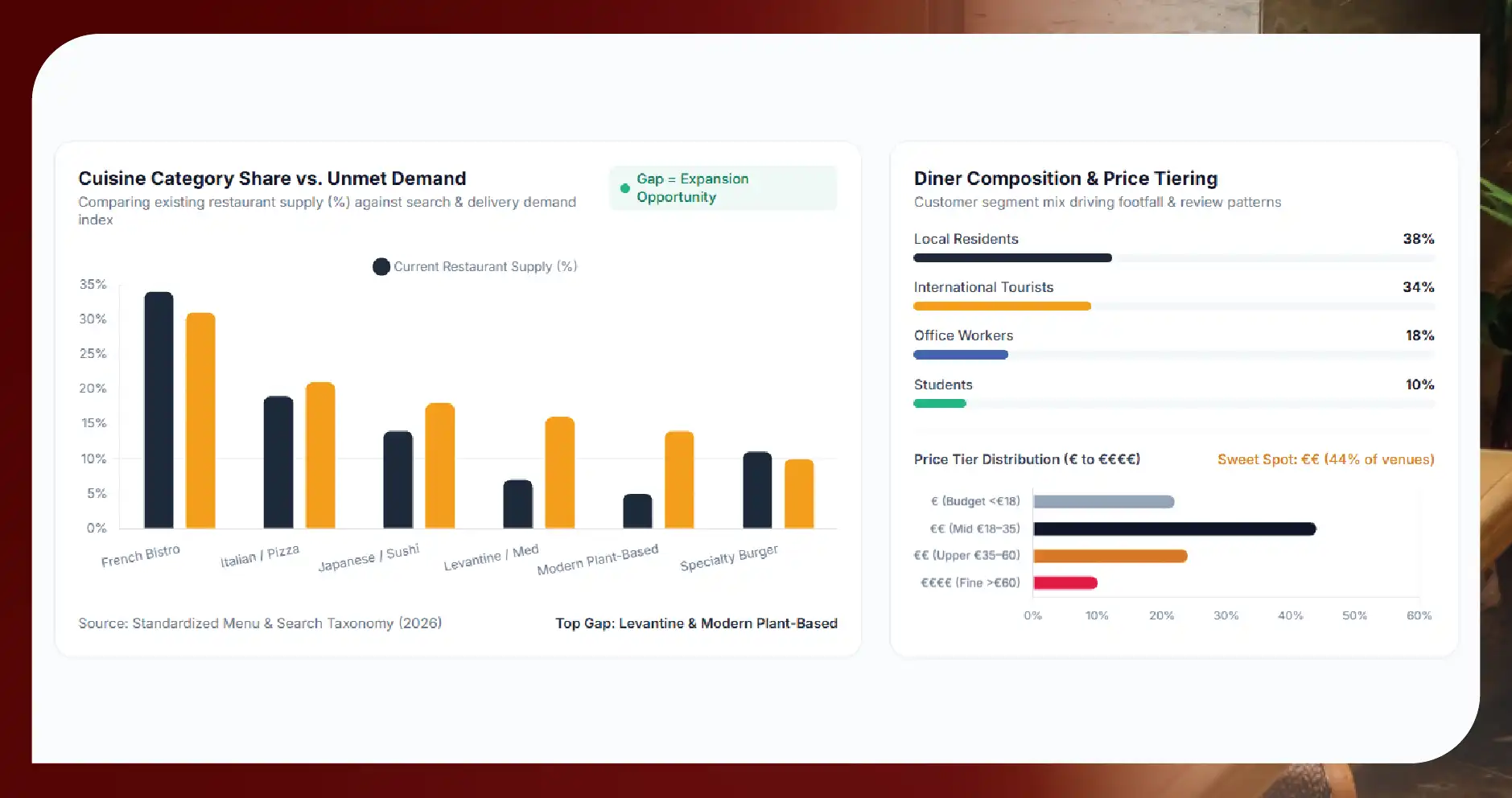
Paris has a diverse restaurant market shaped by tourism, neighborhood dining habits, local residents, office workers, students, and international visitors. Dining preferences can vary considerably between areas such as Le Marais, Saint-Germain-des-Prés, Montmartre, the Latin Quarter, and the business districts surrounding La Défense.
Restaurant data helps businesses investigate these differences systematically. Instead of relying on assumptions about which cuisines or price points perform well, analysts can examine restaurant listings, review patterns, menu categories, and delivery availability within specific geographic areas.
For restaurant operators, these insights can support decisions about new locations, menu development, pricing strategies, and customer acquisition. Food delivery companies can use market intelligence to identify potential restaurant partners and assess underserved cuisine categories. Investors and hospitality consultants can evaluate competitive density and understand how established restaurants differentiate their offerings.
The value of the data increases when information is collected consistently, standardized across sources, and analyzed over time.
Extracting Restaurant Information from Google
Google Maps and related Google business listings provide useful discovery signals for understanding Paris restaurants. Depending on the information publicly displayed and the permitted access method, restaurant research may cover business names, addresses, geographic coordinates, categories, ratings, review counts, websites, telephone numbers, opening hours, and other listing attributes.
These fields can help businesses create a geographic overview of the restaurant market.
Restaurant location and category mapping: Location data allows researchers to organize restaurants by arrondissement, neighborhood, postal code, or defined geographic radius. This makes it possible to compare the concentration of Italian restaurants, French bistros, sushi outlets, cafés, bakeries, and other categories across different parts of Paris.
For example, a food brand considering expansion can investigate areas where its target cuisine appears less represented in the available listings. A restaurant group can also compare nearby competitors before evaluating a prospective location.
Such findings should be interpreted alongside foot traffic, rental costs, population characteristics, and other commercial factors. Listing density alone does not establish actual demand.
Ratings and review counts: Ratings and review counts offer useful indicators of customer feedback and online visibility. Researchers can compare restaurants with similar cuisine types, locations, and price categories to identify patterns in digital reputation.
However, a high rating does not automatically mean that a restaurant generates greater revenue. Review volume, recency, customer expectations, pricing, and restaurant capacity all influence how these signals should be interpreted.
Opening hours and business status: Where permitted and available, operating hours and business status can help identify restaurants that serve breakfast, lunch, dinner, or late-night customers. These details can be especially valuable when studying the competitive environment around transport hubs, tourist attractions, and office districts.
Because business information changes, researchers should establish a process for checking listing accuracy and recording when each observation was collected.
Understanding Deliveroo Restaurant and Menu Data
Deliveroo provides a complementary perspective by showing how participating restaurants present their food offerings to customers using its ordering platform. Depending on authorized access and publicly available fields, relevant information may include restaurant names, cuisine categories, menu item names, descriptions, displayed prices, meal bundles, item images, and availability indicators.
This information is useful for understanding how restaurants compete in the digital food delivery environment.
Menu categories and product assortment: Restaurants organize menus into categories such as starters, main courses, desserts, drinks, salads, burgers, pizzas, and family meals. Analyzing these categories helps researchers compare assortment breadth and identify differences between restaurant concepts.
A French bistro may emphasize traditional dishes, while a burger restaurant may feature customized meals, side dishes, and promotional bundles. Standardizing these categories makes comparisons more meaningful across different restaurants.
Price positioning and meal bundles: Menu pricing can reveal how restaurants position their offerings relative to competitors. Analysts can compare similar products, estimate average displayed prices within defined categories, and investigate differences between individual dishes and bundled meals.
Price comparisons require careful product matching. A standard cheeseburger should not be compared directly with a premium double burger containing additional ingredients. Portion sizes, customization options, delivery charges, service fees, and promotions can also affect the customer's final cost.
Deliveroo's published information about its French price-transparency initiative illustrates why restaurant and delivery pricing deserve separate attention. Its programme compares selected delivery menu prices with corresponding in-store prices under specified conditions.
Availability and menu changes: Restaurant menus change as ingredients, seasons, operational capacity, and promotions evolve. Some dishes may become temporarily unavailable, while others appear only during particular service periods.
Recording observations with timestamps helps distinguish temporary changes from longer-term assortment adjustments. However, researchers should avoid treating a displayed menu as proof that an item is always available or that a restaurant has completed a sale.
Combining Google and Deliveroo for a Complete Market View
The greatest analytical value comes from combining the two sources carefully. Google-oriented restaurant discovery data and Deliveroo menu information describe different aspects of the same market, so they should be connected through a consistent matching process.
Building a unified restaurant database: A structured database can contain a master restaurant record, location details, cuisine classification, Google listing attributes, delivery platform identifiers, menu items, and historical observations.
Restaurant names alone are not always sufficient for matching. A business might use an abbreviated name on one platform, operate several branches, or share a brand name with other establishments.
A reliable matching workflow should compare available addresses, geographic coordinates, business names, and branch-level identifiers. Ambiguous matches should be flagged for manual verification instead of being automatically combined.
Measuring cross-platform visibility: Once the records are linked, businesses can identify restaurants appearing on both platforms, those visible through Google but not found in the selected Deliveroo results, and those requiring further verification.
These comparisons may highlight differences in platform presence, but absence from a dataset does not necessarily mean that a restaurant is closed or unavailable for delivery. Search coverage, delivery addresses, account settings, and platform eligibility can affect the results.
Creating neighborhood-level comparisons: Geographic segmentation makes it possible to compare restaurant categories, displayed prices, rating distributions, and menu assortment across selected Paris neighborhoods.
For example, a restaurant group evaluating a new location could compare the number of nearby competitors, their cuisine mix, their public reputation, and their delivery menu positioning. Combining these indicators provides a more useful picture than examining any single metric in isolation.
Using Restaurant Analytics to Identify Market Opportunities
A well-designed analytical framework converts collected information into actionable business intelligence.
Pricing and competitor benchmarking: Paris Restaurant Data Analytics in Google can help businesses evaluate publicly visible listing attributes and customer feedback alongside restaurant information collected from permitted sources. When combined with delivery menu observations, this analysis can reveal differences in positioning across restaurant discovery and ordering channels.
For example, analysts might compare the displayed prices of comparable lunch dishes across a selected group of restaurants. They could then segment the results by cuisine, neighborhood, or restaurant concept to identify pricing patterns.
Benchmarks should report the sample size, collection date, matching rules, and price definitions. This prevents a small or unrepresentative sample from being mistaken for a complete picture of the Paris restaurant market.
Cuisine demand and assortment gaps: Cuisine classification helps businesses identify categories that appear frequently in particular locations and those represented by fewer restaurants in the observed dataset.
Researchers can examine menu variety, vegetarian options, dessert assortments, family bundles, and other visible product characteristics. These indicators can inform product development and market-entry research, although they should not be interpreted as direct measurements of consumer demand without supporting sales or customer research.
Competitive positioning: Paris Restaurant Market Intelligence becomes more valuable when analysts combine location, pricing, menu breadth, and reputation indicators.
A restaurant with a broad menu and moderate prices may compete differently from a specialist restaurant with fewer dishes and premium positioning. Understanding these distinctions helps brands choose relevant competitors rather than benchmarking every nearby restaurant against the same standard.
The findings can support strategic planning, franchise research, product assortment decisions, and localized marketing initiatives.
Monitoring Customer Reviews and Restaurant Reputation
Customer reviews provide qualitative context that menu prices and restaurant categories cannot capture. They can reveal recurring themes around food quality, portion sizes, service, cleanliness, value for money, and delivery experiences.
Real-Time Paris Restaurant Review Monitoring can help businesses identify changes in publicly visible customer feedback when collection methods and platform permissions allow timely observations. Review analysis may highlight recurring complaints, positive experiences, or emerging service issues that deserve further investigation.
Turning reviews into useful insights: A review-analysis workflow can classify feedback by topic and sentiment. For example, comments mentioning cold food, long waits, generous portions, or friendly staff can be grouped into meaningful categories.
Researchers should distinguish reviews about dining inside the restaurant from feedback about delivery. A customer unhappy with a delayed courier may have a different concern from someone dissatisfied with the food itself.
Historical review snapshots can also help businesses assess whether their public reputation is improving or deteriorating. Because review availability and platform displays may change, monitoring frequency should reflect the project's needs and the access methods permitted by the relevant platform.
Protecting data quality and privacy: Review datasets should retain useful context, such as observation dates and rating values, while minimizing unnecessary personal information. Analysis should focus on aggregate trends rather than identifying individual reviewers or making unsupported assumptions about their circumstances.
Building a Reliable Restaurant Data Extraction Workflow
Collecting restaurant information at scale requires a repeatable process that prioritizes accuracy, consistency, and compliance.
Step 1: Define the research scope
Specify the Paris neighborhoods, restaurant categories, delivery platforms, menu fields, and business questions that the project will address. A clearly defined scope helps prevent irrelevant collection and makes the resulting dataset easier to maintain.
Step 2: Select permitted data access methods
Use available official APIs, authorized integrations, licensed datasets, or other access methods permitted by the relevant platform terms. Google's official data products and Deliveroo's partner-facing APIs have their own availability, access, and usage conditions.
Deliveroo's documentation describes menu management APIs for authorized integrations, including menu categories, items, modifiers, and bundles. These interfaces are primarily designed for partner operations and should not be assumed to provide unrestricted access to every restaurant's data.
Step 3: Standardize and validate records
Normalize restaurant names, addresses, cuisine labels, currency values, and menu categories. Remove duplicate records where appropriate, verify branch matching, and flag missing or contradictory fields.
For restaurant prices, retain the original displayed value alongside the normalized numeric value. This makes the transformation auditable and helps analysts distinguish genuine price changes from data-processing errors.
Step 4: Track historical changes
Store dated snapshots of relevant attributes, including menu prices, item availability, review counts, and business details where permitted. Historical records enable analysts to compare observations across periods without overwriting earlier values.
A change log should identify the restaurant, field, previous observation, new observation, and collection timestamp. Refresh intervals should be selected according to the volatility of the field rather than assuming that every attribute requires continuous monitoring.
Step 5: Publish business-ready outputs
Deliver cleaned information through structured CSV files, spreadsheets, databases, or dashboards. Provide field definitions, source information, collection dates, and quality indicators so users can understand the limitations of the results.
Restaurant Menu Data Scraping Services can support this workflow by organizing permitted menu observations into consistent records that facilitate product comparisons, pricing research, assortment analysis, and market reporting.
Key Challenges and How to Address Them
Paris restaurant data projects face several practical challenges.
- Incomplete coverage: Not every restaurant appears in every source. Define coverage boundaries and document missing records rather than assuming the dataset represents the entire market.
- Duplicate businesses: Similar names and multiple branches can create incorrect matches. Use addresses, coordinates, and branch-level identifiers to improve record linkage.
- Changing menus: Prices, descriptions, promotions, and availability can change frequently. Maintain timestamps and validate important observations before making decisions.
- Inconsistent classifications: Different platforms may categorize the same cuisine differently. Apply a documented taxonomy while retaining the original category labels.
- Platform restrictions: Automated collection may be limited by platform terms, technical controls, and data-use rights. Confirm authorization before collecting, storing, or redistributing information.
- Misleading conclusions: Ratings, review counts, displayed prices, and menu breadth are indicators, not direct measurements of sales or profitability. Combine them with appropriate business data whenever possible.
Paris also offers a useful source of complementary public information through the city's open-data initiative, which includes datasets covering commerce and tourism. Such resources can help researchers enrich their analysis, subject to the relevant dataset licences and definitions.
Turning Restaurant Data into Business Decisions
The commercial value of restaurant data depends on the questions businesses ask and how consistently they act on the findings.
Restaurant owners can compare their public positioning with relevant competitors and identify opportunities to improve menu clarity, pricing, or customer experience. Multi-location operators can investigate differences between neighborhoods and assess whether their offerings fit local competitive conditions.
Food delivery businesses can use structured restaurant profiles to research potential partners, identify cuisine categories, and assess the breadth of visible menus. Consultants and market researchers can use historical observations to track changes in pricing, assortment, and online reputation.
For more advanced analysis, restaurant datasets can be combined with licensed sales information, customer surveys, demographic indicators, and tourism statistics. These additional sources help distinguish online visibility from genuine commercial performance.
The objective is to establish a dependable evidence base for decision-making, not to treat every online signal as a definitive indicator of market success.
How Food Data Scrape Can Help You?
1. Improve Competitive Benchmarking
Compare restaurant locations, cuisine categories, menu assortment, displayed prices, and public ratings across selected Paris neighborhoods to identify positioning differences and support more informed competitive planning.
2. Identify Menu Opportunities
Analyze publicly available menu categories, dish descriptions, and meal bundles to uncover assortment gaps, compare product variety, and develop offerings suited to clearly defined customer segments.
3. Strengthen Pricing Decisions
Track comparable menu items over time, document promotional changes, and benchmark similar restaurant concepts to understand visible pricing patterns without confusing displayed prices with actual profitability.
4. Understand Customer Feedback
Organize permitted review observations into themes covering food quality, service, value, and delivery experiences, helping restaurant teams prioritize recurring concerns and evaluate reputation trends.
5. Support Location Planning
Combine restaurant listings with geographic and neighborhood-level information to evaluate competitive density, compare cuisine representation, and investigate potential expansion areas before conducting detailed commercial feasibility research.
Conclusion
Analyzing Paris restaurant information from Google and Deliveroo gives businesses a practical way to understand restaurant visibility, menu positioning, competitive pricing, and public reputation. By combining geographic listings with structured menu observations and review trends, organizations can move beyond isolated searches and develop a more comprehensive view of the restaurant market.
A carefully managed Deliveroo Restaurant Data Scraping workflow can support menu comparisons, product assortment research, and historical price monitoring when the collection is authorized. Reliable results depend on accurate restaurant matching, consistent data definitions, suitable refresh schedules, and respect for platform terms and applicable privacy requirements.
Businesses can also Scrape Food Delivery API data through authorized interfaces where access is available, helping streamline data integration and reduce repetitive manual research. The specific fields accessible will depend on the API, permissions, and applicable usage conditions.
Well-organized Food Delivery Datasets make it easier to compare restaurants, analyze cuisine categories, and build dashboards for ongoing market research. When combined with appropriate public and licensed information, these datasets can support better-informed decisions about restaurant expansion, pricing, and digital strategy.
Finally, businesses seeking to Scrape Restaurant Data from Google should prioritize permitted access methods, transparent data practices, and quality controls. With these foundations in place, Paris restaurant intelligence can become a valuable resource for understanding competitive dynamics and identifying opportunities in the city's evolving food industry.
If you are seeking for a reliable data scraping services, Food Data Scrape is at your service. We hold prominence in Food Data Aggregator and Mobile Restaurant App Scraping with impeccable data analysis for strategic decision-making.
Get a Free Food Data Sample in 48 Hours.
Tell us your platforms, target markets and required fields — we'll map exactly what's possible with food data scraping, recommend the right approach, and send a working sample so you can verify quality before any commitment.