Introduction
Online food delivery platforms have transformed how customers discover restaurants, evaluate food quality and make ordering decisions. In Turkey, Yemeksepeti is an important digital food delivery marketplace where restaurant ratings, customer feedback, cuisine preferences and service experiences influence purchasing decisions. Analysing this information can help restaurant chains, food aggregators, market researchers and hospitality businesses understand customer expectations and competitive positioning.
Yemeksepeti review scraping provides a structured approach to collecting restaurant feedback, star ratings, review timestamps and other publicly accessible restaurant-level information. Businesses can use these datasets to identify recurring complaints, evaluate customer satisfaction and monitor changes in restaurant performance across different Turkish cities.
Through method to Scrape Restaurant Ratings And Reviews From Yemeksepeti, organisations can examine customer experiences across cuisines, restaurant categories and delivery locations. Similarly, Extract Turkish Restaurant Ratings Data to help businesses understand local customer preferences by combining numerical ratings with Turkish-language review comments. When collected systematically and processed accurately, these datasets become valuable resources for restaurant benchmarking, sentiment analysis and food delivery market intelligence.
1. Understanding Yemeksepeti Review Data and Its Business Importance
Yemeksepeti provides customers with an opportunity to evaluate restaurants after receiving their orders. Its official review guidelines explain that customers can assign restaurant scores between one and five stars, write comments about their experiences and indicate which ordered products they liked or disliked.
The platform also explains that ratings contribute to restaurant averages, with calculations based on eligible evaluations from different users over a recent three-month period. Its published guidance describes a maximum of 150 ratings from different users for the displayed average. The platform also provides sorting options, including top reviews, newest reviews, lowest scores and highest scores.
These characteristics make review information particularly useful for understanding restaurant performance.
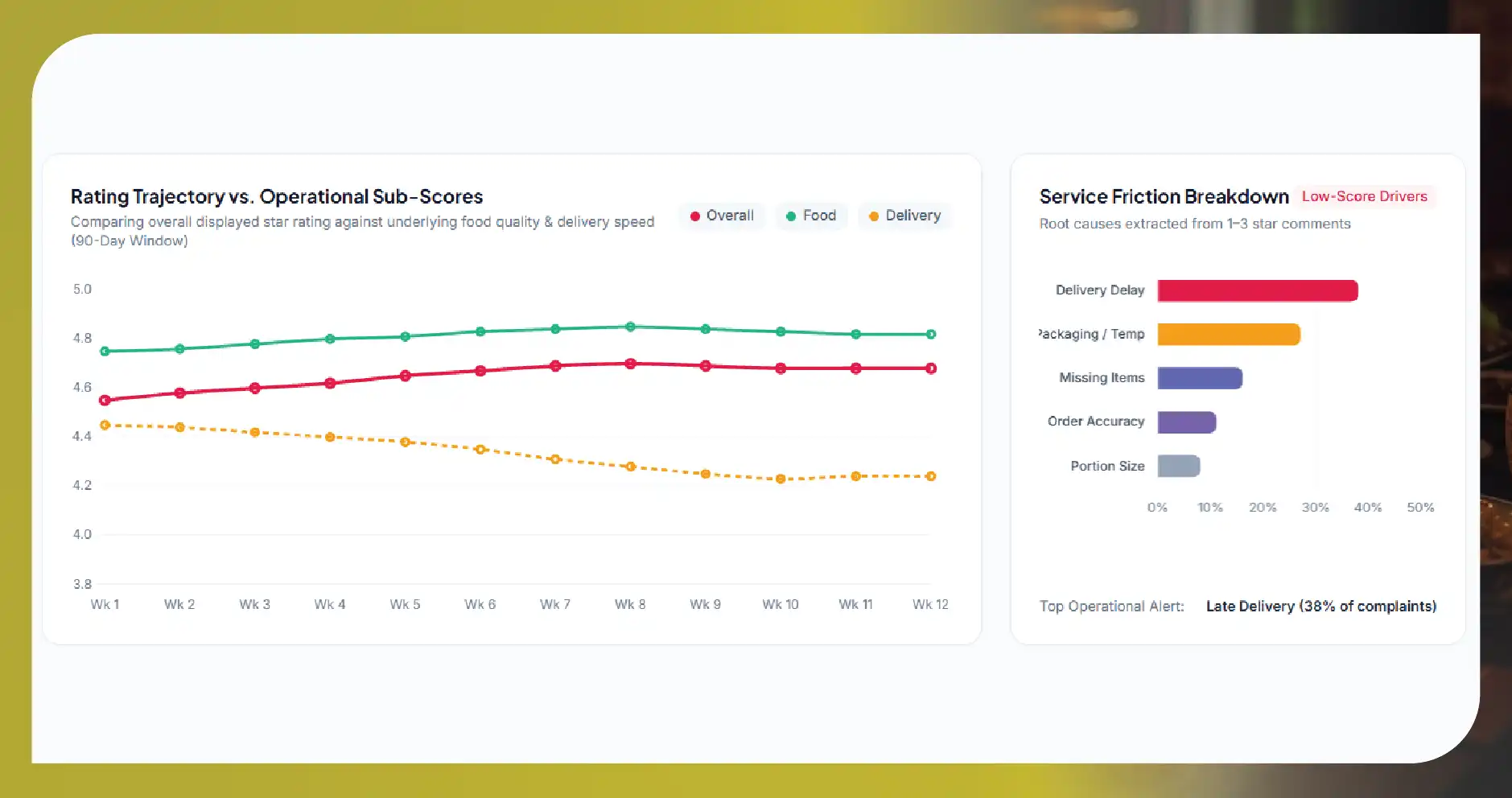
For example, a restaurant maintaining a 4.7-star rating might receive increasing complaints about delivery delays. Another restaurant with a lower overall rating might receive consistently positive feedback about food quality but negative comments about packaging.
Businesses examining these differences can develop more informed operational strategies.
Review information can support:
- Restaurant performance benchmarking across locations.
- Customer satisfaction measurement by cuisine.
- Identification of frequently reported service problems.
- Comparison of restaurant ratings over time.
- Analysis of food quality and delivery experiences.
- Competitor monitoring across different cities.
Rather than examining individual reviews manually, organisations can transform collected information into structured datasets for continuous analysis.
2. Important Fields to Collect from Yemeksepeti Reviews
A useful review dataset should contain more than customer comments and star ratings. Combining restaurant identifiers, review-level information, timestamps and location attributes creates a comprehensive foundation for analysis.
The following fields can be considered when designing a review extraction framework. Actual field availability depends on the information publicly exposed by the platform and the authorised collection method.
| Data Category | Important Fields | Business Application |
|---|---|---|
| Restaurant Information | Restaurant ID, restaurant name, restaurant URL | Identifying and tracking individual outlets |
| Location Information | City, district, neighbourhood, location identifier | Geographic performance comparison |
| Review Identification | Review ID, review URL, review timestamp | Deduplication and historical tracking |
| Customer Feedback | Review text, customer comment, language | Understanding customer experiences |
| Overall Rating | Star rating, average restaurant rating | Measuring overall satisfaction |
| Food Experience | Food-related feedback, available food score | Evaluating product quality |
| Delivery Experience | Delivery-related feedback, available rider score | Monitoring delivery performance |
| Review Engagement | Likes or helpful counts, where available | Understanding feedback usefulness |
| Restaurant Response | Owner response, response timestamp | Measuring customer engagement |
| Restaurant Attributes | Cuisine, category, outlet information | Segmenting restaurants |
| Historical Information | Collection date, update timestamp | Monitoring rating changes |
A particularly important consideration is the distinction between an individual review rating and the restaurant's overall average. These values should be stored separately to prevent incorrect calculations.
For instance, a customer might award a restaurant five stars while its displayed average remains 4.3. Both values provide different analytical insights.
Multi-Outlet Review Data Extraction also enables businesses to compare multiple branches belonging to the same restaurant chain. This helps identify whether customer satisfaction varies according to location, management practices, delivery coverage or operational consistency.
3. Handling Turkish Text During Review Extraction
Turkish-language processing is one of the most important technical considerations when collecting customer reviews from Yemeksepeti.
Unlike English, Turkish contains language-specific characters, suffix structures and grammatical variations that can create problems during extraction, storage and sentiment analysis.
Some important Turkish characters include:
- Ç and ç
- Ğ and ğ
- I and ı
- İ and i
- Ö and ö
- Ş and ş
- Ü and ü
A dataset that does not preserve these characters correctly can produce corrupted comments, inaccurate keyword identification and misleading sentiment classifications.
UTF-8 Encoding and Character Preservation
UTF-8 encoding should be maintained throughout the extraction, transformation and storage processes. This ensures Turkish characters remain readable when review information moves between collection systems, databases, spreadsheets and analytical applications.
For example, the Turkish word "lezzetli" means delicious, while "soğuk" means cold. If character encoding is incorrectly handled, the original meaning may become difficult to interpret.
Turkish Stopword Management
Turkish uses suffixes extensively, meaning the same root word can appear in several grammatical forms.
For example, variations of words relating to restaurants, food and customer satisfaction may contain additional suffixes depending on sentence structure.
Natural language processing pipelines should therefore use Turkish-specific tokenisation and stopword lists rather than relying entirely on English-language preprocessing methods.
Normalisation and Spelling Variations
Customers frequently use informal expressions, abbreviations, emojis and spelling variations in their comments.
A review might include phrases such as:
- "Çok güzel" – Very nice.
- "Hiç beğenmedim" – I did not like it at all.
- "Geç geldi" – It arrived late.
- "Yemek soğuktu" – The food was cold.
- "Tekrar sipariş veririm" – I would order again.
These expressions should be preserved in their original form before applying normalisation techniques. Keeping both original and processed versions makes it easier to validate sentiment classifications.
Restaurant Review Data Monitoring becomes more effective when Turkish-language processing is integrated into regular collection workflows. Businesses can identify emerging complaints, recurring service issues and changing customer preferences without losing important linguistic context.
4. Developing a Restaurant Rating Breakdown Framework
Overall restaurant ratings provide a useful performance indicator, but they do not always explain why customers are satisfied or dissatisfied.
A detailed rating breakdown separates available rating information into meaningful categories and examines how different experiences contribute to customer perceptions.
Yemeksepeti's official guidelines describe an overall restaurant score and optional product feedback, including liked and disliked items. Additional category-specific scores should only be analysed where they are actually exposed in the accessible data.
A structured analytical framework can include the following dimensions:
| Rating Dimension | Information Analysed | Analytical Objective |
|---|---|---|
| Overall Satisfaction | Overall star rating | Measuring general customer experience |
| Food Quality | Food-related scores and comments | Identifying taste and freshness concerns |
| Delivery Experience | Delivery-related feedback and available scores | Evaluating delivery satisfaction |
| Packaging | Comments about packaging and food condition | Identifying handling-related problems |
| Order Accuracy | Missing items and incorrect orders | Monitoring fulfilment performance |
| Value Perception | Comments about pricing and portions | Understanding perceived value |
| Customer Service | Complaints and positive service feedback | Evaluating restaurant responsiveness |
These dimensions should not be presented as official platform rating categories unless the corresponding fields are explicitly available. Some are derived analytical classifications created from customer comments.
Calculating Rating Distribution
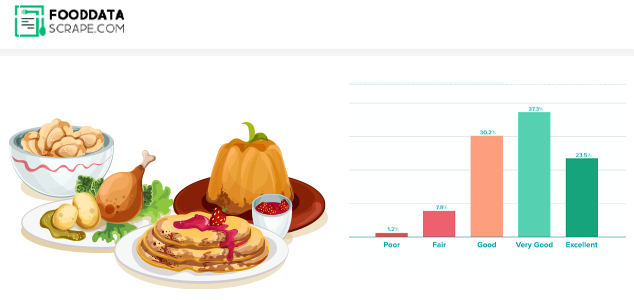
A rating distribution helps businesses understand how frequently restaurants receive different star scores.
For example, consider a hypothetical restaurant with 1,000 collected reviews:
| Star Rating | Number of Reviews | Share of Reviews |
|---|---|---|
| 5 Stars | 520 | 52% |
| 4 Stars | 240 | 24% |
| 3 Stars | 120 | 12% |
| 2 Stars | 70 | 7% |
| 1 Star | 50 | 5% |
| Total | 1,000 | 100% |
The weighted average rating would be:
(5 × 520 + 4 × 240 + 3 × 120 + 2 × 70 + 1 × 50) / 1,000 = 4.16.
This calculation provides an independent average for the collected sample. It should not automatically be treated as Yemeksepeti's displayed rating because the platform may apply its own eligibility rules and calculation methodology.
Restaurant Rating Breakdown Analysis allows businesses to identify whether negative feedback is concentrated among one-star and two-star reviews or spread across different rating categories.
5. Sentiment Analysis and Customer Feedback Classification
Customer reviews provide qualitative information that numerical ratings cannot fully explain.
Sentiment analysis converts Turkish-language comments into structured categories, helping businesses identify positive, negative and neutral experiences.
For example, a review mentioning delicious food and fast delivery can be classified as positive. A comment describing cold food and late arrival may indicate negative sentiment.
However, sentiment analysis should consider the complete sentence rather than relying on isolated keywords.
Turkish negation, suffixes, sarcasm and informal expressions can influence the intended meaning. A phrase containing a positive word might still communicate dissatisfaction when negation is present.
Businesses can classify reviews into several analytical categories:
- Food quality and taste.
- Delivery speed and punctuality.
- Packaging and food presentation.
- Portion size and pricing.
- Restaurant service and communication.
- Missing or incorrect order items.
- Overall customer satisfaction.
Machine learning models and Turkish-language NLP systems can help automate these classifications. Human validation remains important, particularly when analysing sarcasm, ambiguous expressions and regional language variations.
Yemeksepeti Review Intelligence combines structured rating information, Turkish-language sentiment classification and historical review trends to produce actionable restaurant performance insights.
6. Building a Scalable Multi-Restaurant Review Collection Pipeline
Collecting information from a small number of restaurants may be manageable manually. However, analysing hundreds or thousands of restaurants across multiple cities requires a scalable data collection architecture.
A typical workflow includes the following stages:
- Restaurant Identification: Create a list of restaurant identifiers, locations, categories and accessible review-page references.
- Data Collection: Retrieve permitted restaurant information, publicly accessible reviews, star ratings and timestamps through authorised methods.
- Data Validation: Check missing fields, duplicate records, invalid timestamps and inconsistent restaurant identifiers.
- Text Processing: Preserve original Turkish comments, apply UTF-8 encoding and prepare separate normalised text fields.
- Rating Standardisation: Convert available rating values into consistent numerical formats without changing the original platform values.
- Database Storage: Organise information into restaurant-level and review-level tables for efficient analysis.
- Dashboard Integration: Transfer validated datasets into reporting applications for restaurant benchmarking and performance monitoring.
An incremental collection approach is preferable to repeatedly retrieving entire review histories. New reviews can be identified using review IDs and timestamps, reducing unnecessary processing.
Historical snapshots should also be retained to identify changes in average ratings, review volumes and sentiment distribution.
7. Using APIs, Datasets and Automated Monitoring
For businesses requiring regular updates, automated data pipelines can simplify the process of collecting and processing restaurant information.
A Yemeksepeti Food Delivery Scraping API can serve as an integration layer when a provider offers authorised access to the required restaurant and review fields. Businesses should confirm the available endpoints, update frequency, geographic coverage and usage permissions before implementation.
Similarly, Yemeksepeti Food Delivery App Data Scraping can support structured collection from accessible application information where permitted. Mobile interfaces and website interfaces may expose different information, so field consistency should be validated.
Review analysis can also benefit from combining customer feedback with restaurant catalogue information. Scraping Yemeksepeti Restaurant Menu Data alongside review datasets can help businesses investigate whether customer satisfaction varies by cuisine, menu category, product pricing or specific food items.
Organisations can combine these sources into comprehensive Food Delivery Datasets containing restaurant attributes, menu information, ratings and customer feedback.
Where an authorised provider supports structured integrations, businesses can also Scrape Food Delivery API Data to connect collected information with internal databases, analytics platforms and business intelligence systems.
8. Data Quality, Compliance and Collection Challenges
A reliable review intelligence project requires more than successful extraction. Data quality, platform requirements and privacy considerations must be incorporated into the collection strategy.
Yemeksepeti's published terms restrict unauthorised commercial or advertising use of its services. Its privacy policy also addresses the processing and protection of personal information under Turkey's Personal Data Protection Law, commonly known as KVKK.
Businesses should obtain appropriate permissions, review applicable platform terms and avoid collecting unnecessary personal identifiers.
Other important challenges include:
- Duplicate reviews appearing across collection cycles.
- Missing or unavailable review fields.
- Changes in website and application structures.
- Inconsistent restaurant identifiers.
- Turkish character encoding problems.
- Differences between displayed ratings and collected review averages.
- Incomplete historical coverage.
Review records should be deduplicated using stable identifiers wherever available. Collection timestamps should be maintained separately from original review timestamps.
Businesses should also distinguish between missing information and zero values. An unavailable delivery score, for example, should not be interpreted as a zero rating.
9. How Food Data Scrape Can Help You?
- Structured Review Collection: Food Data Scrape can collect permitted restaurant review information, ratings, timestamps and restaurant identifiers, transforming scattered feedback into structured datasets for consistent monitoring and analysis.
- Turkish Text Processing: Its data processing workflows can preserve Turkish characters, organise customer comments and prepare multilingual datasets for sentiment classification, keyword identification and customer experience research.
- Multi-Location Benchmarking: Food Data Scrape can organise restaurant feedback across cities, neighbourhoods and outlets, helping businesses compare customer satisfaction, identify performance differences and evaluate competing restaurant chains.
- Rating Intelligence: Businesses can analyse star distributions, recurring complaints and positive feedback patterns to understand customer expectations, identify operational weaknesses and develop more effective restaurant improvement strategies.
- Automated Data Integration: Food Data Scrape can deliver structured review datasets in flexible formats, supporting integration with business intelligence platforms, analytical databases and reporting systems for continuous restaurant performance evaluation.
Conclusion
Yemeksepeti review information provides valuable insights into customer satisfaction, restaurant quality and food delivery experiences across Turkey. By combining restaurant-level attributes, review timestamps, numerical ratings and Turkish-language feedback, businesses can develop a comprehensive understanding of marketplace performance.
An effective collection framework should prioritise accurate field extraction, Turkish character preservation, rating validation, sentiment classification and consistent historical monitoring. These capabilities help organisations move beyond basic star-rating comparisons towards deeper customer experience analysis.
Integrating review intelligence with AI Restaurant Intelligence can further support automated sentiment classification, restaurant benchmarking and customer preference identification. Businesses can also use a Food Delivery Dashboard to visualise rating distributionsto visualise rating distributions, location-level performance and emerging customer complaints.
Ultimately, organisations that Scrape Restaurant Reviews And Rating Data through compliant and well-structured workflows can build stronger market intelligence capabilities, improve restaurant performance evaluation and make more informed decisions in Turkey's competitive food delivery industry.
If you are seeking for a reliable data scraping services, Food Data Scrape is at your service. We hold prominence in Food Data Aggregator and Mobile Restaurant App Scraping with impeccable data analysis for strategic decision-making.